by OSV News
JERUSALEM (OSV News) — The Latin Patriarchate of Jerusalem said wartime restrictions have forced the cancellation or postponement of key Holy Week observances, urging the faithful to remain united in prayer despite the inability to gather for traditional celebrations.
In a March 22 statement, Cardinal Pierbattista Pizzaballa, Latin patriarch of Jerusalem, said the ongoing conflict has disrupted customary Lenten practices in Jerusalem, including communal observances at some of Christianity’s holiest sites.
“Due to the war, this year we were unable to experience the traditional Lenten journey in Jerusalem, with the solemn celebrations at the Holy Sepulcher and in the Holy Places of the Passion,” the statement said. “Though we were able to pray and prepare personally, we felt the loss of the community journey towards Easter.”
The statement described uncertainty surrounding upcoming Holy Week liturgies — central to the Christian faith and typically drawing large gatherings of pilgrims and local worshippers in Jerusalem.
“Now we ask ourselves about the celebrations of Holy Week, the beating heart of our faith, in Jerusalem and at the Holy Sepulcher,” Cardinal Pizzaballa said, adding the patriarchate remains in communication with civil officials and leaders of other Christian communities to determine what limited observances may still be possible.
“The restrictions imposed by the conflict and the events of recent days do not bode well for any imminent improvement,” the statement said, adding that the situation remains fluid, leaving little room for firm planning.
“The situation is constantly evolving, and it is not possible to provide definitive indications for the days to come; we will therefore be forced to coordinate on a day-to-day basis,” the statement said.
Cardinal Pizzaballa made clear however that large, public liturgies will not take place this year: “Ordinary celebrations open to all cannot take place,” the statement said.
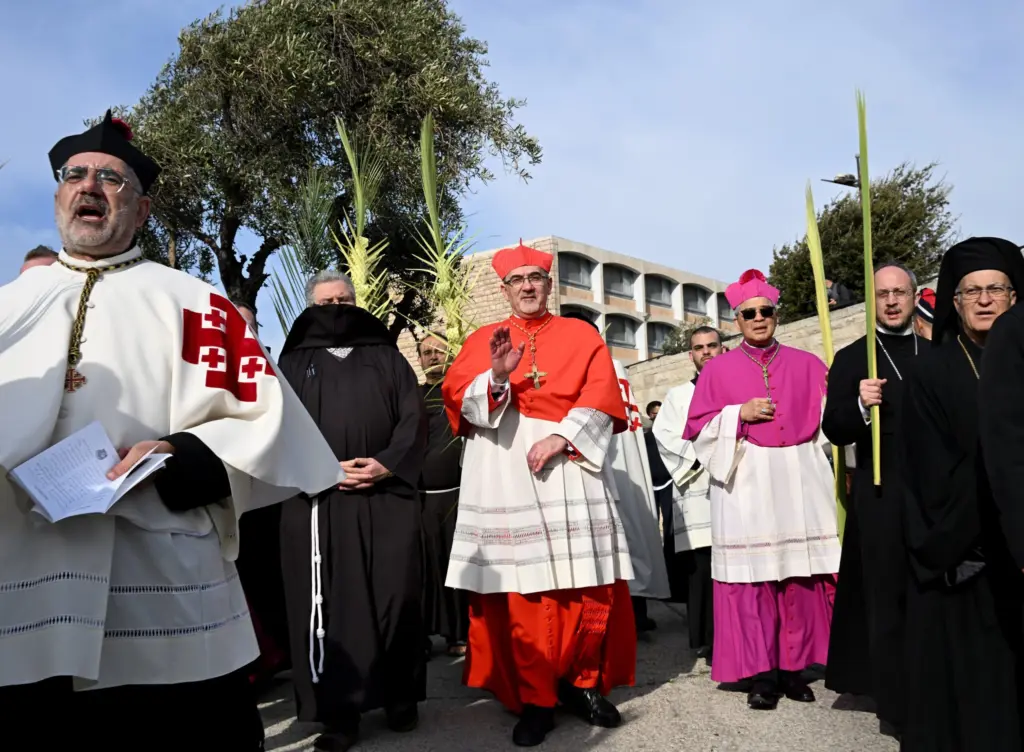
Among the most significant changes is the cancellation of the traditional Palm Sunday procession from the Mount of Olives into Jerusalem, an event that typically commemorates Jesus’ entry into the city and draws thousands of participants.
“The traditional Palm Sunday procession, which goes up to Jerusalem from the Mount of Olives, to Jerusalem is canceled,” the statement said. “It will be replaced by a moment of prayer for the city of Jerusalem, at a location to be determined.”
The chrism Mass, during which priests renew their vows and sacred oils are blessed, has also been postponed “to a date to be determined,” and it will be concelebrated “as soon as the situation allows, possibly within the Easter season,” the statement said, noting that “the Dicastery for Divine Worship has already granted the necessary approval.”
Despite the disruptions, churches in the diocese will remain open, and clergy have been instructed to encourage participation in whatever forms are feasible.
The Latin patriarch acknowledged the emotional toll of the situation, describing the inability to celebrate Easter together as an additional burden amid the broader suffering caused by the U.S. and Israel-Iran war.
“The harshness of this time of war, which affects us all, today bears the added burden of not being able to celebrate Easter together and with dignity,” the statement said. “This is a wound that adds to the many others inflicted by the conflict.”
Even so, the message urged resilience and perseverance in faith and prayer.
“But we must not allow ourselves to be discouraged. Though we may not gather as we would like, let us not give up prayer,” Cardinal Pizzaballa said.
Israeli authorities closed Jerusalem’s Church of the Holy Sepulcher as part of wider closures for security concerns, beginning Feb. 28, when Israel and the United States launched attacks against Iran.
A statement from the head of Israel’s Civil Administration confirmed that “all holy sites in the Old City of Jerusalem, including the Western Wall, the Temple Mount and the Church of the Holy Sepulcher, will remain closed … for security reasons in light of the current tensions in the region.”
In a March 21 statement, the Custody of the Holy Land said the Church of the Holy Sepulcher remains a place of continuous prayer despite restricted access and ongoing uncertainty over Holy Week and Easter, as friars — now praying without the faithful and unsure how long limits will last — appealed to Catholics worldwide to unite in prayer for an end to violence and for dialogue and diplomacy to prevail in what they described as a “time of trial.”
The Latin patriarch’s March 22 statement pointed to Scripture for encouragement, recalling Jesus’ exhortation to perseverance.
“This is the time to remember Jesus’ invitation to his disciples: ‘Pray always and do not lose heart’ (Luke 18:1),” it said.
The faithful were encouraged to pray within their homes and religious communities as a substitute for public gatherings.
“We therefore wish to compensate for these limitations with moments of prayer as families and in our religious communities,” the statement said. “I know that prayer is already being practiced everywhere, and I am comforted by the commitment to keeping spiritual tension alive.”
As a sign of unity, Cardinal Pizzaballa proposed a shared day of prayer — March 28 — “reciting the Rosary to implore the gift of peace and serenity, especially for those suffering because of the conflict,” the statement said.
The appeal emphasized that physical separation does not diminish spiritual unity.
“We will do so with humble hearts, certain that our prayer, even while we are physically distant, is capable of drawing upon the strength of God’s love, which unites us in a spirit of hope and trust,” it said.
“Easter, which we celebrate in the name of Christ’s passion, death, and resurrection, reminds us that no darkness, not even that of war, can have the last word,” Cardinal Pizzaballa concluded. “The empty tomb is the seal of the victory of life over hatred, of mercy over sin.”