by Edoardo Giribaldi, OSV News
(OSV News) — Pope Leo XIV has authorized decrees recognizing the heroic virtues of a group of Catholics from all walks of life — from a Peruvian bishop to an Italian spiritual son of St. Padre Pio.
They all showed steadfast faith in times of suffering and were close to their flock in their daily routines.
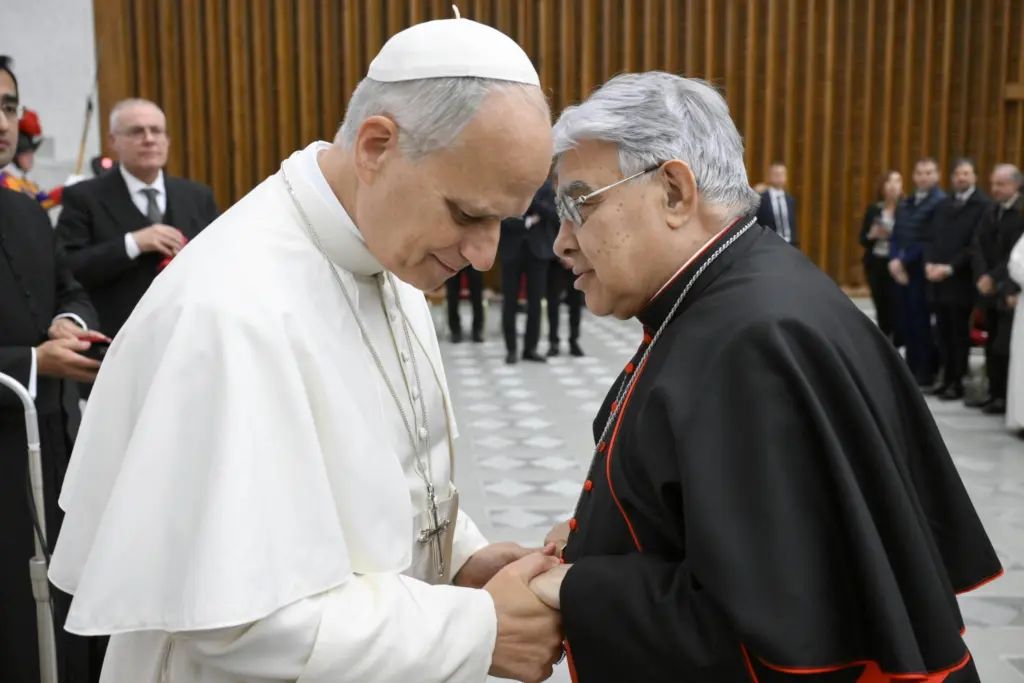
During an Oct. 24 audience with Cardinal Marcello Semeraro, prefect of the Dicastery for the Causes of Saints, the pope declared venerable two missionary bishops, Friedrich Kaiser Depel and Oreste Marengo; Focolare member Margarita Bavosi; Italian priests Fathers Domenico Pogliani and Alessandro Vitetti; and Capuchin Brother Daniele of San Giovanni Rotondo.
Bishop Friedrich Kaiser Depel: A pioneer of the biblical apostolate in Peru
Bishop Kaiser Depel was born on May 24, 1903 in Dülmen, Germany, and grew up in a deeply Catholic family. According to the biography published by the Dicastery for the Causes of Saints, he entered the seminary of the Missionaries of the Sacred Heart in 1919 and made his perpetual profession in 1930.
He was ordained a priest on Aug. 10, 1932. In April 1939, he was sent to Peru, where his congregation had established a new mission. He served as spiritual director and teacher at the seminary in Huánuco, before becoming rector and parish priest of the chapel attached to the missionary community.
Much of his ministry was spent in Lima. In 1957, he was appointed provincial administrator of his congregation and, on Nov. 21 that year, Pope Pius XII named him the first prelate of Caravelí.
After an earthquake struck the region in 1960, he worked to provide water supplies for local communities and rebuild the cathedral. The following year, he founded the Pious Union of the Missionary Sisters of Jesus, Word and Victim. Made up of young local women, the community sought to address the shortage of priests and bring the faith to communities in the Andes.
He attended all four sessions of the Second Vatican Council, between 1962 and 1965, and was ordained a bishop on Dec. 7, 1963.
Ill health led him to resign as prelate in May 1971. He then devoted himself to the theological and spiritual formation of the sisters, whose community St. John Paul II recognized as a congregation of pontifical right on Sept. 14, 1982.
Bishop Kaiser Depel died in Lima on Sept. 26, 1993 and was buried in the sisters’ chapel in Caravelí. His steadfast faith and commitment to making sacred Scripture more widely known earned him recognition as a pioneer of the biblical apostolate in Peru.
Bishop Oreste Marengo: a ‘foreigner’ embraced by India
Bishop Marengo was born on Aug. 29, 1906 in Diano d’Alba, in the Italian province of Cuneo, into a farming family with a strong Christian faith.
At 13, he moved to Turin to begin his Salesian formation, meeting some of the earliest members of the congregation founded by St. John Bosco.
In 1923, he traveled to north-eastern India with eight other novices. Alongside his studies in philosophy, he worked in villages, preparing catechumens and supporting the first Catholic communities. He was ordained a priest on April 2, 1932.
In 1951, he was appointed the first bishop of the newly established Diocese of Dibrugarh. His episcopal ordination took place in Turin’s Basilica of Mary Help of Christians on Dec. 27 that year.
He led the diocese until 1964, when he became bishop of Tezpur, and later served as apostolic administrator of Tura.
Throughout his ministry, he established mission centers and helped people fleeing Pakistan during its war with India. To address the shortage of priests, he welcomed clergy from other parts of the country, including Kerala.
After stepping down as apostolic administrator at age 70, he continued to offer his support to local priests.
He died on July 30, 1998, after repeated stays in the hospital, surrounded by the affection of the people he had served. That bond was particularly significant at a time when foreigners in India could encounter suspicion or rejection.
Bishop Marengo encouraged vocations to the priesthood and recognized the vital contribution of laypeople to spreading the Catholic faith.
Margarita Bavosi: ‘Luminosa’ who lived in the ‘present moment’
Bavosi was born on Sept. 19, 1941, in Buenos Aires, Argentina, into a prosperous family of Italian immigrants. Her mother died when she was 10.
After graduating in history, she felt increasingly drawn to placing God at the center of her life.
She found her vocation in the Focolare movement, learning about its “charism of unity” directly from its founder, Servant of God Chiara Lubich.
Her spontaneous, optimistic personality earned her the nickname “Luminosa.”
In May 1966, she was given responsibility for the movement in Paraná, Argentina. In 1970, Lubich entrusted her with joint responsibility for its work in Spain, and later in Montevideo, Uruguay.
In June 1981, she began to show symptoms of atypical pulmonary fibrosis. She died on March 7, 1985, when she was 43.
Lubich said of her: “Her life, steeped in Gospel love lived … in the present moment, was a swift race towards God.”
Domenico Pogliani: a life devoted to people in need
Born in Milan on Dec. 18, 1838, Pogliani grew in faith at the San Luigi oratory.
He was ordained a priest on May 26, 1861, and served in Rosate, Lecco and Trenno before being appointed an assistant priest in the parish attached to Milan Cathedral.
He later became parish priest in Cesano Boscone, where, with the support of a benefactress, he opened a nursery school and an oratory for girls.
He also founded a care home which, by the outbreak of the First World War, was accommodating 400 people. It included a department for boys with intellectual disabilities and several workshops.
He died on July 25, 1921, and his tomb soon became a place where people gathered to pray.
Alessandro Vitetti: ‘I cannot see, I cannot hear, but I believe’
Father Vitetti was born on Oct. 12, 1915 in Cirò, in the province of Crotone in Italy’s Calabria region, and was ordained a priest on June 16, 1940.
He served in the Diocese of Cariati as a cathedral canon and seminary teacher. He remained in Calabria throughout World War II, becoming known for his care for those most in need.
Over the years, he held several diocesan posts, including chancellor, director of the administrative office, chaplain to young Catholic women and Catholic graduates, coordinator for the missions and defender of the bond at the diocesan tribunal.
A close collaborator of Bishop Orazio Semeraro, he accompanied him to Rome during Vatican II.
In 1964, he joined the Secular Institute of Missionary Priests of the Kingship of Christ, founded by Father Agostino Gemelli, and took the vows prescribed by the institute.
He was much sought after as a confessor and spiritual guide, drawing people from beyond Calabria.
In his final years, diabetes left him blind and unable to move. He faced his suffering with exemplary faith, expressed in the words: “I cannot see, I cannot hear, but I believe.”
He died in Cariati on Feb. 24, 1995.
Daniele of San Giovanni Rotondo, a spiritual son of Padre Pio
Brother Daniele was born Michele Natale on March 11, 1919, in San Giovanni Rotondo, in the Italian province of Foggia.
He worked as a shepherd boy from an early age and was known for his cheerful disposition and ready smile.
At 14, he felt called to join the Capuchin friars. An encounter with St. Pio of Pietrelcina on June 4, 1933, strengthened his vocation: The saint blessed him and offered him words of encouragement.
In 1934, he moved to the friary of Sant’Anna in Foggia, where he served as sacristan and porter. On March 25, 1935, he entered the novitiate in Morcone, taking the name Brother Daniele. He chose to remain a lay brother.
He made his temporary profession in 1936 and his perpetual profession on May 12, 1940.
During this time, his bond with St. Pio deepened, and he became one of his spiritual sons.
Back in Foggia, he worked tirelessly to help the wounded and bury the dead during the bombings of 1943.
From 1952 onward, a series of illnesses led to frequent stays in hospital. Despite his suffering, after Padre Pio’s death he devoted himself to establishing and supporting prayer groups in Italy and abroad, drawing many faithful. He died on July 6, 1994.