by Inés San Martin
OSV News
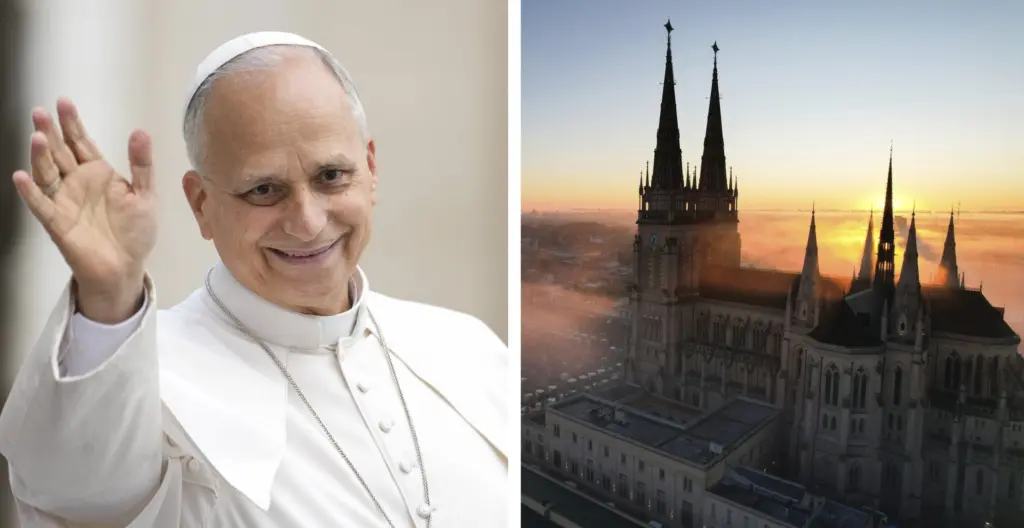
ROSARIO, Argentina (OSV News) — When Pope Leo XIV arrives in Argentina Nov. 8, he will become the first pope to set foot in the country in nearly four decades — and the first to encounter a nation still wrestling with the legacy of the Argentine who preceded him.
Pope Francis remained deeply loved by many Argentines, particularly for his closeness to the poor. But he also became entangled in the country’s political divisions, criticized from the right as Peronist and from other sectors for positions they considered conservative. His decision never to return home during his 12-year pontificate remained a source of disappointment and speculation.
Pope Leo will arrive in a country that Archbishop Jorge Ignacio García Cuerva of Buenos Aires recently described as “a wounded Argentina, a divided Argentina,” marked for decades by poverty, intolerance and the political fracture Argentines call la grieta, or “the rift.”
But the four-day visit also offers an unusual opportunity: to gather Argentines around a figure who does not yet belong to either side of their disputes.
As is often the case with a papal trip, it begins in the most political setting. After arriving from Uruguay, the pope will visit the monument to Gen. José de San Martín, father of Argentina’s independence, attend a welcoming ceremony at the Casa Rosada presidential palace, meet President Javier Milei and address government officials, civil society and the diplomatic corps.
Milei directed fierce criticism at Pope Francis before becoming president. Once elected, however, he invited the pope to Argentina and met with him at the Vatican in February 2024, and his government later initiated the diplomatic process that led to Pope Leo’s visit.
Relations between Milei’s government and the Argentine bishops have nonetheless remained tense. Church leaders have regularly warned about poverty, unemployment and the effects of fiscal austerity, while the president has argued that Argentina must abandon economic policies that perpetuate dependency on state assistance.
Expectations from the papal visit
The economic picture resists a simple political reading. Official poverty figures fell sharply from 52.9% in the first half of 2024 to 28.2% in the second half of 2025, but rose again to 32.3% in the first half of 2026. In August, economic activity was down 1.7% from a year earlier.
Those pressures are shaping what Argentines expect from the pope. A survey by the Observatory of Beliefs and Religions in Argentina, or OCREAR, found that 43% of respondents believed poverty should be the principal priority of Pope Leo’s pontificate.
Peace came second, while doctrinal issues, Church transparency and sexual abuse ranked lower. Only 49% considered the visit very or somewhat important, and 65% expected it to have little or no effect on their own religious practice — though approximately 57% of Argentines continue to identify as Catholic, and another 17% as evangelical.
Roberto Bosca, a scholar of religion and public life and former dean of the law school at Austral University, said the bishops’ attention to social questions is sometimes read as populist, Peronist or left-wing, particularly by a largely secularized middle class that believes they have displaced God with social activism.
“If the bishops’ teaching is read without ideological blinders, it is Christ-centered,” he told OSV News in Spanish. But in Argentina, he said, even Christian language about placing the needy at the center is frequently translated into partisan categories.
On Nov. 9, Pope Leo will visit residents and caregivers at the Don Orione “Little Cottolengo” in Claypole, a center serving people with disabilities. He will celebrate Mass in Buenos Aires for a crowd expected to surpass 1.5 million people, meet representatives of the world of work, address Christian and interreligious leaders, and celebrate vespers with the Argentine bishops and diocesan synodal teams.
The following morning he will travel to Córdoba, before returning to Buenos Aires for a youth vigil on Nov. 10. On his final day, before heading to Peru, he will visit the federal prison of Devoto and celebrate what organizers are calling the “Mass of Charity” at the Basilica of Our Lady of Luján, the country’s national Marian shrine.
Unlike in neighboring Uruguay, where Pope Leo will enter the disadvantaged Montevideo neighborhood of Casavalle, the Argentine schedule includes no visit to one of Buenos Aires’ villas, or informal settlements — places closely associated with Pope Francis’ ministry.
Instead, its encounters with vulnerability are distributed across a disability center, a prison, a meeting focused on labor and the Luján Mass, where organizations including Caritas and the Hogar de Cristo network for people struggling with addiction will receive priority among approximately 8,000 invited guests.
Meeting with abuse survivors
The Vatican also has announced that Pope Leo will hold private meetings with survivors of abuse by clergy or other Church personnel during his three-country journey, without disclosing where.
The announcement is particularly relevant in Argentina, where survivors continue to demand transparency and canonical accountability in cases including the abuse of deaf children at Mendoza’s Antonio Próvolo Institute and that of Bishop Gustavo Zanchetta, convicted by an Argentine court of abusing seminarians.
OSV News confirmed that in October 2024 he was seen in his former Diocese of Orán riding a fire truck while wearing clerical attire. There has been no public update on his canonical status.
Inés Franck, a member of Argentina’s commission for the protection of minors and a former Vatican consultant on the issue, said the region “is developing its tools for prevention and care with little resources, because these are also countries going through financial and development crisis.”
There is still “plenty of work to do, resistances to overcome, resources to optimize and practices to implement,” she told OSV News, “but the meetings of the pope with the victims speak to us about the will of the Church not to look the other way and to be there where there was pain and there still is.”
Córdoba will give the visit a more federal character. Located near Argentina’s geographical center, the city is more accessible for pilgrims from the northern and interior provinces. It is also the land of St. José Gabriel del Rosario Brochero, the “gaucho priest” who traveled the Sierras of Córdoba by mule, evangelizing isolated communities.
Papal visit to the ‘blessed land’
Pope Leo will celebrate Mass at the Military Aviation School and meet clergy, religious, seminarians and lay pastoral workers at Córdoba’s cathedral.
Cardinal Ángel Sixto Rossi of Córdoba, described the visit as both a source of immense joy and of “healthy fear” because of the responsibility involved in receiving the pope and pilgrims from throughout the country.
“Córdoba is not only ‘La Docta,'” Cardinal Rossi said, using the city’s traditional title as Argentina’s historic center of learning. “It is a blessed land, walked by saints who knew how to transform faith into service, closeness and self-giving.”
In a reflection submitted to OSV News, Cardinal Rossi described the visit as a sign of continuity with Pope Francis, but said the new pope would give it “his own imprint.”
“The shepherd comes to meet his people, to confirm us in faith, renew our hope and give us a pat on the back so that we do not lose heart,” he wrote.
The visit will conclude at Luján, the shrine of Argentina’s national patroness and one of the few religious spaces capable of gathering Argentines across social and political divisions.
Authorities are preparing for as many as 1.7 million people in a city of approximately 95,000 residents. Access roads will begin closing the day before the Mass, 1,500 extraordinary ministers are expected to distribute Communion, and Buenos Aires province plans to deploy about 11,000 police officers and cadets. The original 17th-century image of Our Lady of Luján will be brought out of the basilica for the celebration.
Political rivals working hand in hand on papal visit organization
Organizing the event required cooperation among Milei’s national government, the provincial administration of Axel Kicillof — one of the president’s principal political opponents and Peronist governor of Buenos Aires — the local municipality and church authorities.
The papal visit has obliged competing political sectors to work together before Pope Leo has spoken a word.
If anything connects people divided by harsh polarization, it’s the local Church’s most revered shrine.
Father Lucas García, rector of Argentina’s major Marian shrine, said devotion to Our Lady of Luján reaches Argentines who rarely take part in Church life but may still carry a family photograph, a promise or a prayer inherited from their grandparents.
“In an Argentina that often experiences divisions, differences and difficulty encountering one another, the Virgin remains a point of unity,” he told OSV News.
“Luján is much more than a place of pilgrimage,” he said. “It is a home where Argentines can recognize one another as brothers and sisters.”
Different sectors will inevitably try to fit the pope’s words and gestures into their familiar divisions. But for four days, his itinerary will also invite the country to meet outside those categories: alongside people with disabilities, workers, prisoners, young people, pilgrims and the Virgin whom Argentines call their mother.
Whether that encounter lasts beyond the crowds will determine whether the visit becomes merely a historic event — or, as Cardinal Rossi hopes, leaves Argentina with “tasks for the heart.”