A PASTORAL LETTER ON SYNODALITY IN THE ARCHDIOCESE OF KANSAS CITY IN KANSAS – Part 4 of 7
The following is taken from Archbishop Shawn McKnight’s Pastoral Letter “Renewal from the Heartland,” which explains the ongoing synodal process the Archdiocese of Kansas City in Kansas is currently undertaking to determine the archdiocese’s future path. This series will be presented in seven parts. To read the entire pastoral letter, click here.
DEEPENING OUR RELATIONSHIP WITH GOD
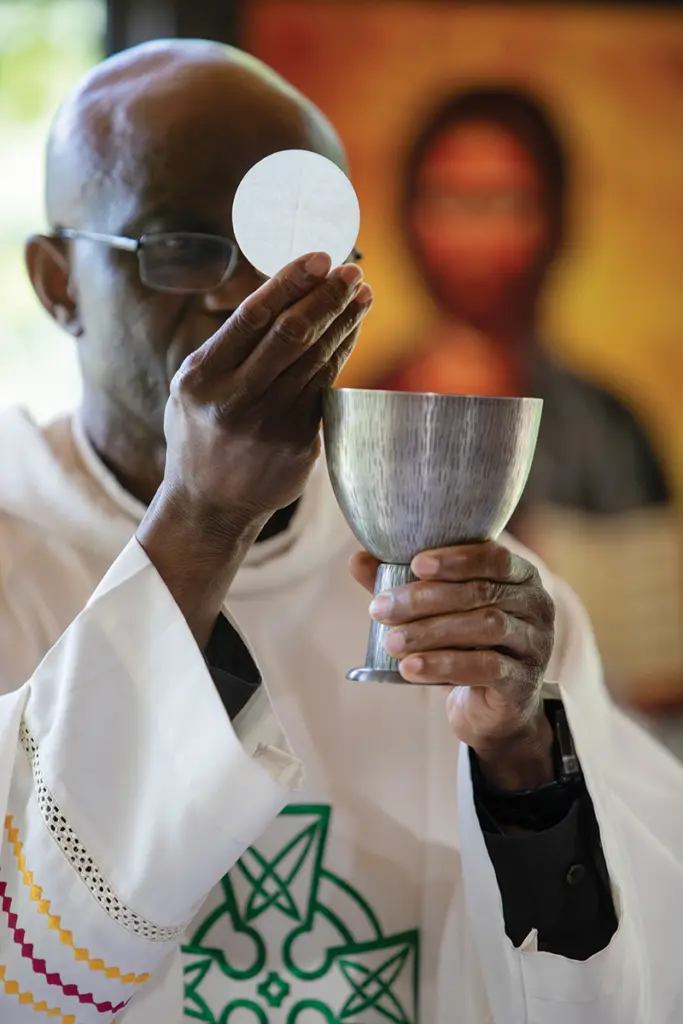
As Catholics, we know the sacraments are “efficacious signs of grace, instituted by Christ and entrusted to the Church, by which divine life is dispensed to us” (Catechism of the Catholic Church, n. 1131).
Many who answered our survey and participated in the listening sessions seem to have this definition etched into their DNA. It’s not just head knowledge but an involuntary reflex of our souls. Time and again, people described most notably the Eucharist, but also the other sacraments, as indispensable sources of healing, identity, spiritual strength, and renewal.
Here I want to make a special appeal to my brother priests and deacons:
The Church is an assembly of sinners struggling to become saints. In our hearts, we know we need the sacraments to bring us more fully into the communion of the holy ones. As ordained ministers and sacred collaborators, our duty is to assist the assembly, God’s people, to preserve our communion in the Christian way of believing, living, and praying. The First Letter of St. Peter challenges us who are in ordained ministry to be the kind of leaders Christ desires for his flock:
“So I exhort the presbyters among you, as a fellow presbyter and witness to the sufferings of Christ and one who has a share in the glory to be revealed. Tend the flock of God in your midst, overseeing not by constraint but willingly, as God would have it, not for shameful profit but eagerly. Do not lord it over those assigned to you but be examples to the flock. And when the chief Shepherd is revealed, you will receive the unfading crown of glory.” (1 Peter 5: 1-4).
Furthermore, Pope Leo has challenged us who are priests to give ourselves as the love of the heart of Jesus:
“Dear priests, renew each day your ‘Here I am’ before Christ’s pierced Heart. Give yourselves entirely to him, so that you may love his people with the same love with which he loves them. And joyfully remember how the saintly Curé of Ars loved to say that ‘the priesthood is the love of the heart of Jesus’” (Message to Priests on the Occasion of the Day of Prayer for the Sanctification of Priests, 12 June 2026).
Our people are asking the same thing of us. They desire reverence in worship, whether as a community gathered around the altar, in quiet adoration before the Blessed Sacrament, or in the important cultural devotions of the people — these are all expressions of our Catholic identity.
And yet there is some unease in our local church, in that some consider their personal preferences for legitimate liturgical expressions as the only way to be truly reverent according to the mind of the Church. We need more walking together, listening together, and discerning together the legitimate diversity of liturgical expressions afforded the Universal Church, while firmly committing ourselves to our unity in faith and practice as expressed in the teachings of the Second Vatican Council. Across the spectrum, many articulated the pain that divisiveness creates, especially around the liturgy. They see these “us vs. them” feelings as corrosive to co-responsibility and mission. They call for more welcoming and receptive attitudes by all.
Several weeks ago, Pope Leo addressed these concerns in a letter to the prefect of the Dicastery for Divine Worship. It’s quite succinct and, while it was directed at those attending a conference on liturgical formation being held in Oregon, it has great relevance to us.
Pope Leo’s letter reminds us to be faithful to the approved texts and instructions for the celebration of the sacred mysteries, including the rites promulgated by his predecessors, Pope St. Paul VI and Pope St. John Paul II. He sets that reminder within the context of what he calls “the first practical opportunities for liturgical formation,” the celebration of the Sunday Eucharist. He writes:
“[I]t is essential that [the liturgies] also be profoundly formative, promoting an ever deeper understanding of the ars celebrandi, expressed not only by the celebrant of the liturgy, but also by the entire assembly. In this way, through proper education and reverent worship, Catholics will be formed both for the liturgy and by the liturgy” (cf. Desiderio Desideravi, n. 34 and 54).
As we encounter strong opinions and preferences from all sides, let us start by considering them not as opposites. Instead, can we consider these diverse experiences as a shared desire for the proper celebration of the liturgy, just expressed differently? That perspective could perhaps be helpful as we consider how to use pastoral planning to address change, conflict, and disagreements in our parishes and other ecclesial communities. How can we build bridges and bring unity, amidst diversity, among our communities? We priests and deacons, listening to our people in this manner with the “ear of the heart,” can help us hear another deep desire, which aligns with what our Church teaches.
Resonating with Pope Leo’s comments on the liturgy, participants in the listening sessions and survey also want us to preach and teach in those liturgical moments, fostering both interior reverence and outward missionary enthusiasm, or missionary zeal.