by Catherine Halbmaier
Special to The Leaven
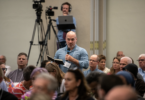
ATCHISON — Benedictine College’s School of Business seeks to offer “a new paradigm” for business students pursuing degrees at the Atchison institution. To this end, the Thompson Center for Integrity in Finance and Economics hosted The Catalyze Conference, a morning-long opportunity for students and families to hear from Catholic leaders in the world of business.
The Thompson Center, headed by associate professor Dave Geenens, exists to help form a generation of virtuous young professionals. From priests to CEOs to small business owners, the featured “Virtuoso” speakers provided insight into integrating Catholic faith with business practices.
“Consecration, for us, is a natural first step for business owners,” said Ryan Foley, former vice president of Covenant Eyes, a company offering filtering and accountability software to protect families from internet pornography. After setting the tone, Foley introduced each of the Virtuoso speakers.
In his keynote address, Father John Bartunek encouraged young people to be unafraid of creating change.
“You are called and equipped to be agents of the renewal that you want to see,” Father Bartunek said.
In his time as a Legionary of Christ, Father Bartunek has offered theological expertise to countless media projects. Most notably, he provided spiritual support on the set of “The Passion of the Christ.” He has since appeared on networks such as NBC, CNN, Fox and the BBC with religious commentary.
Before ordination, Father Bartunek worked as a high school history teacher, drama director and basketball coach. At Catalyze, he once again found himself addressing lessons to the next generation.
“Remember the signs,” Father Bartunek told listeners. This was the first of his four core lessons.
“Fill your mind with good food,” he continued, exhorting young people to monitor their consumption of media thoughtfully. Father Bartunek also implored that students “keep the crown on Christ,” and “put the focus on people, not projects.”
“The law of God’s kingdom is: However you treat the lowest person on the totem pole is how you are treating Christ himself,” he said in illustration of his final point.
Peter Freissle, CEO of Polydeck, carried on with the theme of ministering to the people one works with. Freissle founded the Polydeck Caring Culture to tend to the physical, mental and spiritual needs of employees after undergoing a spiritual awakening at a retreat. Now, even his business cards include a purpose statement that references God and core values such as “caring, integrity, excellence and humility.”
“I hope that I can give [students] a new paradigm,” Freissle said. “New ways of seeing business. And [a glimpse of] how theology of the church can be applied in the real workplace. I hope they’ll take that with them. And thirdly, that regardless of where they go in life, that they should have a purpose.”
Freissle also remarked on surrender to God in all of one’s endeavors.
“I hope that they’ll take that with them, to say, how can God use me where I am with the gifts that he’s given me? How can I be a steward of what I’ve got to point towards him?”
The final speaker, Larry Ryan, founded a successful employee-owned landscaping company. Uniquely, Ryan Lawn and Tree has nearly 500 full-time, full-benefit employees. For Ryan, this is yet another example of how a Catholic business leader ought to tend to their team members.
“We have to constantly ask ourselves,” Ryan said, “are we living the life, the story, that Our Lord wants us to live?”
Like Freissle, Ryan endeavored to care for his employees as people until his retirement from the business. Now, Ryan Lawn and Tree is in the hands of his team. But even in retirement, Ryan takes the time to invest in young business leaders keen on integrating faith into their companies.
For the Virtuoso speakers and organizers of Catalyze, this was the heart of the event: that students might learn to think of business and faith as inseparable and be unafraid of using that knowledge to transform culture.
“These are the people that are the next generations,” Freissle said, “and I believe that they are the future.”