

by Olivia Martin-Davies
olivia.martin@theleaven.org
KANSAS CITY, Kan. — When Suzi Blake and her husband Josh looked at their monthly expenses earlier this year, something wasn’t adding up.
Both held steady jobs. Both worked hard. Yet, the numbers on paper never seemed to match the strain they felt in real life.
“We knew we made enough money to not be as broke as we were,” said Blake. “But we just didn’t know how to get it together.”
That confusion led the Blakes to Catholic Charities of Northeast Kansas and its Family Financial Transformations (FFT) program. It was a yearlong initiative designed to help households achieve long-term financial stability.
FFT was designed specifically for those who do not qualify for emergency assistance, but who still need guidance to break patterns, build stability and pass on healthy financial habits to their children.
The program also offers basic budget coaching for those in crisis who aren’t yet ready for a full yearlong commitment. There is programming for children as well, and aftercare sessions for FFT graduates who need help navigating new financial questions as life changes.
FFT has existed for more than a decade, but for program manager Kimberly Burau, its impact is still surprising.
“I’ve learned so much doing this job, things I didn’t know even in my mid-thirties,” she said. “People are just expected to know how to budget, how loans work, how credit works.
“But unless someone teaches you, where would you learn it?”
Meeting families where they are
FFT participants begin by tracking their spending — an exercise that is often more revealing than expected.
For example, Blake discovered her family was spending far more on snacks and outings than she realized.
“We thought we didn’t eat out that much,” said Blake. “But all the little things added up.”
So, she pivoted. Blake bought a $10 picnic basket and began packing food in the car instead.
“It makes it cute for me,” she said with a laugh. “And honestly, it saves us a lot.”
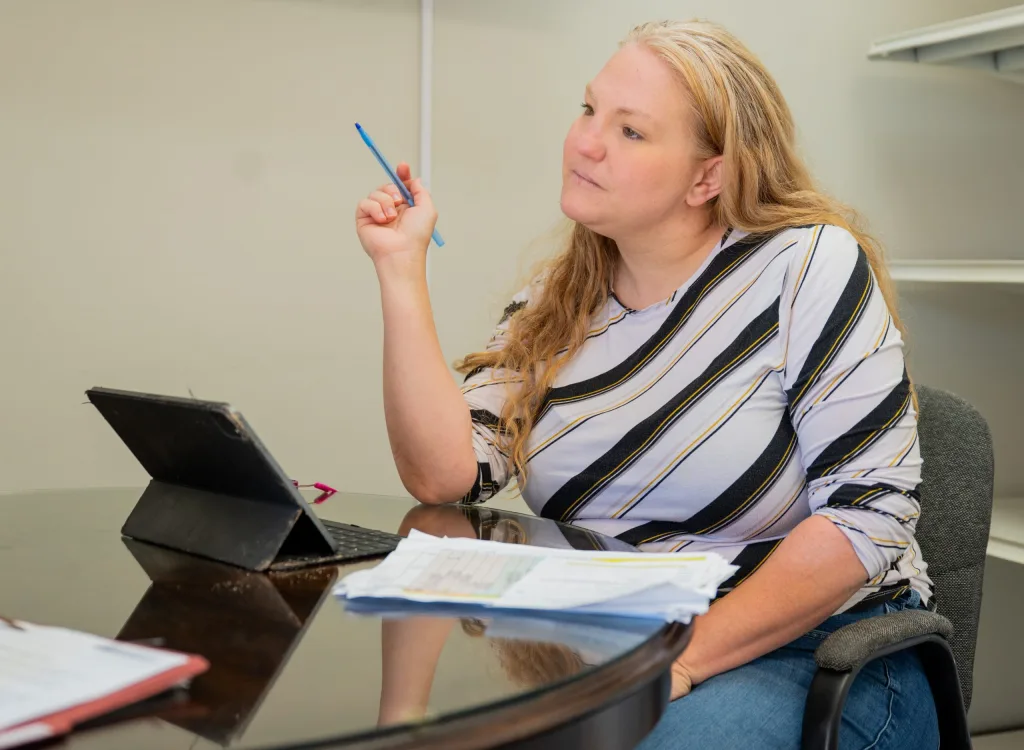
The program also accommodates busy schedules and different learning styles.
Blake, who is neurodivergent, meets in-person with her caseworker while her son is in preschool; her husband attends structured online discussions in the evening.
“They even talk to each of us in the way our brains work,” Blake said. “That’s been huge.”
Retirement-ready
For Kelli Parkey of Atchison, the FFT program arrived at just the right moment.
A mother of seven and a longtime child care provider, Parkey had spent decades in what she called “survival mode.”
“Budgeting during those crazy days of raising multiple children was just survival,” said Parkey.
Especially as she approaches retirement, her grown children have started urging her to prepare.
“It’s kind of scary [thinking about retirement], and especially when they’re talking about how there may not be Social Security,” said Parkey.

When FFT staff visited Parkey’s workplace earlier this year, she recognized an opportunity. She enrolled and the results came quickly.
“As of [October], I’ve paid off all of my debt except one hospital bill, and that will be paid off in April,” said Parkey.
Her next goal: Contribute the maximum to her IRA every year.
While FFT certainly has made a big difference to her finances, Parkey says the biggest impact has been emotional.
“The peace of mind . . . that’s the best thing this program gives,” she said. “I get to know where my money goes. I get to decide.
“It’s not going out to car payments. And it’s not going out to title loans.”
Saving money, marriages and lives
Financial crises never wait for convenient timing.
When Josh Blake’s car engine blew unexpectedly, the Blakes did what they once thought impossible: They identified their options and emailed their caseworker for guidance.
“Before this, we would have been in full panic mode,” Blake said. “Now at least, we have a method.”
That method is also saving marriages and lives.
Burau remembers one woman who came to Catholic Charities terrified to face her husband after accumulating debt across 14 credit cards.
Together, they mapped out a debt-snowball plan. When the projection revealed she could be debt-free in just 32 months, the woman burst into tears of relief.
“She just needed to know there was a path forward,” Burau said.
By the end of the yearlong program, the woman had paid off eight of the 14 cards.

Burau recalled another participant who confessed at her final FFT meeting that the day before enrolling, she had been contemplating suicide.
“She said she’d give it one more day and come talk to me,” Burau said. “You just never know what people are going through when they walk in our doors.”
Learning without judgment
Most participants describe the same unexpected grace from Catholic Charities — no shame, no scolding and no condescension.
“It’s embarrassing to be an adult who doesn’t know how to budget,” Blake said. “But they make sure you never feel judged.”
Parkey echoed that sentiment.
“You have to make finances a priority,” she said. “You set small, consistent goals. But you also need encouragement. You need accountability. This program gives you both.”
Today, both women track their spending, set goals and feel equipped for decisions that once overwhelmed them.
Their circumstances differ, but their relief is the same.
“Finances are hard, and they keep getting harder,” Blake said.
“But it’s okay to need help,” she added. “We’re human.”







[…] by Olivia Martin-Daviesolivia.martin@theleaven.org […]