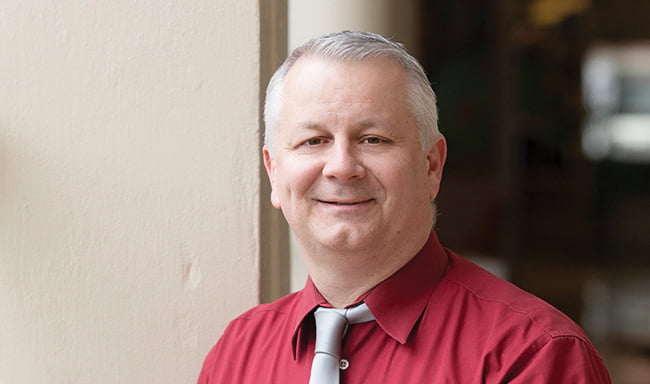
by Vince Cascone
The Latin phrase “Nemo dat quod non habet” means “you cannot give to others that which you do not possess yourself.”
The faculty and staff members in our Catholic schools have the awesome responsibility of helping to pass on the faith to our precious young people. The Second Vatican Council’s Declaration on Christian Education (“Gravissimum Educationis”) highlights how teachers are called to be “well-prepared in both secular and religious knowledge, skilled in pedagogy, and serving as witnesses to the faith.”
The Blessed Seelos Institute provides each of our schools in the archdiocese with faculty faith formation. At the heart of this formation is a simple but demanding truth: God has given us a human nature, and that nature flourishes when it develops virtue.
To become virtuous is to become the kind of being we are created to be. Just as a plant needs certain conditions to flourish, and just as a dog or a cat requires its own particular care, so too, the human person has a definite set of conditions necessary for flourishing.
This is precisely what Catholic education is uniquely able to do in a way no other institution can. One of the touchstones of the conversations with the faculty and staff members of our schools has been the image of Jesus as the master teacher, whose primary lesson is to make us more like God — a transformation that occurs through virtue.
We began the year with a convocation Mass with our new archbishop, followed by an opening talk by Professor Mulholland from Benedictine College in Atchison. In that talk, he introduced this year’s theme of virtue — a topic that will guide our faculty formation for both this year and the next. It was a fantastic introduction to two years of sustained reflection and growth.
The goal in these two years of formation is to allow our understanding of human nature and virtue to give us a clear vision of the human person, and thereby shape our craft of education.
The Blessed Seelos team consists of Sebastian D’Amico, Jennie Punswick, Dr. Aaron Williams, Deacon Curtis Keddy and Austin Krause. Our hope is that this year and next will continue to give our teachers a shared language as they discern the best means of forming the children of our diocese, so that they may grow in wisdom and virtue and become the people they are meant to be.
Sebastian D’Amico from the Blessed Seelos Institute contributed to this column.