by Caroline De Sury, OSV News
PARIS (OSV News) — After years of debate, legal challenges — including a high-profile clash with figures from French cinema — and careful discernment at the highest levels of the Church, a major project to create a place for society’s most vulnerable is finally taking shape in the heart of Paris’ district of architectural chic.
On the site of a former monastery, a vast community center is rising in one of the capital’s most desirable neighborhoods — a place where vulnerable people will live alongside dynamic and committed volunteers.
Stéphane Bazin, deputy project manager coordinating the development of the complex known as Maison de la Visitation-Vaugirard, told OSV News the work has now entered a decisive phase. “The construction of the new buildings is now beginning in earnest, after months of preparation and foundation work,” he said. “At the same time, the restoration of the former convent is progressing.”
Until 2012, the convent belonged to the Sisters of the Visitation, a congregation founded in the 17th century by St. Francis de Sales. Their distinctive mission was to welcome even sick and disabled women as nuns, fostering a deeply fraternal life despite physical vulnerability.
“In 2012, the last nuns, who were very old, moved to another Parisian convent,” Basin explained. “They then gave their monastery to the Archdiocese of Paris, asking that it be made a place of fraternity inspired by the Gospel, in keeping with the vocation of their congregation.”
The 78,500-square-foot property is exceptionally valuable, located in today’s affluent 6th arrondissement. It includes a remarkable 43,000-square-foot garden. On one side lies the picturesque Rue du Cherche-Midi, lined with charming shops and restaurants; on the other, the long Rue de Vaugirard, home to the French Senate.
“The location is exceptional,” Bazin confirmed. “It took many years to carefully consider how it would be used. Four successive archbishops considered the issue.”
Ultimately, the Archdiocese of Paris entrusted the project to three relatively young, lay-founded Catholic-inspired associations dedicated to living in solidarity with vulnerable people. “Then, it was with these associations that the architectural project was developed,” Basin explained.
The first, Simon de Cyrène, focuses on people with disabilities and requiring specially adapted facilities. “For them, we are undertaking the construction of a completely new and modern building that meets standards for the disabled,” Bazin explained.
The second, Marthe et Marie, supports pregnant women in difficulty, pairing them with supportive young roommates. For this initiative, the archdiocese is renovating a girls’ boarding school built by the sisters in 1867.
The third, l’Association pour l’amitié, brings together formerly homeless individuals and young professionals. “It is for them that we are renovating the large and manor house that the sisters acquired in 1819 to turn it into their convent,” Bazin explained. “The most beautiful of these buildings will thus be used to help the poorest.”
To ensure financial sustainability, a rental building is also part of the plan. Altogether, over 96,000 square feet of housing will be created or redeveloped.
“The density of housing will be offset by the garden we are creating on the site of the former garden of the sisters’ enclosure,” Bazin explained to OSV News. “It will be intended for residents of the Maison de la Visitation, but will be open to the public during the day, thanks to a passageway that will allow pedestrians to cross from one street to another through this garden.”
For Bazin, the project’s social impact is just as important as its architectural ambition. “The human richness of this project is exceptional.”
“The garden will be landscaped with trees and rose gardens, and even playground equipment,” he said. “Thousands of children will visit this garden over the years. They will become familiar with vulnerable and disabled people, who in turn will come out of their isolation.”
The architect behind the project is Jean-Marie Duthilleul, known not only for designing high-speed rail stations, restoring cathedrals and building churches in France and abroad — but also for his Catholic faith. “He played an important role in this project,” Basin said. “After getting to know the three associations, he took all the necessary steps and negotiations with the heritage structures involved, the town hall and the institutions of the Ministry of Culture, in order to obtain the building permit.”
The path forward, however, was far from smooth. “It was not easy,” Bazin specified. “The project was put on hold for three and a half years because of appeals filed by neighbors and associations, which went all the way to the highest administrative courts in France to oppose it.”
Among the opponents was actor Gérard Depardieu, a major figure in French cinema, who feared the development would affect light and views from his property. “The diocese ultimately won the case,” Bazin said. “The project was approved by all the authorities, and the building permit was granted in September 2019. But it then took time to adjust the financing conditions.”
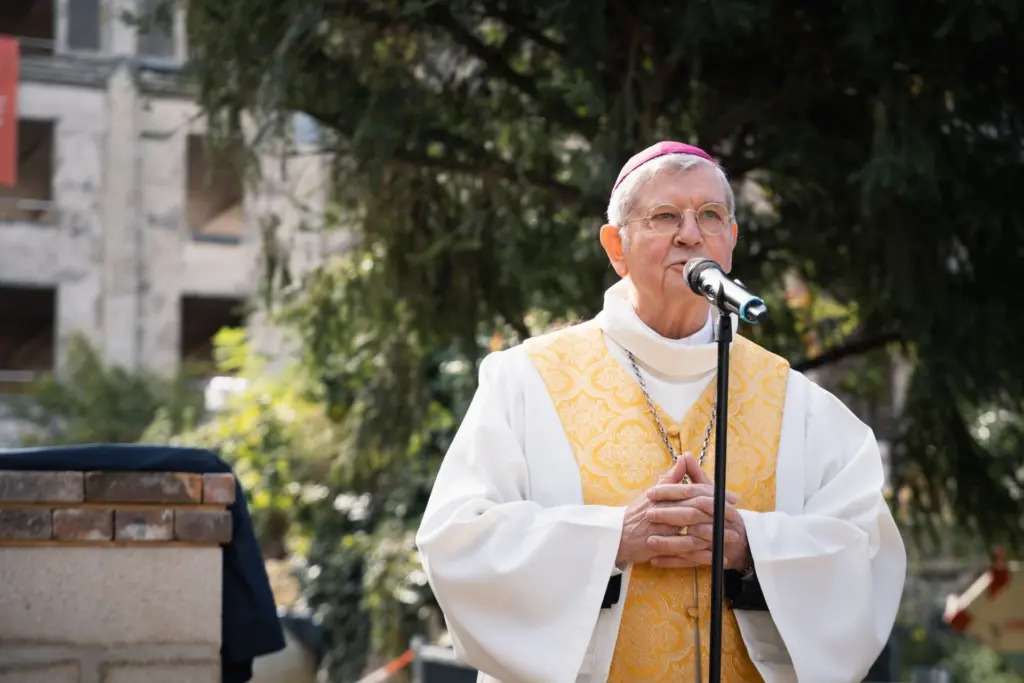
A key milestone came in November 2024, when the archdiocese signed a contract with Eiffage Immobilier, a company specializing in both historic renovation and new construction. On Sept. 22, 2025, Archbishop Laurent Ulrich blessed the foundation stone.
Since early January, visible progress has been made along Rue de Vaugirard. For Bazin, the choice to dedicate such a prestigious site to the most vulnerable is deeply meaningful.
“Investment properties could have been built there, and a lot of money could have been made,” he noted. “But the Church chose to give the best to the most vulnerable, to the poorest. That is where all the richness, value, and meaning of this project lies.”
“I am proud,” Bazin concluded, “to be working alongside the diocese to meet this challenge.”
The project is expected to be completed by summer 2027.