by Jay Soldner
Special to The Leaven
COLUMBUS, Ohio — In the quiet setting of the Pontifical College Josephinum, priestly formation takes place within a mission that reaches far beyond its 75-acre campus — one grounded in service to the universal Catholic Church and in preparing priests to serve every kind of parish and every kind of Catholic.
For Archbishop Shawn McKnight, that mission is not an abstract ideal but a lived reality. The Josephinum is not simply another seminary option; it is a place he knows personally and trusts deeply.
“Having been a seminarian myself here in this institution and having taught here for several years, having served on the board now for three years, I’m very familiar with what happens here,” he said.
That familiarity, deepened over decades, now shapes a significant decision: The Archdiocese of Kansas City in Kansas will be sending seminarians to study at the only pontifical seminary in the United States, located in Columbus, Ohio.
(The archdiocese will have seminarians at Kenrick-Glennon Seminary in St. Louis, St. John Vianney Seminary in Denver, Pope Saint John XXIII Seminary in Boston and Conception Seminary College in Conception, Missouri, as well.)
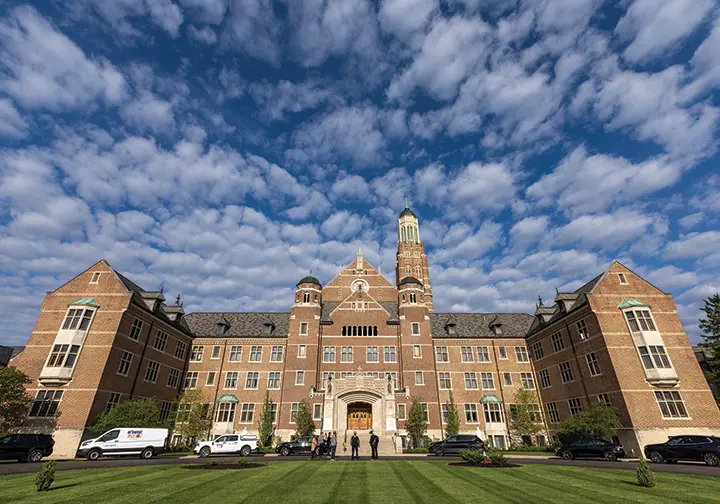
“I’m also very familiar with the history of the Josephinum, its origins, its particular mission in the United States as a pontifical seminary and a national seminary,” Archbishop McKnight said. The Josephinum’s direct connection to the Holy See has remained central to Archbishop McKnight’s understanding of its identity.
“We [seminarians] were aware of the special character of this seminary as pontifical,” he recalled. “Not in any triumphalist way at all, but that instilled in me a sense of linking up or syncing up with the Holy Father.”
That sense of communion with the successor of Peter has shaped his priesthood and episcopal ministry.
“Throughout my entire priesthood, I have always desired to be close to the Vicar of Christ and the successor of Saint Peter, and to try to match as much as possible his pastoral vision for the church,” he said.
At the Josephinum, that universal dimension of the church is not theoretical — it is lived daily through prayer, study, hospitality and community life. Archbishop McKnight believes this environment is essential for forming priests who will serve parishes and schools across northeast Kansas.
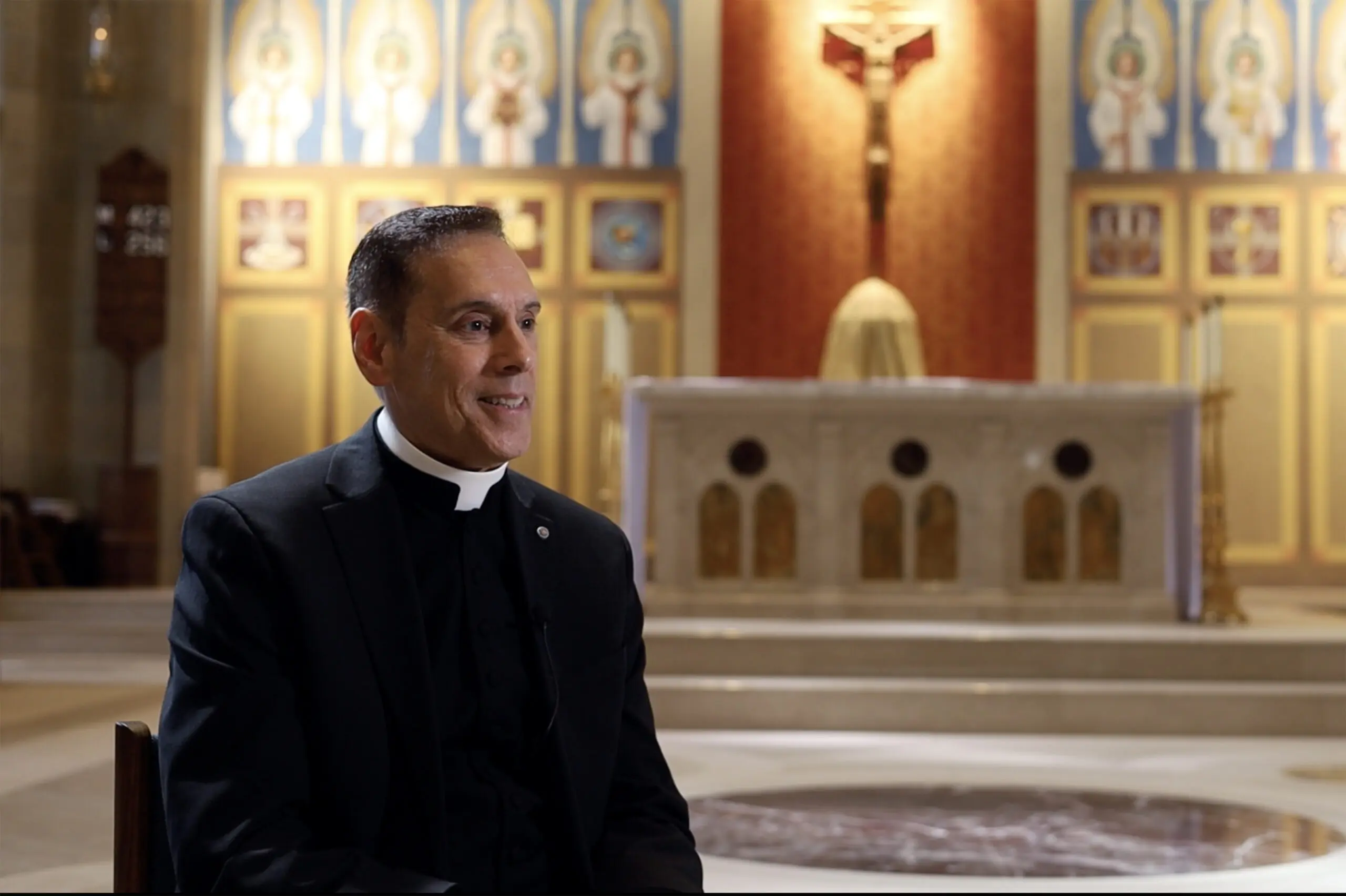
Father Ken Brighenti, Ph.D., vice-rector of the configuration stage and assistant professor, is also the co-author of the “Catholicism for Dummies” series.
He describes formation as an integrated process.
“We try to integrate and I think everything comes together in their pastoral formation — their intellectual, their spiritual and their human formation, because human formation is very important,” he said. “Because it could be a bridge to people, or it could be a block. So, that’s what we work on a lot in formation itself. But it all converges in the pastoral.”
He often explains the process with a visual analogy.
“When Michelangelo saw a block of marble and he said, ‘Oh, this is going to be the Pieta,’ but it had a flaw in it, he didn’t see the flaws,” he said. “So, when you first start, big chards come off, and then later on, you’re polishing it, you’re refining it . . . until we see the masterpiece that we see today.”
Father Brighenti applies that image directly to seminary formation.
“At first, big chards come off and then later on in formation, that’s where we refine it — and also in spiritual direction. That’s what spiritual direction is, formation.”
For Archbishop McKnight, this kind of formation must reflect the diversity of the church itself.
“In my mind and in my vision, having some of our seminarians here helps to instill that sense of mission in our priests to serve everyone in our community back home in the Archdiocese of Kansas City in Kansas,” he said.
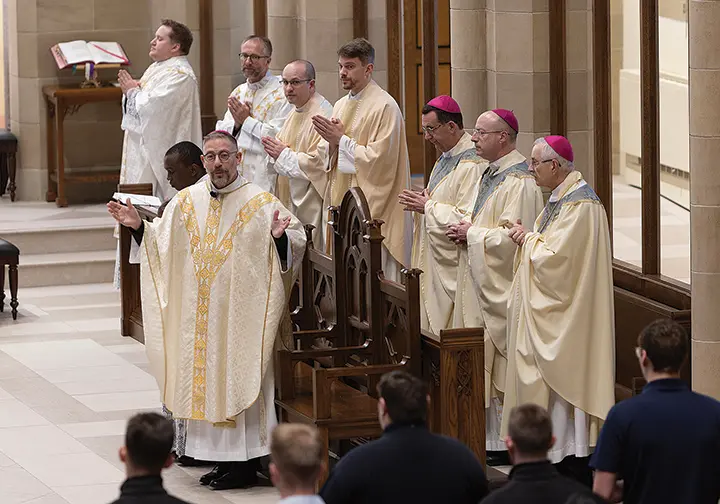
He emphasized the realities of a multicultural church.
“Because of the multicultural character of our local church, I think once one has an understanding of the diversity of cultures within the Catholic Church and the fact when one is called to be a priest, he’s not called to be a priest for just one type, but for all, for everyone,” he said.
That vision extends to parish life itself. Archbishop McKnight explains.
“The real goal here is to eventually have every parish in the archdiocese . . . welcoming and [prepared to] accept anybody who feels called to enter our doorways and to join our communities.
“And that we have priests who are equipped and are ready to help them.”
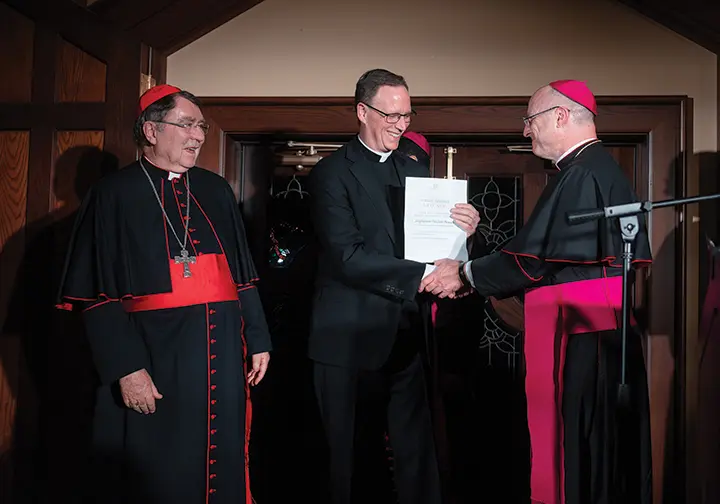
The Josephinum’s formation culture is also deeply shaped by relationships. For Msgr. Steven Beseau, rector and president of the Josephinum, his connection with Archbishop McKnight spans more than 25 years. (During this visit, Cardinal Christophe Pierre announced that Father Beseau had been appointed a Chaplain to His Holiness, or a monsignor.)
“I met Archbishop McKnight back when he was Father McKnight,” Msgr. Beseau said. “Both of us were studying in Rome at the Casa Santa Maria (dell’Umiltà) in the late 1990s. I’ve known Archbishop McKnight since 2000, so over 25 years.”
That relationship evolved into collaboration.
“When I became the rector of the Josephinum, he was one of the first bishops I called and said, ‘Would you serve on the board?’ And he agreed,” he said. “So, I’ve had the privilege of working with him as a board member, and then as a bishop who has entrusted us with his seminarians.”
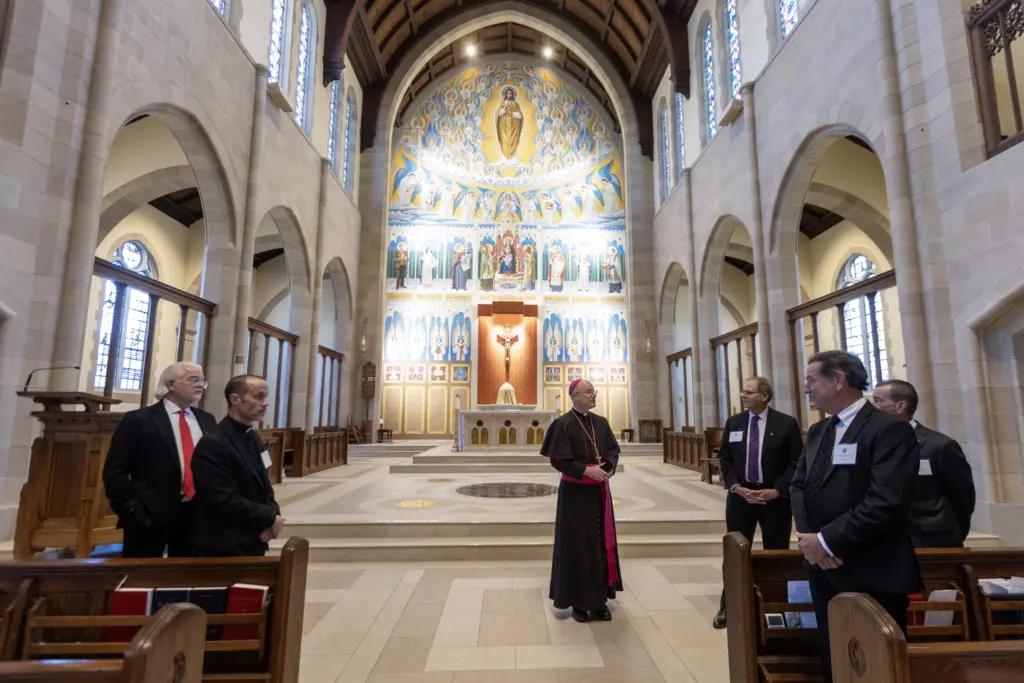
For Archbishop McKnight, those relationships are not secondary; they are central to priestly formation. And ultimately, his decision rested on a conviction formed long before he became a bishop.
“What makes a human institution memorable are the people we encounter there,” he said.
“My fellow students and seminarians, the faculty, the rector and those involved here at the Josephinum all made an impression upon me,” he said. “As well as those with whom I served in the outlying areas and in the various parishes and hospitals I was assigned to over the years.”
The archbishop suggests that it’s those encounters that really shape a priest for ministry. At the Josephinum, formation is intentionally challenging and well-rounded, shaping seminarians spiritually, intellectually, pastorally and in their human development.
“The future of the church passes by way of the seminary,” said Msgr. Beseau. “A good priest makes all the difference for a parish, a good priest makes all the difference for a high school,” he said.
“These are good men,” he continued. “They’re honestly seeking the Lord’s will in their lives.” He described seminarians who are not seeking recognition, but faithfulness.
“Christ is the solution. Jesus Christ is always the solution,” he said. “And I want to be a part of the response.”
That formation process is structured and deliberate.
“To say that a guy’s not ready to enter doesn’t mean that he doesn’t have a vocation,” said Dr. Perry Cahall, academic dean of the School of Theology. “It just means at this moment in time, he’s not at the point where he could receive formation and benefit from it.”
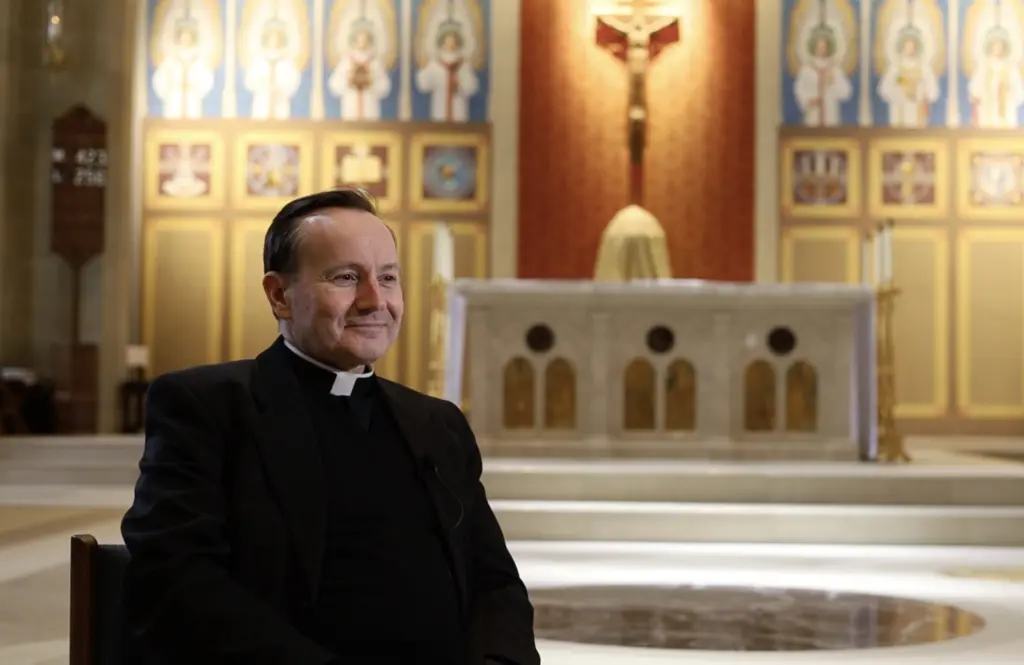
Once admitted, seminarians enter a disciplined but communal way of life. “It’s a very solid day from sometimes 5:45 a.m. to 9 at night,” Msgr. Beseau said. “There’s not a lot of downtime built into the schedule.” Still, community life remains central.
Father Nicholas Monaghan, STL, vice-rector for discipleship formation, noted that theology is made concrete in daily life.
“We make theology come alive rather than remain abstract for the seminarians by drawing on the tradition that we have in the seminary; we teach what the tradition of the church is, but also we apply it to how we’re living today,” he said.
While the Josephinum is independent of any diocese, it maintains a close working relationship with the Diocese of Columbus led by Bishop Earl Fernandes. The surrounding local church has experienced significant growth.
“There’s a real significant growth here in Columbus,” Msgr. Beseau said. “They’ve doubled in five years — the numbers of Catholics, the numbers of religious orders, the numbers of seminarians.”
“That growth,” he added, “is part of the seminary’s daily life.
“We’re not isolated from the church — we’re very much in the life of the church here.”
And he sees many similarities between the two dioceses, making Josephinum a good fit for an archdiocese preparing seminarians to minister to a diverse population.
For Archbishop McKnight, that integration of formation, community, and church life is exactly why he is sending seminarians to the Josephinum. It is a place where future priests are shaped not only academically, but relationally and spiritually within the wider church.
Ultimately, his decision rests on a conviction formed long before he became a bishop.
“What makes a human institution memorable are the people we encounter there,” said Archbishop McKnight.
“In those encounters — between seminarians, formators and the broader church — the future of the priesthood continues to quietly take shape,” he said.