by John Sorce
Special to The Leaven
KANSAS CITY, Mo. — “The short-term tourism impact is important. But this is so much more than that. We have said if we could just get people here, they would see what we all know. This is a special place.”
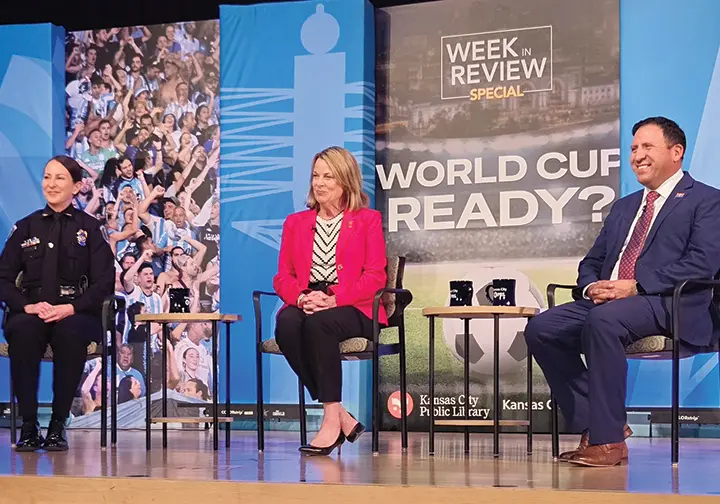
That quote from Pam Kramer, CEO of KC2026, at a public World Cup information session at the Kansas City Public Library: Plaza Branch on May 12 signifies both the short- and long-term importance that this event is going to have on Kansas City.
“I just came from interviews with The Times of London, The Daily Mail, a Netherlands newspaper and an Argentinian television station who are in Kansas City doing pre-tournament stories,” Kramer said.
“We can’t buy that kind of publicity,” she continued, “and I think exposing people to who we are is an important part of the story.”
The town hall event, which was moderated by Kansas City PBS host Nick Haines, also included Kansas City, Missouri, police chief Stacey Graves and city manager Mario Vasquez.
A bigger opportunity
As the smallest host city, there was initial doubt that Kansas City would host any teams. Yet they ended up with four — with three of them being pot one teams — including the reigning champions in Argentina.
But Kramer feels that Kansas City’s smaller size in comparison to other host cities can work to its advantage.
“I think that because we are smaller, we recognize the opportunity is bigger,” Kramer said.
According to Visit KC, Kansas City is projecting 650,000 visitors over the duration of the World Cup.
Graves noted that in addition to local and regional law enforcement officers, the city will be importing officers from 11 states, with the majority staying at nearby universities to keep hotel space open for visitors.
As far as tickets go, Kramer said the local host committee has no involvement in prices or sales, as that is all handled by FIFA.
But it was important for the committee to keep the FIFA Fan Festival — which will be held on the lawn outside the World War I Museum and Memorial in Kansas City, Missouri — free for the general public.
“We want to make sure that people can go there to experience the World Cup and connect with fans from around the world,” Kramer said.
Public transportation
Kansas City is leasing 200 buses that will be returned once the tournament ends, and there will be park-n-ride locations throughout the metro, helping fans get to matches from locations such as the Fan Festival, Oak Park Mall, North Kansas City and Independence Center.
Vasquez said those buses are being paid for by a combination of federal funding, as well as some funding from private partners and the states of Kansas and Missouri.
There will be limited parking at the stadium on match days, so fans and locals are being encouraged to utilize this method of transportation.
Vasquez doesn’t want locals to stop living their daily lives and to continue coming downtown, explaining the majority of traffic will be heightened during the evenings of Kansas City’s six game days.
“We are open for business and want people to continue to live their lives,” Vasquez said. “We are not shutting down the city for this.
“Big cities host big events, and we are a big city.”
More information regarding transportation can be found at: kc2026.com/transportation.
Different laws
Countries with fans coming to Kansas City have been in communication to keep travelers informed about legal differences before they travel, Kramer said.
“We have been meeting with the consulates since after the draw and we knew which countries were coming here,” she continued. “They want their citizens to know what the laws are before they arrive, and they could be different here on either side of the state line.”
One of the biggest differences is going to be the age of legal alcohol consumption. Graves said the police department will focus on prevention and making sure hospitality areas are following U.S. laws. The department has also communicated with other countries for guidance.
“We not only built relationships and learned best practices, but also best deployment,” Graves said. “One of the big takeaways was learning about fan behavior. If you think the tailgating for the Chiefs is something else, the fan behavior that we learned about is something that we haven’t seen in this country.
“Their passion is exciting, and we’re excited to host them and are prepared for whatever comes our way.”
‘Mahomes times 100’
Vasquez is excited for the World Cup to start and likened the world popularity of Argentina’s Lionel Messi as “Patrick Mahomes times 100.”
This is going to be that big for Kansas City, and he is looking forward to welcoming people from across the globe.
“We’re going to gain world class exposure,” Vasquez said. “People will see our facilities, our downtown and our skyline, and our community coming together to be a host. I think that’s something that’s going to stay with us for the long-term.”
Kramer hopes that its role as a host city will help Kansas City redefine how it sees itself.
“We have the reigning world champions with the most popular player in the world starting their title defense in Kansas City,” Kramer said. “That doesn’t happen unless something good is happening here.
“I think the excitement that’s coming and the way that we welcome the world can really change the way we see ourselves.”