How Catholic immigrants built America
This is the fourth article in a series.
by Therese Horvat
Special to The Leaven
GERMAN
St. Boniface Parish in Scipio and St. Joseph Parish, Leavenworth
The histories of St. Boniface Parish in Scipio and St. Joseph Parish, Leavenworth, share strong German and Carmelite connections.
Three years after he took up residence in Leavenworth, Bishop John Baptist Miege established St. Joseph Parish in the city to serve the growing German population. In July 1859, the first church was dedicated.
Father David McEvoy, O.Carm, is a native son of Leavenworth, former pastor of St. Joseph and current parochial administrator of St. Boniface. He explained that the Carmelites came to the United States from Germany in 1864. St. Joseph was their first permanent establishment in the United States.
A year later, two more Carmelite priests were sent to serve German immigrants in Scipio. The Carmelites established a priory there that at one time housed 10 to 12 priests and working Brothers. The religious Brothers helped quarry stone that went into building the parish church.
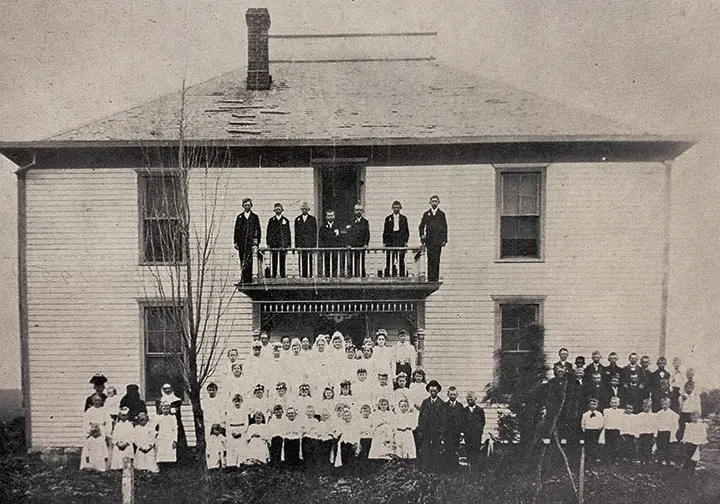
Economic opportunities, the promise of free or inexpensive land and a climate akin to their homeland attracted large numbers of Germans to Leavenworth. Among these immigrants were Father David’s maternal great-grandparents.
In 1871, the present parish church was blessed. At St. Joseph, the German language was spoken for 80 years. Mass was in Latin and the homily in German. St. Joseph hosts an annual Germanfest to celebrate the heritage of the parish and the lasting traditions of the German people.
Sts. Peter and Paul Parish, Seneca
While he is a member of St. Joseph Parish in Leavenworth, Kenneth Uphaus traces his family roots back to Seneca.
In 1926, his father August, age 17, came to the United States through Ellis Island from Vörden, Germany. August traveled by train to Baileyville, where he provided free labor on the large farm of a so-called “second cousin.” In return, the farmer sponsored August and provided collateral for a loan to purchase land in Seneca.
“People made good for one another in those days,” said Uphaus.
By the time August arrived in Seneca, Sts. Peter and Paul had been a parish for almost 60 years. In the 1860s, a Benedictine priest from Atchison celebrated monthly Masses in the home of Matthias Stein, with 10 families in attendance. Bishop Miege saw the need for a church in Seneca and asked Stein to locate suitable property. Catholics and Protestants alike supported the idea and contributed funds to purchase a district school building and the entire block on which it stood.
While German was commonly spoken, August refused to teach the language to his sons because the Benedictine Sisters had emphasized the importance of learning English.
August owned 600 acres at one time. He purchased and rebuilt a house from his in-laws. Uphaus and his five brothers grew up in the home and attended grade school and high school at Sts. Peter and Paul.