
by Todd Habiger
todd.habiger@theleaven.org
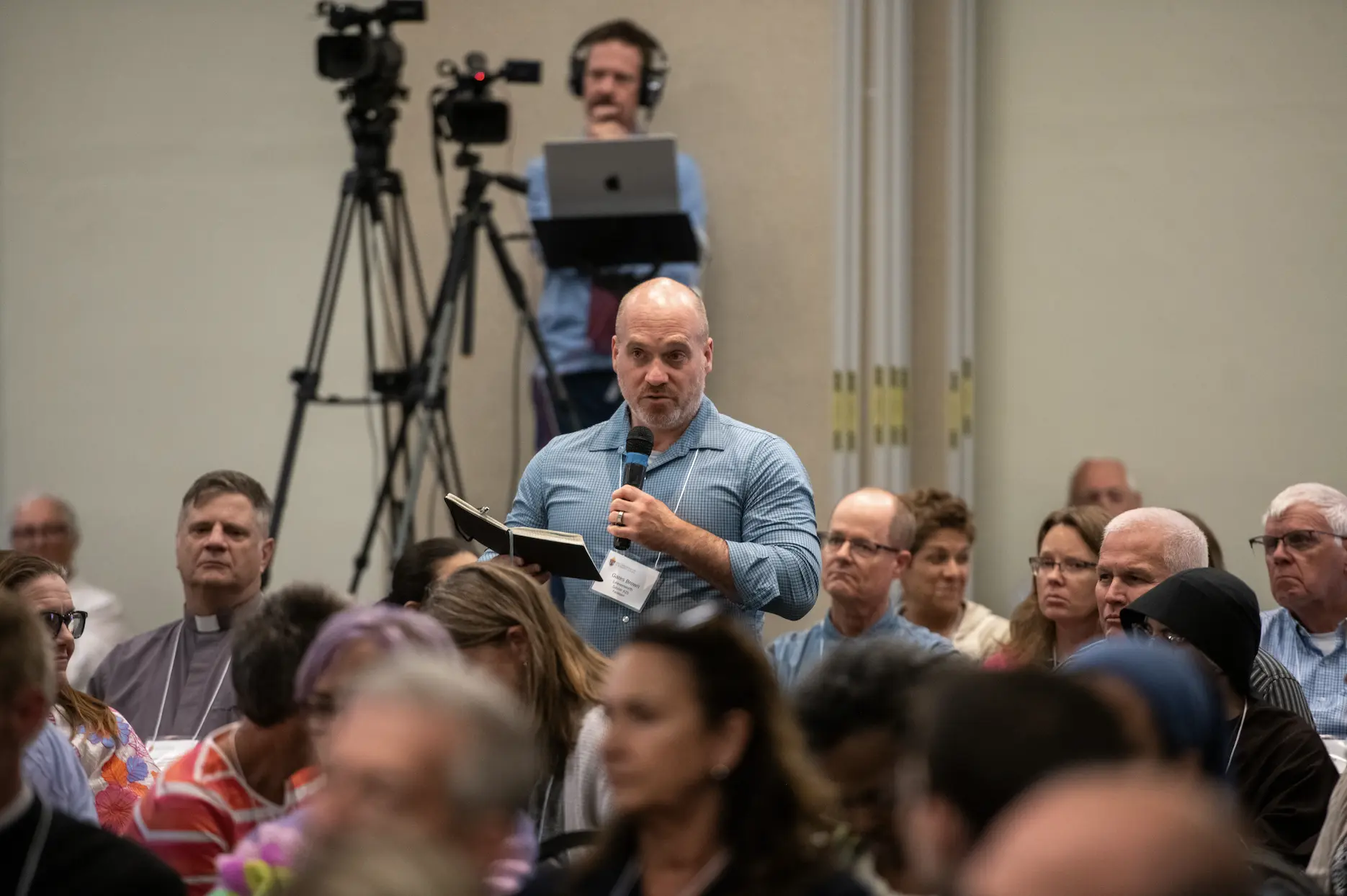
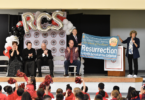
KANSAS CITY, Kan. — Parish leaders from all corners of the Archdiocese of Kansas City in Kansas gathered Sept. 12 at Savior Pastoral Center here for the Renewal from the Heartland convocation, which launched the pastoral planning process for the archdiocese.
A Renewal from the Heartland began last year under the direction of Archbishop Shawn McKnight with listening sessions in each deanery of the archdiocese. The responses to those listening sessions and an online survey that followed were recorded and analyzed to determine the next phase of pastoral planning.
“What we have seen, heard and shared under the inspiration of the Holy Spirit we now proclaim, as we begin the second year of Renewal from the Heartland, our archdiocesan response to the Holy Father’s call for us to become a more synodal church,” said Archbishop McKnight in his opening address, which came from his pastoral letter on synodality in the archdiocese (available at: archkck.org/renewal-heartland).
“Synodal,” a term with Greek origins, loosely means “walking together.”
According to Archbishop McKnight, becoming a more synodal church is not about creating more documents and programs in parishes, but rather renewing parish life.
That starts by listening to the people.
“Bishops, priests, deacons, consecrated persons and lay faithful are called to move beyond individualism and to build authentic communion through mutual listening, trust and shared responsibility,” the archbishop said.
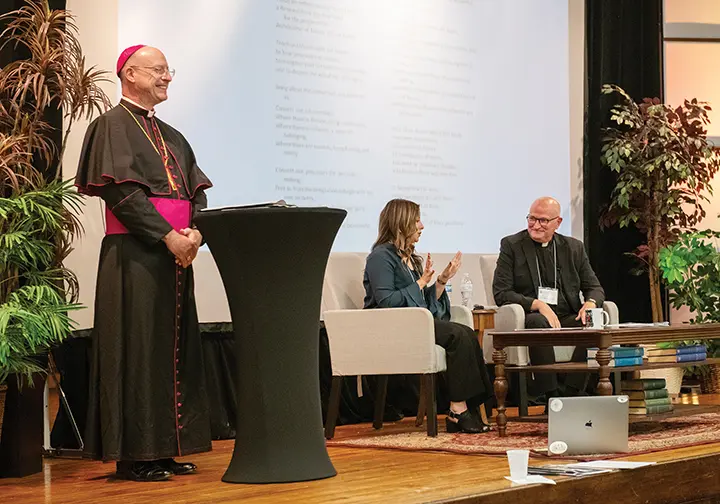
The listening sessions provided parishioners with the opportunity to speak from the heart about their own questions, hopes and fears in the local church.
“I want to point out how the clergy, religious and faithful of the archdiocese were given the opportunity from the very beginning to shape the pastoral planning process that is now to follow,” Archbishop McKnight said.
The data says
Following the archbishop’s opening address, Helen Osman, a member of the archdiocesan synodal team, touched on the data and key points that came from the listening sessions and online survey.
Approximately 1,000 people total participated in 32 listening sessions, which were held in 17 parishes, two prisons, four high schools and seven community centers. Discussions took place in English, Spanish and American Sign Language (ASL).
The Center for Applied Research in the Apostolate (CARA) analyzed the data and found that more than 97% of archdiocesan parishes were represented, 93% of respondents were lay people and 8% of respondents were Hispanic.
According to Osman, Spanish-speaking Catholics were particularly vocal in their wants and needs.
“Our Spanish-speaking brothers and sisters are really crying for help,” she said. “They want to be integrated into parish life, and they need more resources. That came across loud and clear.”
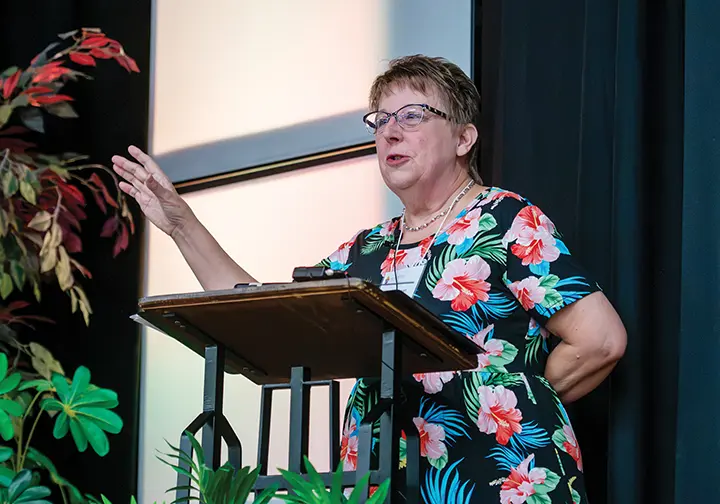
Osman also highlighted that 85% of respondents said they attend Mass at least weekly.
“I think every one of us knows that is not typical of the general Catholic population, unless the Archdiocese of Kansas City in Kansas is extremely unique,” she said. “Nationally, the numbers are somewhere between 25 and 32 percent of Catholics who are in the pews on any particular Sunday. So, these are people who are deeply committed to their parish.”
Osman said the archdiocese needs to look beyond committed Catholics and reach out to those who have not been heard from during this process.
Talking it out
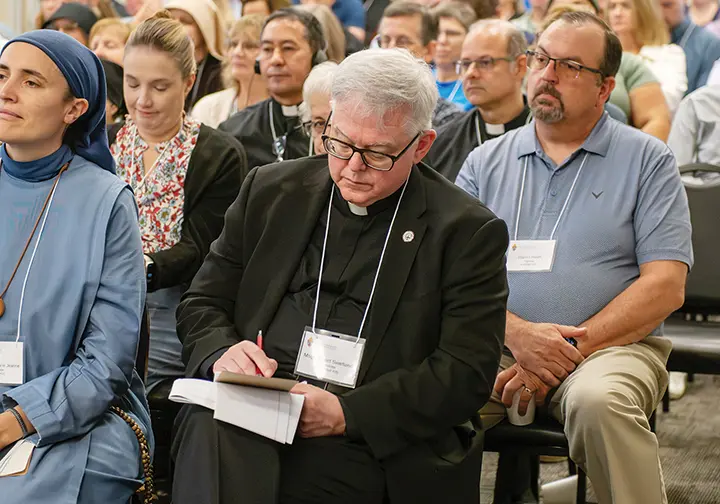
Following Osman’s presentation and a panel discussion from priests and laity about how synodality has worked in their parishes and ministries, attendees broke into small groups to discuss the results of the listening sessions and survey, as well as what resonates in their parishes.
Larry Koster from the Lawrence Deanery said his group expressed concern about the church losing young Catholics and the need to keep them engaged in the faith.
In the Atchison Deanery, Kate Werring and her small group focused on the concept of belonging.
“Hospitality is important” in helping parishioners feel included, she said, “but not just one little stab at hospitality.”
Gates Brown from the Leavenworth Deanery joined a group representing the Southern Deanery. They discussed ways to reach out to those who feel alienated from the church and how to deal with tensions that arise with different liturgical preferences.
“‘Never forbid what the church allows, never allow what the church forbids’ is a good way to balance the tensions that can come up,” said Brown.
Next steps
Moving forward, each deanery will host three listening sessions with clergy and laity to determine its pastoral priorities.
Father Michael Hawken, vicar general and moderator of the curia, said each deanery will create a pastoral plan specific to their needs.
“For example, if a deanery plan includes creating an OCIA program that will serve more than one parish, then those parishes grouped in that program would prioritize the success of that new OCIA program within their parish,” he said.
Each of the 21 counties in the archdiocese has its own gifts and challenges, said Archbishop McKnight, which should be considered in pastoral planning.
“This vision will be discerned in each deanery according to the local realities there — the resources available, the cultures of the communities and the capacity among those who gather as leaders in the deanery,” he said.
Each deanery will submit its report to the archdiocese, which will review the plans and adjust its overall pastoral plan accordingly. The results of that plan will be presented at the 2027 archdiocesan convocation.
It is obvious that the Diocese of Kansas City, Kansas is moving full steam ahead on the Synodal Path. I find it hard to believe that the surveys are accurate regarding the feelings of Catholics on this topic. I believe most, have no idea about what the Church is attempting to do. Christ, was quite clear about how he wanted His Church to be structured, He left a complete blue print that is very well defined in the Scriptures of the Holy Bible. With the election of Francis and now Leo, the Church is being led in a completely different direction and it is away from the Commandments of God, the teachings of His Son, Jesus Christ with the guidance of the Holy Spirit. Not too long ago, Pope Leo was asked by journalist Elise Ann Allen, if the Church would change its approach to LGBTQ. His response was: “people want the Church to change, I think we have to change attitudes before we even think about changing what the Church says about any question.” The move towards Synodality was happening before Pope Leo and we could see, if we followed what was happening, that the di was cast. Pope Francis elevated and appointed clerics that were progressive and would follow his lead without question. Pope Leo has continued, and at much greater speed to change the Church and Her Doctrine. Both Popes wanted to open the Church to be inclusive of all religions and also lifestyles, married priests and even female priests. Both have agreed with the World Health Organization and the United Nations on many things. Pope Leo has elevated clerics that he knows want to move towards a progressive Church that is aligned with public opinion, that I might add, often changes! McElroy, Cupich and Tobin to name just three. All three of these prelates have openly celebrated at or with priests that have gay welcomed gay couples to Mass and Holy Communion. I believe one of them attended a gay marriage; I have not even mentioned James Martin, Jesuit who has the ear of the Pope and is included in the preparations to move towards universal synodality. The very holy and reverent “Men of God” who would like review and discussion on this path have been sidelined and removed from their appointments, parishes and some have lost their clerical status. There is much confusion regarding the excommunication of the SSPX; most Catholics have no idea about who wrote the articles of the excommunication document and that he did not even do it correctly, therefore the SSPX has not been officially excommunicated form the Church. I might add, that they have not refused to acknowledge Pope Francis or Leo as the head of the Catholic Church. They moved ahead with the ordination of Bishops because they saw the direction away from the traditional and real teachings of Christ and His Church and wanted to ordain so that these teachings would continue. The, of course want to continue with the Latin Mass, but they greatest concern is the fact that the Doctrines of our Holy Mother Church are no longer being promoted, rather the Church is being changed to reflect the culture being promoted and lived today. I also want to add that the synod map has been planned with the involvement of those that promote the gay agenda and lifestyle, even those that support abortion, and other things that have beliefs that are the antithesis
of Catholic Doctrine. I am a traditional Catholic, that has not attended a Latin Mass since Vatican II, as I live too far away from a Church that has a Latin Mass. While I greatly miss the reverence of the Latin Mass, I have never felt that I was not at a real Mass. I willl never vear away from the teachings that came from Christ and I find myself wondering where will I go, when and if the Vatican makes more changes to the Mass. I believe that the Latin Mass has been attracting many young people and that is why the Vatican is trying take it away. We have been warned by Our Lady and several Saints that what we see happening in the Church today, would happen. I have no doubt that Christ’s return will be sooner rather than later if this process continues.
Hi. I wanted to leave some comments about this article. I’ll caveat this with I have not read Archbishop’s letter yet, so there may be some more information in there. It would have been helpful to have indicated that the results of the survey and listening sessions are available on the archdiocesan website (preferably with a website address) so that readers could go and look at the results themselves. I went searching for this and it wasn’t that hard to find. After looking through the data, it seems like the portion on “The data says” doesn’t really describe “the data” with much accuracy. For example, if I just read the article, I would have come to the conclusion that about 1000 people participated, 8% of them were Hispanic, the needs of the Hispanic community was the driving conclusion from the “process”, and that most of the respondents were weekly Mass attendees. However, looking at the “data” that isn’t what is indicated.
About 7300 people participated in the survey. In addition to the about 1000 people participating in the listening sessions, that makes roughly 8300 people participating. Assuming that the people in the listening sessions did not participate in the survey, which I think is an assumption that is likely not correct. But, for the sake of argument, we’ll assume that 8300 people participated. According to the archdiocesan website, there are 181,000+ catholics in the archdiocese. With those numbers, it indicates a participation rate of less than 5%. That number would have been helpful. My employer (4000+ employees) performs an employee satisfaction survey every couple of years. If they aren’t getting a participation rate greater than 50%, then the survey is considered to be of insufficient participation to derive significant results from, and this statement is made by the professional firm doing the survey, not the employer trying to drive participation. It would interesting to know if the Archdiocese considers whether a 5% participation rate is sufficient enough to derive meaningful results from. From a statement in the article quoted from Ms. Osman, it seems like it might not consider the results significant, because a majority of the participants were regular Mass attendees. Some clarity on this would have been helpful. Another number that might be worthwhile knowing would be the percentage of regular Mass attendees that participated in the survey, but I was not able to get this from the survey. Since the Hispanic number of 8% was mentioned, it would be helpful to know what the Hispanic participation rate was, are they also at 5%, lower or higher?
The percentage numbers quoted in the article, if read literally, would indicate that these were the numbers that participated in the listening sessions, but the few deanery summaries that I looked through did not have any demographic data on them, and the demographic numbers presented in the article matched what was given in the survey. This should be more clearly stated. Also, it states that 97% of the parishes were represented, but that is not necessarily correct. 97% of the parishes had a person participate, but that doesn’t mean that those people represented the parish. Without greater participation rates, I’m not sure how it could be stated that the parishes were represented with any certainty.
Yes, the parishes should be more welcoming to the Hispanic people in the parish and community. And I’m not saying that more work should not be done to reach out, and I’m not saying that this shouldn’t be a priority of some kind (high, medium or otherwise). However, unless Ms. Osman had experience from a listening session that the 8% Hispanic participation was a very vocal participation, I don’t see how she can draw this conclusion. I did not get a similar conclusion from looking at the survey report. Yes, there was a Hispanic component, but there was also a lot of other comments, most of which seem like they should also be given some weight. More information on how this “very vocal” minority should determine the archdiocesan path forward should be provided, if this is indeed the direction. As the article is written, whether you meant it to or not, it appears to be misleading. More data is needed here to support this statement in the article.
Lastly, the survey does very strongly indicate that a high priority should be given to the fostering of a greater appreciation for the celebration of Eucharist as the source and summit of our Catholic lives. Given that this was THE highest priority that came out of the survey, it seems like this should have been given some mention in the article. If this, as the highest priority indicated, was not discussed at the convocation, why are we even going through this process? Surely the thing that was indicated as the highest priority should have been given some text in the article and discussion at the convocation.
Sorry to bend your ear for so long. I guess I just needed to vent my frustrations. Thanks for the opportunity to respond.
Consider that it was not in the best interest to give accurate information on how popular the senile pathway is in the Catholic Church. Few people understand the process and the outcome is desired.