by Moira Cullings
moira.cullings@theleaven.org
KANSAS CITY, Kan. — Denise Mills understands what it’s like to feel invisible at church on Sundays.
“I didn’t really know a lot of people in the church, even though I had been in our parish for 10 years,” said Mills, a member of St. Michael the Archangel Parish in Leawood.
It wasn’t until she attended a Christ Renews His Parish retreat at St. Michael that she discovered deep friendships rooted in the Catholic faith.
“We had women from all ages, all generations, all different walks of life,” said Mills.
The experience transformed how she views the people around her in the pews and called her to a greater involvement in parish life.
She foresees a similar transformation for Catholics throughout the Archdiocese of Kansas City in Kansas as Archbishop Shawn McKnight and the archdiocese launch a new pastoral planning process beginning this Lent.
Titled “A Renewal from the Heartland,” the process is designed to fulfill the archbishop’s desire to see each parish become a more intentional center of charity and sanctuary of mercy.
Parishioner involvement is key.
“The whole desired outcome is how we best serve the mission of the church,” said Father Mike Hawken, vicar general and moderator of the curia.
“[It’s] all of us in communion with the Holy Father and with the bishops throughout the world,” he said, “sharing co-responsibility for making this mission that Jesus entrusted to us the best that it can be.”
Mills is excited to see the impact the process can have on the local church.
“In today’s growing epidemic of isolation and loneliness — even if we have people around us — I believe . . . this process will challenge us to be more intentional to engage those who are invisible,” she said.
A new yet ancient approach
“A Renewal from the Heartland” was created by Archbishop McKnight and his synodal team: Father Hawken, Mills, Deacon Jim Mullin and Helen Osman, team coordinator.
The group is following the universal church’s plan outlined in “Pathways for the Implementation Phase of the Synod (2025-28),” which was approved by Pope Francis on March 11, 2025.
He had begun the synodal process in 2020, and it will culminate with an Ecclesial Assembly in Rome in October 2028.
“‘A Renewal from the Heartland’ is our response to the Holy Father’s call to be a church that lives up to its definition,” said Archbishop McKnight.
“As St. John Chrysostom wrote, the church is a ‘name standing for walking together.’ How we ‘walk together’ in the Archdiocese of Kansas City in Kansas is ‘A Renewal from the Heartland.’ It’s as simple and profound as that,” he said.
Osman, a consultant for the Vatican’s Dicastery for Communication, was skeptical when first asked to assist with the synodal process in 2021.
“I read the documents and I thought, ‘Maybe this works in other parts of the world, but I don’t see it happening here,’” she said. “It was a lot of listening, which I think people in the U.S., we tend not to function that way.
“It really is this ancient practice of Christian discernment. And that’s something that’s really foreign to many.”
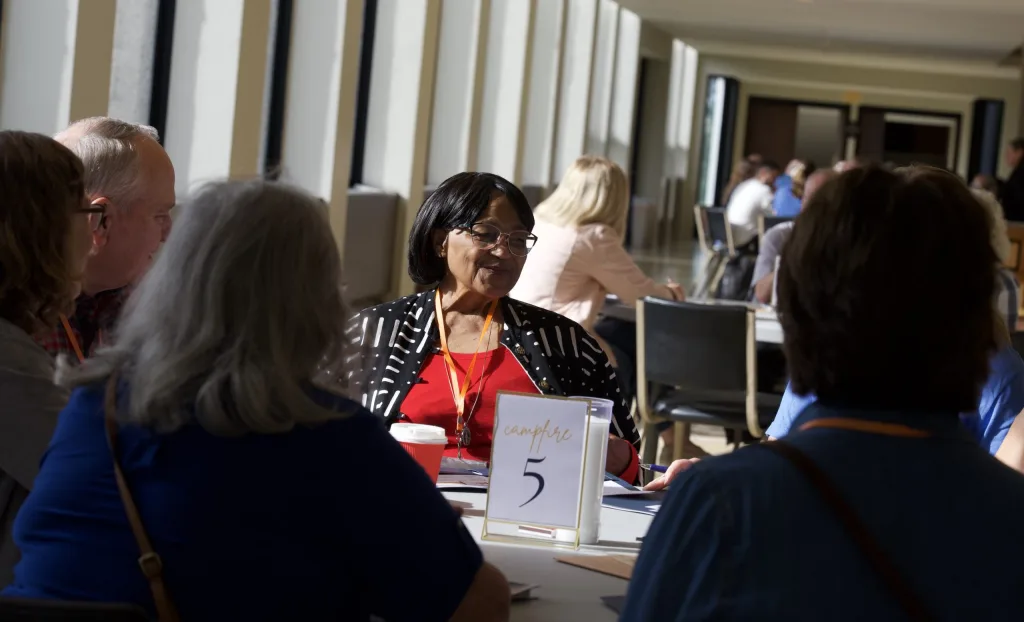
But since then, she’s seen its success and looks forward to the impact it can have on the archdiocese.
“What I’m most excited about is giving people some hope,” said Osman. “I can say that my experience has been that this is not just an exercise in making people feel good.
“I have seen people’s hearts are touched. And parishes have responded.”
The synodal team emphasized that “A Renewal from the Heartland” is not about rewriting doctrine or church teaching.
“We are not changing the definition of what it means to be Catholic or our teachings,” said Archbishop McKnight. “What we are hoping to improve is how we live that definition and teaching of being church.”
Deacon Mullin, director of evangelization at Church of the Nativity in Leawood, said the process is “about reshaping how we live and experience the faith we already profess.”
“The early Christian communities didn’t think of the church as something ‘out there,’” he continued. “Their faith was lived in homes, relationships, prayer, mercy and shared life — that was the church in motion.”
For Mills, it’s as simple as noticing the people around her at Mass, engaging with them, noticing when they’re not there and helping them fill a need without them having to ask.
“It’s simply walking together, being and doing as a Christian what Christ is calling us to be — and the Beatitudes are the road map,” she said.
Guided by the standard
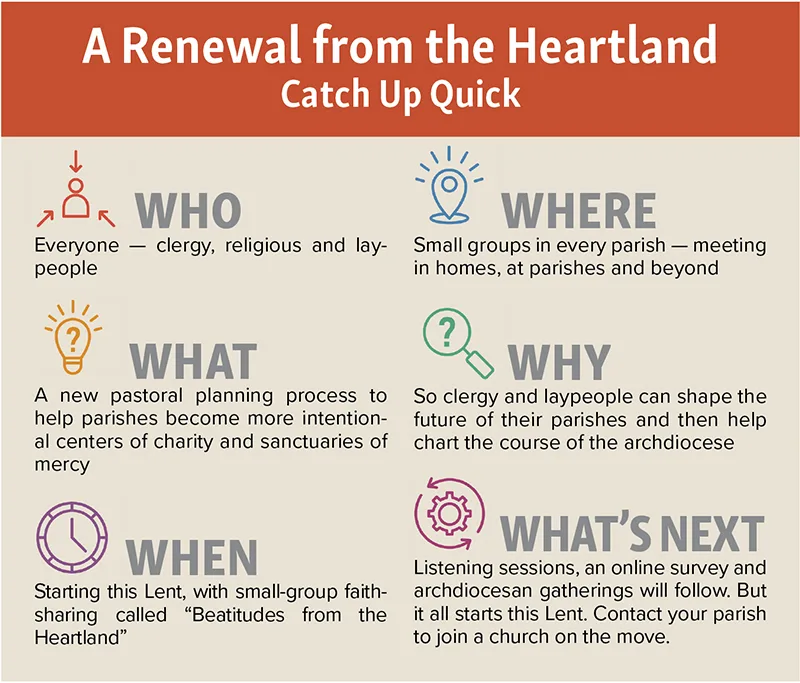
“A Renewal from the Heartland” will kick off this Lent with a small-group, faith-sharing program titled “Beatitudes from the Heartland.”
All Catholics in the archdiocese are encouraged to participate.
“Lent always calls all of us to a spirit of renewal,” said Father Mike Hawken, and this series will be special in that parishes across the archdiocese will be participating at the same time.
And not just parishes: The synodal team is encouraging any group to pick up the materials, including high schoolers, young adults, religious communities, moms’ groups or even neighbors.
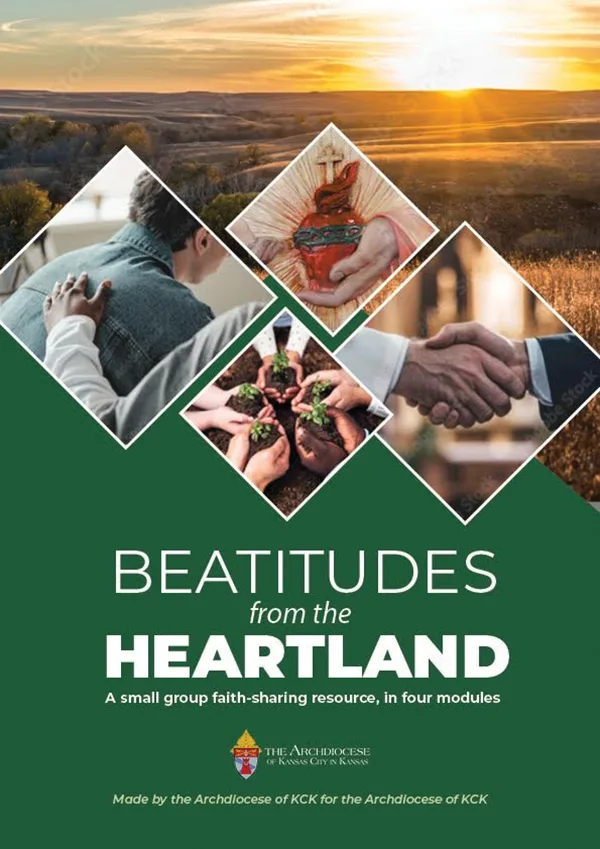
Facilitators and hosts will choose where to meet for the four-part series — whether at the parish, in homes or public spaces.
Participants will have the opportunity to reflect on the Beatitudes given by Jesus during the Sermon on the Mount in Chapter Five of Matthew’s Gospel and how they can guide Catholics today.
“There’s no purer way to set the standard of Christianity than the Beatitudes,” said Mills.
“The Beatitudes show how we can be true disciples of the Lord in the way we bear the difficulties of life with faith,” said Archbishop McKnight.
“The Beatitudes are moments that draw the Holy Spirit to us and when we are closest to God,” he continued. “They are truly ‘blessed opportunities’ that bring a deeper meaning to life and spiritual satisfaction like no other.”
The series will incorporate excerpts from Pope Leo’s first apostolic exhortation “Dilexi te” (“I Have Loved You”), Pope Francis’ apostolic exhortation “Evangelii Gaudium” (“The Joy of the Gospel”), and “Lumen Gentium” (“Light of the Nations”), one of the principal documents of the Second Vatican Council and promulgated by Pope St. Paul VI.
Like the entire pastoral planning process, it’s designed to cultivate grassroots co-responsibility among all Catholics in the church’s mission.
“For a lot of us, the church has been something outside of us — something we attend or approach when needed,” said Deacon Mullin. “This experience invites people to realize something much deeper: that each one of us is the church.
“If this Lenten series helps people truly discover that, then everything changes. The relationship moves from ‘The church is something I go to,’ to ‘The church is something I am part of, responsible for and alive within.’
“That kind of awakening strengthens faith in a way no program ever could.”
Engaging the whole church
The next phase of “A Renewal from the Heartland” will be “Listening with the Heart”: listening sessions throughout the archdiocese.
Those sessions will take place across the archdiocese from April 12-26.
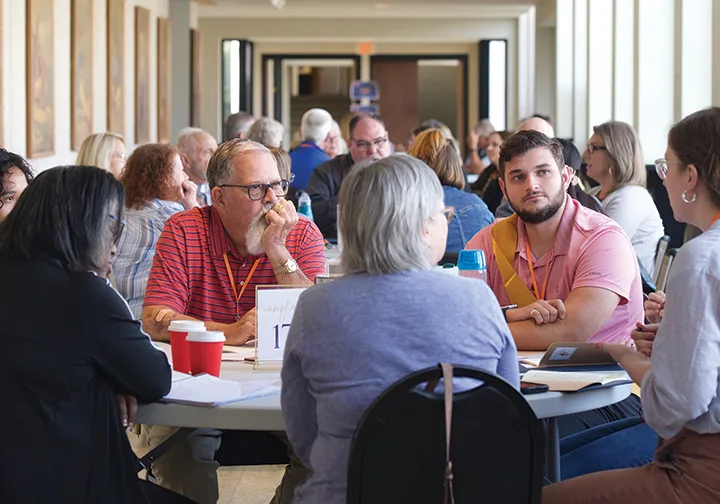
“The listening sessions are gathering small groups together,” said Mills, “and asking them, ‘How can we be a better church in our community?’
“What do the people of the community need? The church can meet those needs and walk with people who need it.”
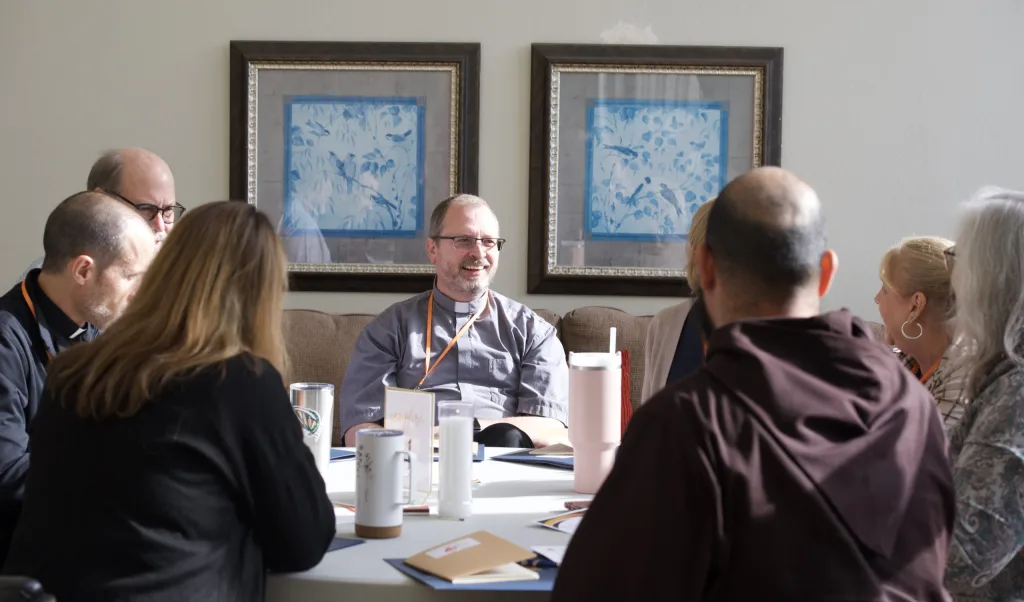
Father Hawken’s message to Catholics for this phase is simple: “You are needed in this process. And we really want to hear from you. We want you to be a part of it.”
“[Participants] will be prompted to share their joys as well as their concerns about not only their individual parish, but the local church and the church universal,” said Father Hawken.
“The listening sessions are not debating doctrine,” said Mills. “We have our Catechism [of the Catholic Church]. We know what the church should be.
“This is how we can be a better church.”
Deacon Mullin said it’s not a top-down approach that starts with answers but one that begins with listening to the needs of the people.
Thus, the synodal team plans to engage the entire church community, including Catholic school students, those with special needs and people who are in prison.
“We want to hear from everybody — as many as possible,” said Father Hawken,” [everyone who] makes up the beautiful, unique parts of the body of Christ here in northeast Kansas.”
Looking ahead
Following the listening sessions, the archdiocese will conduct a survey for anyone interested in sharing feedback.
Archbishop McKnight and the synodal team will process the information and share any themes it identifies with the deans (pastors who oversee a deanery, which is made up of parishes within a geographic location).
The deans will then work with the archbishop, synodal team and archdiocesan pastoral council to figure out ways to respond to needs locally.
On Sept. 12, an archdiocesan-wide gathering of pastors and parish pastoral council representatives will convene.
There, the synodal team will present a report on the themes it discovered, and the archbishop will offer a reflection.
Synodal team members said that’s where the pastoral planning process will truly begin.
“We look to every member within our archdiocesan church to get involved in this,” said Father Hawken of the process, “and to help us promote it and invite people into it.”
He hopes Catholics will be ready to “discover anew how to live this mission that Christ entrusted to us the best that we can.”
Deacon Mullin said at the core of this process is the Sacred Heart of Jesus, which he believes “is gathering his people, softening our hearts and drawing us back into the kind of love that can actually heal the world.
“These are the kinds of moments God uses to change the course of history.
“And he’s choosing to begin it here, with us, in the heartland.”
To learn more about “A Renewal from the Heartland,” visit the website at: archkck.org/renewal-heartland.