by Marc and Julie Anderson
mjanderson@theleaven.org
OVERLAND PARK — Roughly one-third of Catholics do not know what the church teaches about the death penalty.
That statistic is just one of several factors motivating Krisanne Vaillancourt, executive director of the Catholic Mobilizing Network, a national organization that works in collaboration with the U.S. Conference of Catholic Bishops. She seeks to educate Catholics, along with all people of goodwill, “to value life over death, to end the use of the death penalty, to transform the U.S. criminal legal system from punitive to restorative and to build capacity in U.S. society to engage in restorative practices.”
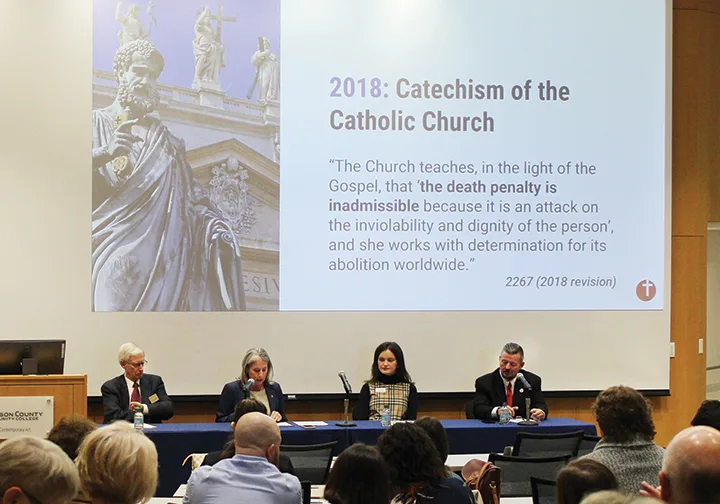
Vaillancourt was part of a speakers’ panel on Repeal to Heal: Death Penalty Repeal Advances the Culture of Life, during the Kansas Coalition Against the Death Penalty’s yearly conference Nov. 22 at Johnson County Community College in Overland Park. The conversation aimed to “share perspectives of Catholic and conservative leaders and the growing interest of the pro-life community in ending the death penalty.”
The speakers’ panel also included Rep. Bill Sutton, a member of the appropriations committee for the Kansas House, and Nan Tolson, director of Texas Conservatives Concerned About the Death Penalty, who discussed the death penalty from other perspectives, including its fiscal impact on the state budget.
After the panel’s presentation, a short Q&A period followed, along with an overview of legislation being considered for the 2026 session starting in January. The nearly three-hour event ended with an opportunity to donate to the Kansas Coalition Against the Death Penalty.
In her presentation, Vaillancourt discussed the church’s teaching on capital punishment dating back to the papacy of St. John Paul II and continuing through Pope Benedict XVI, Pope Francis and Pope Leo XIV. All have publicly stated a consistent pro-life ethic requires upholding the dignity and sanctity of every human life from natural conception to natural death.
It was Pope Francis, said Vaillancourt, who finally revised the Catechism of the Catholic Church in 2018 to read: “Recourse to the death penalty on the part of legitimate authority, following a fair trial, was long considered an appropriate response to the gravity of certain crimes and an acceptable, albeit extreme, means of safeguarding the common good.
“Today, however, there is an increasing awareness that the dignity of the person is not lost even after the commission of very serious crimes. In addition, a new understanding has emerged of the significance of penal sanctions imposed by the state.
“Lastly, more effective systems of detention have been developed, which ensure the due protection of citizens but, at the same time, do not definitively deprive the guilty of the possibility of redemption.
“Consequently, the church teaches, in the light of the Gospel, that ‘the death penalty is inadmissible because it is an attack on the inviolability and dignity of the person,’ and she works with determination for its abolition worldwide.”
It is in light of this teaching, Vaillancourt said, that the Catholic Mobilizing Network advocates transforming the American criminal justice system from one of retribution to one of restoration.
Vaillancourt shared the current justice system focuses on laws broken, identifying the guilty parties and determining punishments.
Restorative justice, said Vaillancourt, focuses on a different set of questions and falls more in line with Catholic Church teaching. Questions focus on the harm caused, who was affected by it and how, and what steps need to be taken to make it right. It also offers the possibility of redemption and transformation in people’s lives.
For more information, go to the websites of the Catholic Mobilizing Network at: catholicsmobilizing.org or the Kansas Coalition Against the Death Penalty at: ksabolition.org.