by Caroline De Sury
OSV News
PARIS (OSV News) — Just days after Pope Leo XIV’s Sept. 25-28 apostolic visit to France, scenes of unrest have replaced the atmosphere of unity and peace that marked the papal trip.
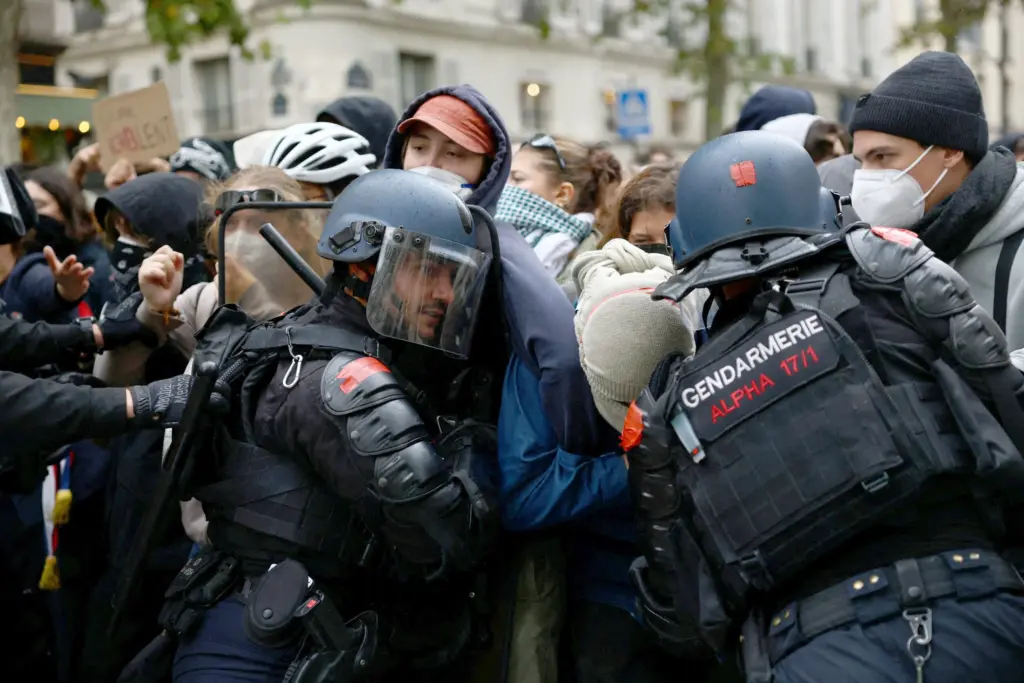
Riots that began in the Paris region on a small scale Sept. 17 spread nationwide after Sept. 28, forcing closures or disruptions at nearly 900 of France’s 3,700 public high schools by Oct. 6.
“After those… days of serenity, the joy of being together, and peace” during the papal visit, “reality quickly caught up with us,” Bishop Hervé Gosselin of Angoulême commented on Oct. 2 in a conversation with Les Coulisses de l’Info, podcast of the regional daily Charente Libre.
Since the outbreak of protests in Paris, students have been joined nationwide by union and political leaders, as well as hooded rioters, who fired fireworks, smashed windows with cobblestones or set trash cans on fire.
According to the public radio station France Info, the Ministry of Justice has reported more than 5,000 people taken into police custody, while several hundred police officers have been injured.
Bishop Olivier de Cagny of Évreux said many young people face fears about climate change, unemployment, war and social isolation, but at the same time he called violence “unnecessary.”
“What a contrast between these scenes and those witnessed during the pope’s visit,” he said, urging prayer and renewed dialogue to end the violence.
For Le Figaro Magazine, the pope’s trip in France was therefore “a blessed interlude, a providential truce in these times of anxious gloom,” Guillaume Roquette wrote in the paper Oct. 2.
In the face of erupting violence, Bishop Matthieu Rougé of Nanterre, near Paris, remembered the papal visit as an event freeing “from the triviality and violence that all too often plague contemporary public life.” He said it was a “moment of comfort” for a France that fell into chaos hours after the pope departed from Metz and headed to Rome.
Why the protests erupted
The unrest is primarily economic in nature: The ongoing negotiations over the 2027 budget are expected to be difficult against a backdrop of inflation and soaring gas prices.
Joining the students were also farmers, whom agricultural unions had encouraged to protest following a summer of heat waves in France. The total lack of rain has dangerously strained their finances. But France’s public debt, which has hit a new record high, is making it increasingly difficult to provide the social assistance being demanded.
For Bishop Gosselin, some of the students’ demands are “futile,” such as those concerning their poorly balanced class schedules, but others are “much more profound,” as they are expressing their anxieties about the future, and these, in his opinion, must be heard.
“But violence is a failure,” the bishop insisted. “Under no circumstances can violence be justified.”
St. Denis mayor had welcomed Pope Leo, then joined protesters
The bishop’s remarks were also in response to questions about Saint-Denis Mayor Bally Bagayoko, a Muslim of Malian origin known for his widely publicized affiliation with radical far-left parties, who warmly welcomed the pope upon his arrival for the youth vigil Sept. 25 in Saint-Denis’ national stadium and participated in the vigil.
But since then, Bagayoko has spoken out alongside students, to the point of facing legal action for “alleged acts of incitement to commit a crime.” On Sept. 29, he publicly stated that “violence, at a certain point, can be legitimate,” although he conceded that “whenever it can be avoided, that is better.”
Church leaders in those circumstances have repeatedly called for dialogue over confrontation.
Bishop: Path of dialogue needs to be rediscovered
For Bishop de Cagny, “violence is unnecessary,” even to resolve “entirely legitimate problems,” such as the poor condition of certain school buildings or the shortage of teachers.
“A blockade can be a worthwhile form of protest if it helps open a dialogue,” he emphasized in his conversation with La Croix Oct. 4. “But in the current situation, no one seems to really understand what is happening.”
Bishop de Cagny said, “There is no denying that the world in which young people are growing up may seem frightening to them.” Their future “may seem bleak; climate change is a source of anxiety, as are the prospects of unemployment,” he noted. For the bishop of Evreux, young people are facing an “anxiety-inducing atmosphere,” fueled by wars and amplified by social media.
“Families are sometimes themselves weakened by crises, a lack of communication, and the omnipresence of screens,” Bishop de Clagny also noted, observing that young people are “often left alone to face their anxieties” and “sometimes find it hard to believe that dialogue is truly effective in resolving conflicts.”
“They are confronted with a world they perceive as violent and uncertain, and today, they rebel against this situation,” he added.
For Bishop de Cagny, “this inner violence can simmer beneath the surface, remaining unexpressed, and when an outlet presents itself, as is the case with this mobilization, some rush into it, driven by a sort of fascination with violence, without always fully grasping the consequences.”
“Paradoxically, they do not realize that they themselves resort to violence,” the bishop said.
“In the face of violence, young people especially need to rediscover a path of dialogue. We must pray that this violence will cease.”