by Mark Johnson
The Catholic Spirit, OSV News
PLYMOUTH, Minn. (OSV News) — No one would likely have predicted Dominican Sister Amelia Hueller’s future path when she was a girl in Stillwater — least of all the sister herself.
Though born to a family filled with “natural virtue,” she was raised without religious faith and was not baptized.
At age 12, she began to babysit for a Catholic family, Tom and Patty Hooley, who had four children at the time and later five. She recalled asking Tom early on, “How is it that you’re able to love Patty so well?” “It’s simple,” he replied. “I love God first, then Patty, then the kids.”
When she heard that, “my jaw dropped, and I was deeply offended that Patty wouldn’t be first in his life,” Sister Amelia told The Catholic Spirit, newspaper of the Archdiocese of St. Paul and Minneapolis.
But the conversation “sat on my back burner,” said Sister Amelia, a member of the Dominican Sisters of St. Cecilia in Nashville, Tennessee, who is on the staff of Providence Academy, a Catholic college-preparatory PreK–12 school in Plymouth.
The future religious sister continued babysitting for the Hooleys through high school and admiring their rich family life.
Then at age 16, she traveled to Chile as an exchange student. There, the images of the Virgin Mary she encountered began to tug at her heart, and a priest gave her a miraculous medal — a cheap, little plastic thing — which she thought “was the most beautiful thing I’d ever held.”
Likewise, though agnostic, she was drawn to religious believers there, including “two girls in my high school class who exuded such beauty in their talk and in their gaze — it was like they had pearls in their eyes, and I think it was just purity.”
From then on, Sister Amelia always wore a miraculous medal because “what girl doesn’t want to be a beautiful woman one day?”
In Chile, she began meeting weekly with a priest to pour out her yearnings. At the end of her stay, he told her, “God has done his part, now it’s up to you.” Sister Amelia protested, “I don’t know what you’re talking about, because I don’t believe in God.” The priest replied, “Well, you’ve been in here every week asking about God because you have a hunger for him, and now you have to do something about it.”
Back in the United States, Sister Amelia attended George Washington University in Washington, where she earned a degree in international affairs, with a focus on global health. On breaks, she continued to babysit for the Hooleys, talking long into the night about Catholicism and the Church’s teachings on the moral issues she was facing in public health.
After college, Patty Hooley finally said to her, “You have got to start asking God your questions,” and advised that, for her, the “one place that’s quiet enough to hear the Lord is at Eucharistic adoration.” So, for Lent, Sister Amelia went to adoration each day. Soon after, she began OCIA, or the Order of Christian Initiation of Adults, at the Cathedral of St. Paul in St. Paul with Tom Hooley as her sponsor.
Sister Amelia joined the cathedral’s young adult group, began attending daily Mass and visited the Dominican Sisters at their convent near her home in Stillwater. She believed the tapestry of the Church she was experiencing was equipping her to be a wife and mother.
Then something occurred that devastated Sister Amelia. After one of her regular visits to the Stillwater Dominican Sisters, she was overcome by a sensation “like a concrete block pushing my stomach into the ground.” With despair, she realized that — though still unbaptized and agnostic — she was being called to become a religious sister.
She recalled crying, “This is horrible.” “God made me with a heart that wants to be a mom. Why would he make me one way and then take that away from me?” That night she began a journal; the first sentence was, “Remember that you didn’t want this!”
Then one day shortly thereafter, as part of her work as a nutritional counselor for pre- and post-partum mothers for the Ramsey County Public Health Department, she held a 6-pound baby in her arms. As she contemplated the child’s beauty, “it was as if a rush of wind went through me,” she said.
“It was as if I heard my own voice saying, ‘It’s OK if she’s not yours — all women are called to be spiritual mothers and some biological as well, but even for biological mothers, it can’t be a possessive love, because your children don’t belong to you.”
She recalled Tom Hooley’s words to her as a young teen: “God must be first,” and took that to mean that “no other person exists to satisfy something in me.” “Then as I looked down at the baby, she felt lighter and I loved her more deeply. I knew she was in my arms for love, not for my life improvement.”
Sister Amelia was baptized that following Easter, entered the Dominican Sisters convent in 2006 and made final vows in 2013.
As a Nashville Dominican, Sister Amelia has had various teaching assignments. She has also served as a campus minister — at the University of Maastricht in the Netherlands. She met students at coffee shops and bookstores, engaging in conversations about God’s call in their lives.
She compares that kind of mission to being “a Navy SEAL — like I was asked to parachute in and just make things happen. I love that kind of mission!”
In 2023, after several other assignments, she was sent on a similar mission as the first Dominican Sister at Providence Academy, a pre-K through 12th grade school in Plymouth, and she lives in the Stillwater Dominican convent.
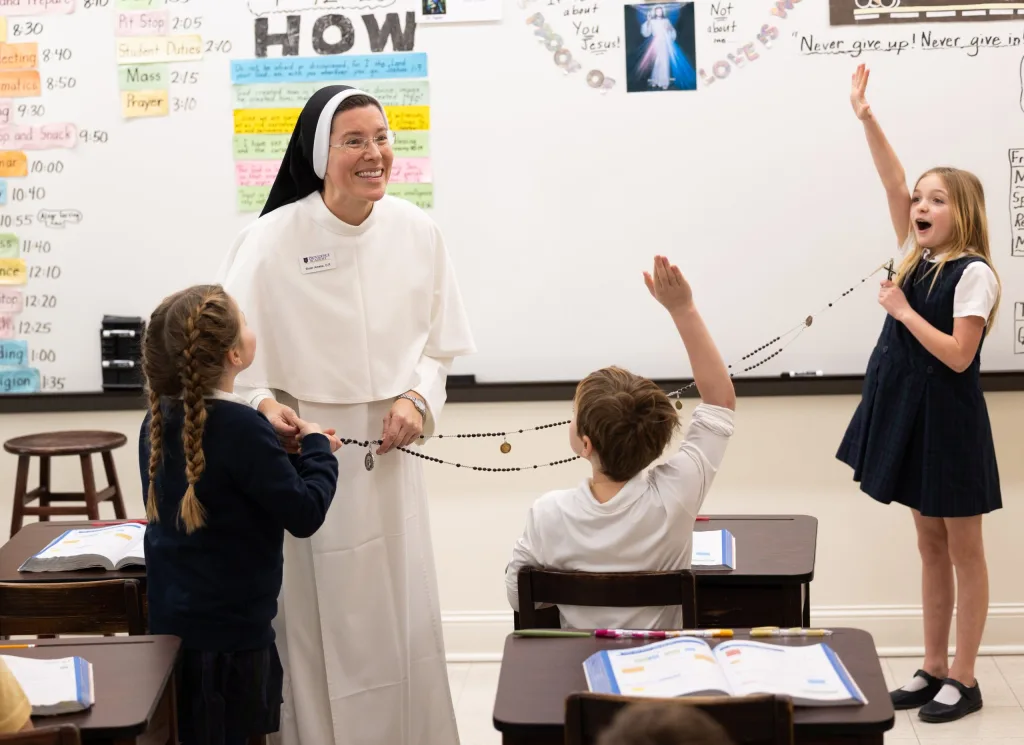
She is at Providence mainly to provide a religious sister’s presence throughout the school. Sister Amelia works with upper and middle-school students and regularly visits pre-K through fifth-grade classrooms.
Her office is in a high-traffic hallway, where she keeps her door open whenever possible, and spends several hours a day just talking to students. Sometimes they want to talk about questions of faith or challenges at school. Sister Amelia expands her outreach by joining students at meals.
Her duties also include several hours of teaching per week: seventh grade religion, focusing on sacraments and morality. She also leads retreats and extended trips for students.
“It is essential to show young people that a religious or priestly way of life is not only a plausible thing, but a beautiful, joyful thing,” said Todd Flanders, Providence headmaster.