by Marc and Julie Anderson
mjanderson@theleaven.org
TOPEKA — Eight of the nine people on death row in Kansas have filed clemency applications.
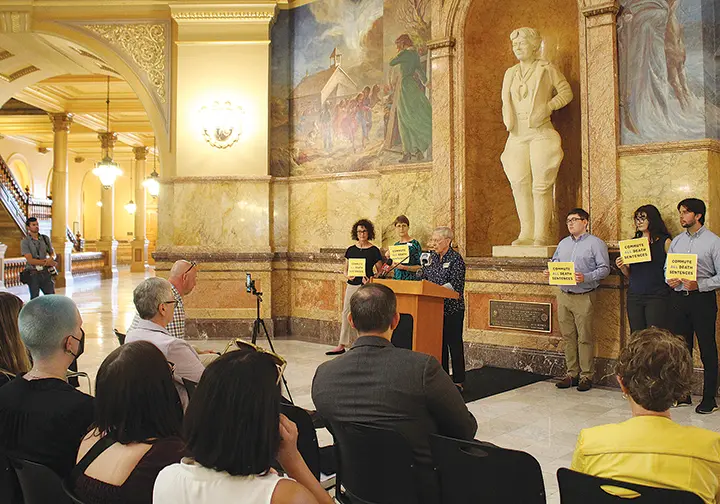
Of those eight, three have already been denied by the governor, including two on the very morning of a news conference at the Kansas State Capitol hosted by the Kansas Coalition Against the Death Penalty. During the event, a delegation of Kansas faith leaders from various traditions urged Gov. Laura Kelly to commute death sentences to life imprisonment.
Among those delivering remarks was Sister Therese Bangert, SCL, who has spent 40 years working to repeal the death penalty in Kansas.
Besides Sister Therese, other speakers included Rev. Kyle Reynolds of the United Methodist Church, Deacon Steve Becker of the Mennonite Church, a retired judge and former state legislator, and Rev. Eva K. Brown, a retired elder of the United Methodist Church.
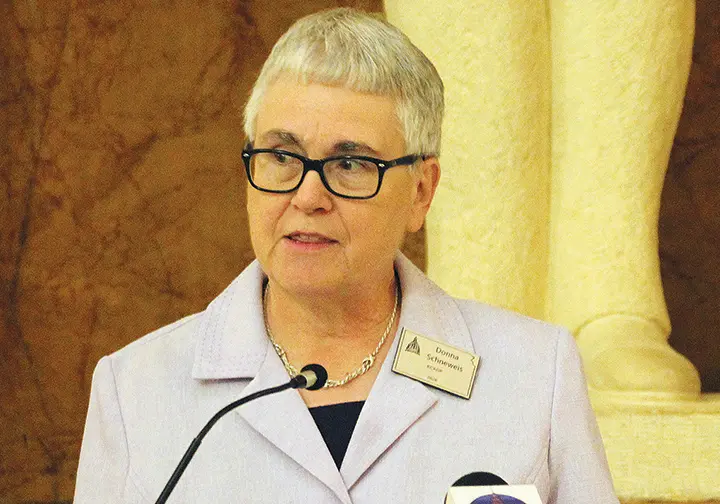
Following the news conference, led by Donna Schneweis, chair of the Kansas Coalition Against the Death Penalty board, the delegation delivered a letter signed by more than 50 Kansas faith leaders. They also presented three additional letters supporting clemency, including one from Catholic Mobilizing Network, which works with the U.S. Conference of Catholic Bishops to end the use of the death penalty. Archbishop Shawn McKnight also wrote to the governor requesting clemency.
The coalition’s letter states, “Our faith traditions teach that every human being possesses inherent worth and remains capable of change. Even in the most difficult cases, mercy and accountability need not be in conflict. A sentence of life imprisonment without parole ensures public safety while preserving the possibility of redemption and affirming the value of human life.”
In her remarks, Sister Therese said, “I have had almost daily interactions in some form or another during the past 40 years with this policy, and more importantly, with the people that it impacts. I have been to death penalty trials and heard stories and seen pictures that have left scars on my spirit. I have walked with victim family members, listened to their journeys, and witnessed some of them go from intense grief to an ability to, at times, forgive and to live and love through the anger and the grief.”
From her ministry as a Kansas City, Kansas, police chaplain for 30 years, the Sister of Charity had more experience than most with both perpetrators and victims.
“I have hugged the children of officers who have been murdered,” said Sister Therese. “I have listened to members of the police department as they journey with the loss of a member of the family in blood, their team member, and their friend.”
A religious Sister for 62 years, Sister Therese said that in 1989 the Sisters of Charity of Leavenworth “embraced a statement in opposition to the death penalty and pledged to work for its abolition.”
She also stated that recent popes, including Pope St. John Paul II, Pope Francis and Pope Leo XIV, have consistently opposed capital punishment.
Quoting “Magnifica Humanitas” (“Magnificent Humanity”), the first encyclical of Pope Leo XIV, Sister Therese said the pope wrote, “No sin, failure, humiliation, or exclusion can diminish the profound value of a human life that God has willed and called into being.”
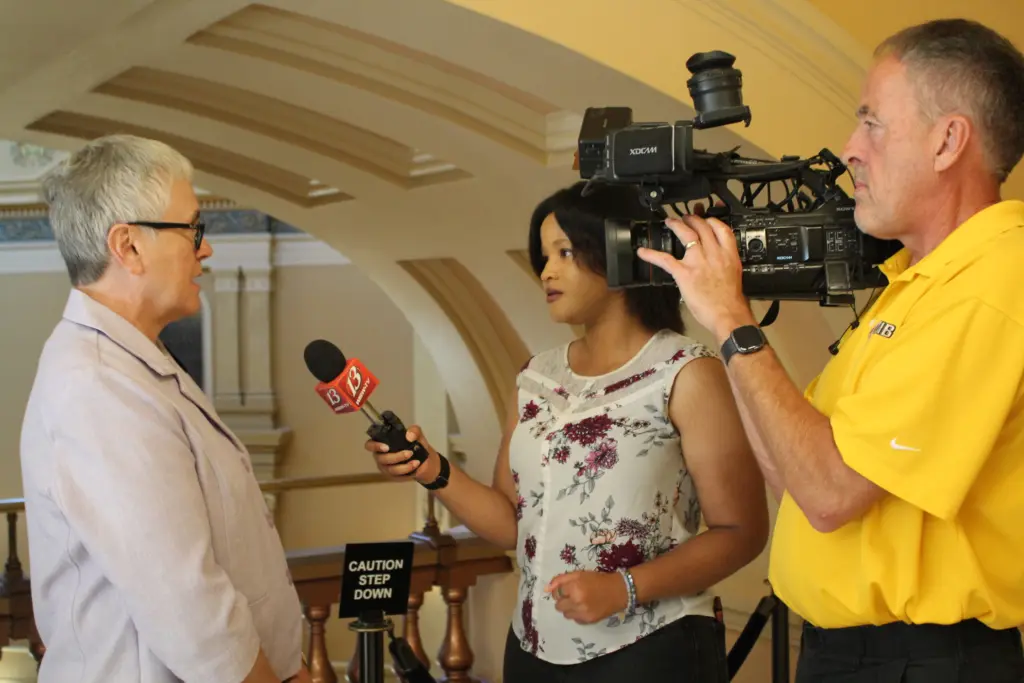
In closing, Sister Therese made her final appeal.
“From the experiences that I have described and more, not mentioned, I know that the profound value of a human life cannot be honored by an execution,” she said. “The death penalty ripples to correction workers, law enforcement, governors, judges, jurors, victim family members, and friends, the children of both the victims and the defendants.
“Those who cry out for an end of the death penalty, and who cry out for Governor Kelly to use her power of clemency, do this to protect the magnificent humanity of all of us.
“Please, Governor Kelly, hear us. Convert the sentences of those Kansans facing the death penalty to life in prison without parole. Again, Governor Kelly, please hear us.”