by Junno Arocho Esteves
OSV News
(OSV News) — As the scourge of war spreads across the Middle East, including Lebanon, the ones paying the ultimate price are the innocent men, women and children who want to live in peace, said Melkite Greek Catholic Archbishop Georges Iskandar of Tyre.
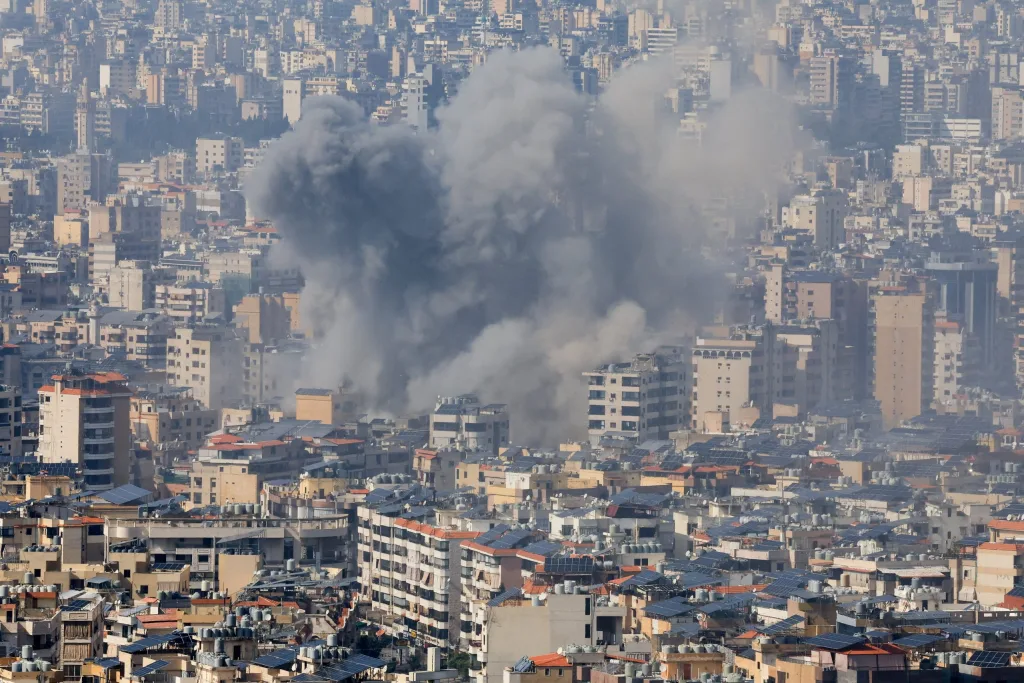
In a message to OSV News March 2, Archbishop Iskandar said the region was awakened at midnight “to the sound of intense airstrikes” by Israel in “an abrupt escalation that civilians did not anticipate.”
“What weighs most heavily upon the heart is that those paying the price are simple and peaceful people: families in their homes, children, the sick and the elderly — men and women who have no part in the calculations of greater conflicts and no responsibility for the forces that have brought about this violence,” the Melkite archbishop said.
“In a matter of moments, they found themselves at the center of a storm they did not choose, armed only with fear and prayer,” he added.
Hours after the U.S. and Israel launched a Feb. 28 attack on Iran, resulting in the death of Iran’s longtime supreme leader, 86-year-old Ayatollah Ali Khamenei, Hezbollah militants fired missiles and drones on an Israeli military outpost in Haifa.
In response, Israel fired missiles on southern Lebanon and issued evacuation notices to dozens of villages in southern and eastern Lebanon, prompting mass displacement. Archbishop Iskandar confirmed to OSV News that the “rapid Israeli warnings” for residents to evacuate came “within a very short timeframe.”
“Within minutes, the roads were overwhelmed with vehicles, and traffic came to a standstill for long hours,” he said. “Families with children and elderly relatives were stranded on the roads, uncertain where to go, carrying only what they could gather in haste, leaving behind homes, memories and livelihoods.”
“It was a painful sight: unarmed civilians fleeing danger, not because they are parties to a conflict, but because the geography in which they live suddenly became a theater of confrontation,” the archbishop lamented.
Lebanese Prime Minister Nawaf Salam condemned Hezbollah’s attack, saying that “launching rockets from southern Lebanon is an irresponsible and suspicious act.”
“It endangers Lebanon’s security and safety and provides Israel with pretexts to continue its aggressions against it,” he posted on X March 2.
The papal foundation Aid to the Church in Need, or ACN, issued a statement March 2, warning that the escalation of violence across the Middle East could have “catastrophic consequences for Christian communities throughout the region.”
“The Christian presence in the Middle East must not die out,” said Regina Lynch, ACN International’s executive president. “A new spiral of violence could push already fragile communities beyond the point of survival.”
Lynch said already precarious situations for Christians in Iraq, Syria, Gaza and the West Bank, as well as Lebanon, have been further exacerbated by the war.
“They want peace and are innocent, yet they repeatedly become victims of conflict,” Lynch said regarding Christians in southern Lebanon. “ACN teams on the ground report growing anxiety as thousands have already been displaced.”
Archbishop Iskandar told OSV News that the Melkite Greek Catholic Archeparchy in Tyre opened its doors to Christian families seeking refuge because the Church “is a home open to every suffering person.”
“Priests, volunteers and members of the local community immediately organized whatever space and resources were available, striving to ensure that each arrival would feel welcomed as in his or her own home, and sustained by the prayer and charity of the ecclesial community,” the archbishop said.
The act of “spontaneous solidarity,” he added, showed the “true face of Lebanon” as “a people who stand beside the innocent who have suddenly found themselves exposed to fear and displacement.”
The Melkite archbishop, without specifically naming Hezbollah, noted the Lebanese government’s position that “the decision of war and peace rests exclusively in the hands of the state” and that any party acting otherwise places itself outside the law and the will of the Lebanese people, “who long for stability and peace.”
Archbishop Iskandar told OSV News that the renewed conflict continues to inflict a heavy “psychological and spiritual burden” on the people of Lebanon who are “exhausted” from war and violence.
“They fear for their children and their future; they yearn for a simple and ordinary life: that a child may go to school without fear, that an elderly person may sleep peacefully in his home, that a father and mother may work for their daily bread in dignity,” he said. “This is a fundamental right of every innocent person, beyond the noise of arms and political calculations.”
Nevertheless, for the Melkite archbishop, his main concern is to remain close to the innocent, “to listen to their suffering, to pray with them, and to remind them that their dignity is safeguarded in the sight of God, and that Christian hope is not built upon balances of power but upon faith in the Lord of history, who wills peace for His people.”
“I thank you again for your concern for the suffering and resilience of our people,” Archbishop Iskander told OSV News. “And I humbly ask for your prayers, for the protection of the innocent, for the cessation of all violence, and for the gift of a just and lasting peace for our region and for Lebanon as a whole.”