by John Sorce
john.sorce@theleaven.org
It is probably not often that people tend to think of saints like musicians.
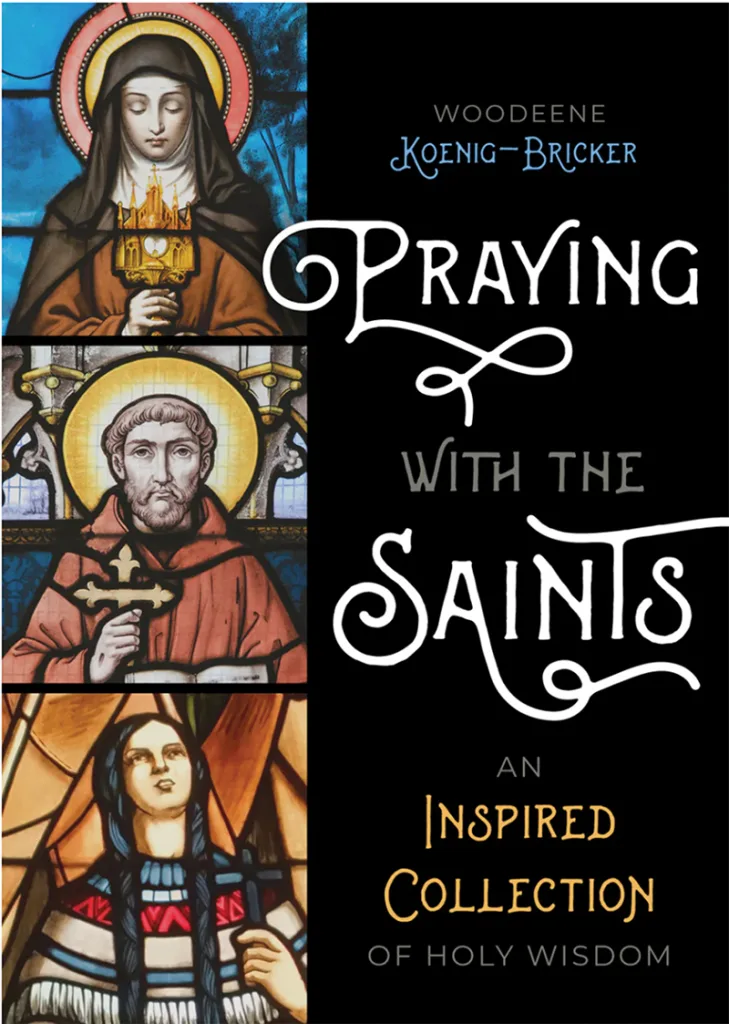
But that is the analogy used by author Woodeene Koenig-Bricker in discussing her book “Praying with the Saints.”
She drew the comparison between Beethoven and Jimmy Buffett. Two completely different styles of music, but she said that people might feel obligated to say that Beethoven is better if asked to compare the two.
But folks who aren’t into classical music may prefer Buffet’s style better. And that’s OK.
We are allowed to view saints in a similar way.
“Don’t feel like you need to love every saint in the book,” she said. “They are all different. We are all different. And just like you get to choose the musical genre that you like, you can choose the saints that you like, too.
“There are going to be some [saints] in there that you just like better than others,” the author continued. “It doesn’t mean they are better, but they resonate closer with you. And that’s why I wanted to have such a wide selection of saints.”
The book, which was released on Aug. 13, is an overhaul of Koenig-Bricker’s earlier book based on prayers she has collected for decades; she wanted to put them together to help people in their prayer journey.
“I think one of the real emphases was that we often find it difficult to pray,” she said. “We don’t feel confident in using our own words and sometimes, the formal prayers of the church just don’t express what we’re feeling.
“When I looked at the prayers that I’ve collected, I realized that the saints were facing so many of the same situations that we face and sometimes their words can help guide us into our own prayer.”
The main purpose of this edition, which features 100 saints that are either canonized or are currently going through the process, was to include modern saints, as well as add diversity.
“What I wanted to do in this updated version was include many more of the modern saints,” Koenig-Bricker said. “The earlier iterations focused on very traditional saints of the church. I wanted this to reflect modern times.
“Secondly, I wanted it to be much more diverse. When people thought about saints in the past, they tended to think of priests and nuns from the Middle Ages, as opposed to contemporary people.
“I wanted to make this up to date with very contemporary people and modern saints.”
One of the modern saints included is Carlo Acutis, who became the first millennial saint at his canonization in September.
Koenig-Bricker also wanted to include saints that represented the cultural, racial and gender diversity of the church. She included many women as well as laypeople, and people from every ethnicity and continent.
“I wanted this to have a broad vision of what the church is and of what sainthood is like,” she said.
Her personal favorites are prayers from Julian of Norwich and Gregory of Nazianus.
Julian’s prayer reads: “All shall be well, and all shall be well, and all manner of thing shall be well.”
It helps to bring her comfort.
“Julian of Norwich’s prayer is a wonderful mantra that is so suitable for so many times in our lives,” Koenig-Bricker said. “It’s a short, heartfelt prayer that affirms trust, but it’s also very comforting. It’s easy to remember and it’s very soothing for lots of situations.”
Gregory’s prayer focuses on the many challenges that we are all faced with, referred to as “dragons” in the prayer. She can relate to and empathize with Gregory.
“We face dragons every day,” she said. “All of us have our own individual dragons to face, whatever it is. I think this prayer gives us a chance to recognize that there’s a real commonality for us.”
Her two favorite saints, however, are different.
Nicholas Black Elk was born in present day Montana, which is where Koenig-Bricker grew up.
She also likes how he didn’t abandon his roots after becoming Catholic in 1904.
“Even after he converted to Catholicism, he never rejected the rituals and expressions of spirituality from his people,” Koenig-Bricker said. “He has a profound and deep respect for the creatures that live upon the earth, almost like one of the very first environmentalists.”
If canonized, Nicholas Black Elk will be the second Native American saint after Kateri Tekakwitha.
Her other favorite is Josephine Bakhita, who was captured as a slave in what is now Sudan and sold various times. One of those times was to an Italian who took her to Italy, where she was placed in the care of the Canossian Sisters in Venice.
But when he came to take her back, she refused and used the Italian court system to prove that she was a free woman and had the right to refuse her return to slavery.
“I love the idea that we don’t have to just simply accept whatever comes our way as being God’s will,” Koenig- Bricker said. “We can use our own mind and the laws of our land to create our own destiny. I love how she stood up to the system — and won.”
Koenig-Bricker hopes people who need encouragement in prayer, are interested in the saints and who want to explore some of the richness of the Catholic faith will read this book.
She hopes people take away from it that the saints might be more relevant to them than they might think.
“I hope what people take away from it is that saints have experienced everything that we have experienced, and their lives are not very different from ours,” she said. “They have the same joys and sorrows, struggles and issues that all of us have. We just need to realize that it doesn’t matter what your state in life is. We all encounter such commonalities.
“Hopefully, there’s at least one person in this book whose prayer resounds with you as a reader.”