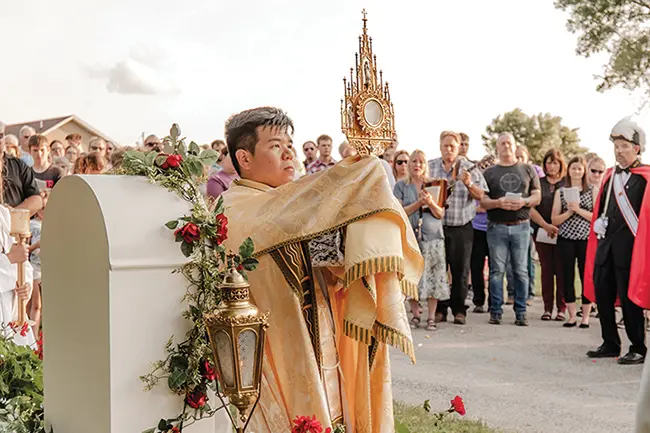
by Father Viet Nguyen
There is a lot of talk today about identity — identity politics, especially. Are you Republican or Democrat? Man or woman? Black or white? The trouble with framing identity that way is that it always turns into a competition: One side has to be better than the other. That was the struggle I carried with me growing up.
My parents are refugees from the Vietnam War who came to America in 1975. I was born in Kansas City, Missouri, on July 29, 1990. By ethnicity, I am Vietnamese. By nationality, I am American. I went to school at Curé of Ars in Leawood, but on the weekends my family crossed the state line to worship at Church of the Holy Martyrs, a Vietnamese Catholic parish.
In the 1990s, my family was among only a handful of Asian families at Curé of Ars, and I always felt like I was crossing a cultural border every single day. The question that followed me everywhere was simple but unrelenting: Am I American or am I Vietnamese?
At school, I noticed how different I was — the food I ate, the customs I kept, the household I came home to each afternoon. It wasn’t until I traveled to Vietnam for the first time in 2013 that I discovered just how American I actually was in the way I thought and the values I held.
For years, I felt split in two — Vietnamese on one side and American on the other — because I believed that whichever one I chose had to prove itself better than the other. Somewhere along the way, though, I began to understand what my parents had actually been trying to teach me all along: My true identity was never meant to rest in being Vietnamese or American, but in Christ. I was, before anything else, a beloved son of God.
Coming to that truth meant tearing down all the false identities I had spent years trying to build for myself — the belief that if I could just prove I was smart enough, athletic enough, successful enough, then I would finally know who I was.
Scripture tells us plainly what our identity really is: “See what love the Father has given us, that we should be called children of God; and so we are” (1 John 3:1). St. Paul says it even more directly: “There is neither Jew nor Greek, there is neither slave nor free, there is no male and female, for you are all one in Christ Jesus” (Gal. 3:28).
Our categories — the ones the world insists we rank and defend — dissolve in the light of that truth.
When I began to actually believe I was a beloved son of God, it stopped mattering whether I was smart or athletic, rich or poor, Vietnamese or American. None of those labels could be the foundation, because none of them could hold the weight. Only one identity is sturdy enough to withstand every comparison, every division, every question of “which one is better”: being a beloved child of God.
This is, I believe, an invitation for all of us. Culture, nationality and the countless categories our world uses to divide us are not evil in themselves — my Vietnamese heritage and my American upbringing are both gifts I’m grateful for. But they were never meant to be the foundation of who I am. Only Christ can hold that place.
When we root ourselves there, in the truth that we are beloved sons and daughters of God, every other identity finds its proper place — no longer competing, but woven together into the one life he has given us.