by Marc and Julie Anderson
mjanderson@theleaven.org
TOPEKA — An estimated $1.4 trillion.
That’s how much people around the world are expected to spend on gift cards this year with approximately $260 billion spent by Americans. Just this past holiday season alone, Americans spent an estimated $29 billion on gift cards.
But what happens when gift cards are used for ill gain as part of a scam involving the people we trust the most?
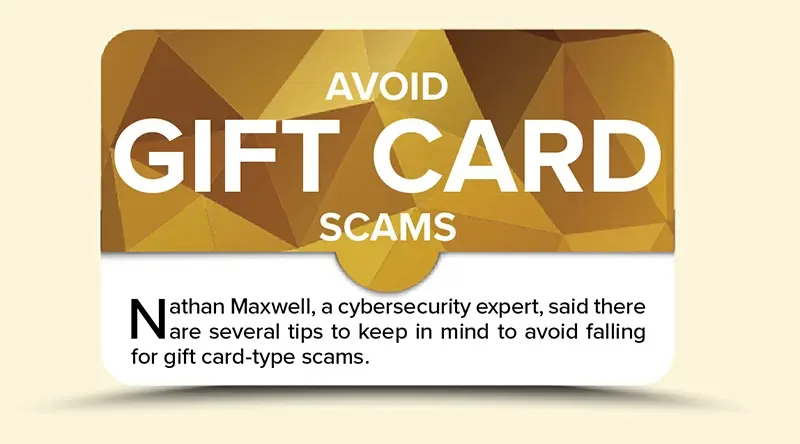
According to Nathan Maxwell, an expert for cybersecurity and network issues, every single archdiocesan parish has been affected by scams of all kinds, including one in particular which exploits the kindness of unsuspecting parishioners by impersonating priests, deacons or parish staff and using their positions to ask for gift cards, often claiming a need for immediate but discreet assistance.
Scammers tell people to put money on a specific gift card such as Apple, Target or Google Play. Then, they’ll ask for the gift card number and PIN on the back. And just like that, parishioners have been scammed out of their money.
Father Anthony Ouellette, pastor of Topeka’s Christ the King Parish, said he finds these types of scams particularly troubling, especially those impersonating priests.
“I just don’t want to see parishioners taken advantage of, either people pretending to be me or any other priest or any other relationship like this,” he said. Especially because the life of a parish depends very much on trust.
“The scam is attempting to exploit that trust,” he said. It can lead to spiritual harm if the parishioner unknowingly falls for the scam and never receives an expression of gratitude from the parish priest who has been impersonated, even though the priest had nothing to do with the scam nor had any knowledge it occurred in the first place.
Impersonating priests, Father Ouellette said, takes the scam to a whole new level and has left him both angry and frustrated.
“[Being a priest] is not a job. . . . There is a profound level of trust there,” he said. “We are invited into so many delicate, important and emotionally charged moments in people’s lives. And we have to navigate those moments so tenderly and carefully in order to care for those people. And someone wants to insert themselves in that and then take advantage and exploit that trust?”
Oftentimes, Father Ouellette explained, parishioners who unknowingly fall for the scam can feel embarrassed and angered by their experience so much so that they become suspicious of genuine and legitimate requests for help.
Father Brandon Farrar, pastor of St. John Paul II Parish in Olathe, agreed, saying that falling victim to a scam can lead to suspicion not only of priests, but of others, too.
“It creates a general suspicion of our fellow man and perhaps decreases the likelihood that help will be given when someone truly is in need,” he said.
On the flip side, though, Father Farrar said, if parishioners exercise caution when they get what appears to be an urgent request, it can lead to a thoughtful and heartfelt response.
“Charity depends on truth, be it in attending to someone who is starving, or addicted, or selfish, or unbelieving,” he said. “This means understanding the condition of the person and then serving them accordingly. It means a thoughtful response.”
But gift card scams discourage thoughtful responses, instead playing on fear and haste to trick the victim. But it doesn’t have to be that way.
Instead, if we take our time and “engage at a more thoughtful level, thinking through the email address and the request before replying,” Father Farrar said, “the scams can end up encouraging us to make a response of the heart and the head — whole person giving.”