by Jonathan Luxmoore
OSV News
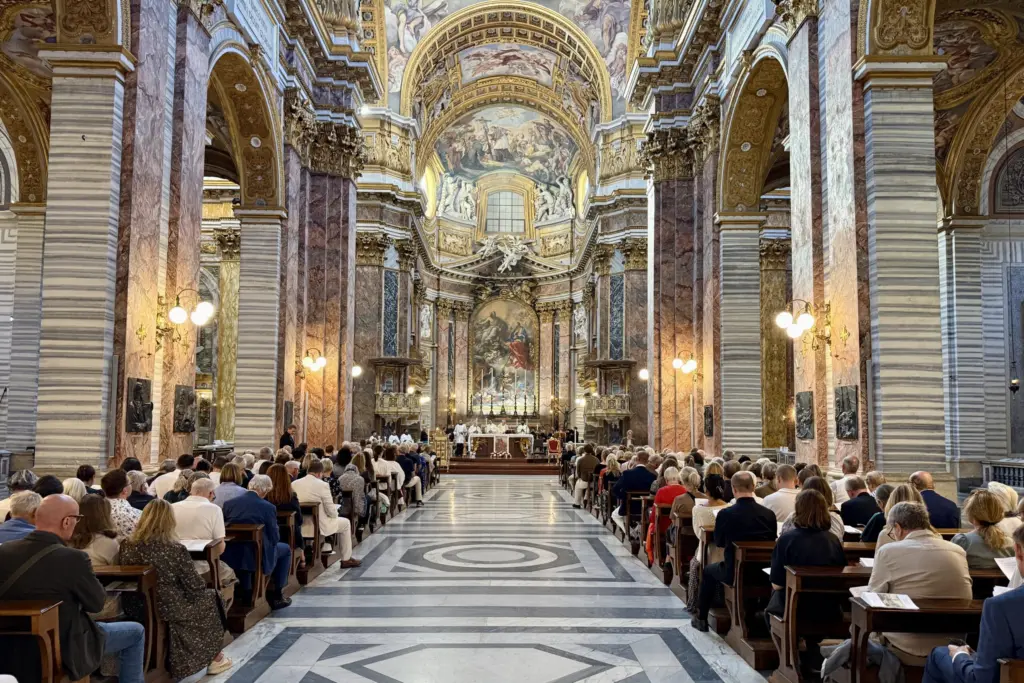
(OSV News) — As the northern winter approaches, Scandinavia’s Catholic Church is witnessing unprecedented growth, with more people turning to the faith in reaction to the region’s highly secularized culture.
“The Church is gaining strength thanks to an upsurge in Catholic conversions,” explained Ragnhild Aadland Høen, public affairs officer for Norway’s Council of Catholic Bishops.
“And where there was once anti-Catholic feeling, public prejudices are now much diminished. Young people are finding each other in parishes across the country, while others show a positive interest in ways we haven’t seen before,” she said.
The lay Catholic spoke as Bishop Fredrik Hansen of Oslo marked World Mission Sunday Oct. 18 by unveiling plans for his diocese’s first-ever synod on evangelical needs and challenges.
In an OSV News interview, Aadland Høen said many young people have discovered the faith after “terrifying experiences” of pagan and New Age practices, adding that Norway’s Church was now seeing a significant rise in confirmations and adult initiation courses.
Meanwhile, a prominent Danish Catholic told OSV News the country’s Church was also observing new signs of interest, but was also seeking to ensure converts properly understood Catholic teaching and were not merely making a “conservative, counter-cultural statement.”
“The growth isn’t as pronounced here as in Norway and Sweden,” said Nik Bredholt, parish council chairman at St. Ansgar’s Cathedral in Copenhagen.
“But many are discovering the Catholic Church via the internet and coming to our Masses in a genuine search for God. Something significant is clearly happening.”
Catholics suffered severe repression throughout post-Reformation Scandinavia, when predominant Lutheran churches gained official denomination status.
However, although Norway’s Constitution, amended in 2014, still declares the Lutheran Church to be “established,” it no longer requires government ministers to be practicing members and says other faith communities must be “supported on equal terms.”
Demands for similar modernizing reforms have been made where Lutheran state churches still hold sway.
With 406,000 members, including 419 priests and 349 nuns, according to 2025 data, the Catholic Church has seven dioceses in Denmark, Finland, Iceland, Norway and Sweden, representing around 2.9% of Scandinavia’s combined population of 28 million.
Its reported rapid growth over the past decade, however, is buoyed by an influx of Catholics from Poland and other countries, and a succession of high-profile converts.
Cardinal Lars Anders Arborelius, a Discalced Carmelite and former Lutheran who became Sweden’s first cardinal in 2017, was voted “Swede of the Year” in 2021 by the country’s Fokus magazine and widely tipped as a candidate for pope in 2025.
In 2023, Norway’s Catholic novelist and playwright Jon Fosse, another convert from Lutheranism, won the Nobel Prize for Literature.
In her OSV News interview, Aadland Høen said the high cultural status of “celebrity converts,” like Fosse, had made the Church visible and interesting, while Scandinavia’s many ancient pilgrimage sites had also acted as a magnet for “seekers of religious truth.”
“This is one of the world’s most secular regions, and many have tried out the predominant worldview and found it empty,” said the Catholic spokeswoman, who converted from Lutheranism in her early 30s.
“It’s obvious to everyone that Catholics are in the Church because they really believe something — if they were driven by social convention they wouldn’t be there. They’re witnessing to the Christian faith in a powerful way, and this really strikes and impresses people.”
While maintaining their own national councils, Scandinavia’s eight Catholic bishops belong to a single Nordic Bishops’ Conference, with a Copenhagen-based secretariat tasked with coordinating pastoral work through “joint deliberations and decisions.”
It’s been headed since 2024 by the Trappist monk, Bishop Erik Varden of Trondheim, another former Lutheran, who preached for the pope and Roman Curia at their February 2026 Lenten retreat.
Sister Anna Mirijam Kaschner, the Nordic conference’s veteran secretary-general, thinks Church leaders across Scandinavia have enough in common to function as a united entity.
At their fall plenary, the bishops appealed for greater support for the poor and homeless, as well as for Indigenous cultures, and urged Catholics to raise their voices against “rising populism” and the “hardening of public discourse.”
“Although we’re still a small presence here, we have the potential to keep growing — if we can retain those who’ve joined our Church and nurture their faith,” Sister Anna Mirijam, from the Missionary Sisters of the Precious Blood, told OSV News.
“The Church clearly offers a different set of values from those of today’s liberal, permissive society, and this is attracting people. With anti-Catholic feeling now largely consigned to the past, we’re also cooperating well with our Protestant neighbors. Incorporating so many different kinds of people, our Church looks set to play a special role in future.”
The Catholic Church also found an unexpected ally in its growth in Scandinavia.
In August, the latest of six medieval Catholic churches was unearthed close to a one-time Norse settlement in Greenland, a vast territory belonging to the Church’s Copenhagen Diocese, geographically the world’s largest. It covers the entire country of Denmark, as well as Greenland and the Faroe Islands
While such discoveries have highlighted the Catholic Church’s ancient roots here, they’ve also strengthened calls for Catholics to be accorded equal status with Lutherans.
Under a 2020 law, Norway’s Catholic Church is eligible with other faith communities for state support, and now receives some $26 million annually.
While this has supplied a welcome boost to the Church’s outreach, Aadland Høen said Norway’s Church leaders are also encouraging Catholics to donate more directly, fearing the Church could lose public funding in future over its canonical practices and moral teachings.
Yet with many people looking to the Catholic faith after bitter “liberal experiences” of sexual permissiveness and family breakdown, Aadland Høen points out, it’s also wrong to assume today’s Scandinavians are naturally liberal in outlook.
“Our countries share a common history and identity — we see ourselves as brother-nations, and the Catholic Church is providing an institutional framework for furthering these links,” said the Council of Catholic Bishops officer, who is the Norway bishops’ liaison with government and public officials.
“While each nation brings its own gifts to the Church, we understand each other’s languages and have much in common through our culture, including a direct contact with the beauty of God’s creation which is visible throughout Scandinavia.”
Besides the Oslo Diocese’s announcement of its first synod, Sweden’s Catholic Church marked Mission Sunday by introducing a new nationwide course on “what it means to become a Catholic,” while a joint Oct. 25 pastoral letter from the Nordic Bishops’ Conference will outline plans for synodal teams across Scandinavia to discuss an expansion of Catholic ministry.