by Moira Cullings
moira.cullings@theleaven.org
KANSAS CITY, Kan. — The Aug. 27 shooting during an all-school Mass at Annunciation Church in Minneapolis horrified Catholics across the country.
The following day, Archbishop Shawn McKnight called a meeting of his cabinet and Dr. Vince Cascone, superintendent of Catholic schools, to discuss school safety in the archdiocese.
“We want to assure [parents] that we are doing everything possible to assure the safety of the students in every one of our schools,” said Cascone.
Clear communication
This fall, the archdiocesan office of Catholic schools (OCS) sent a safety plan template to all 42 schools with protocols they should be considering.
OCS followed up with each school through a survey designed to accomplish two things.
“Number one, to see if there is anything we can do to support them in certain areas that they might need to address a little bit more thoroughly,” said Cascone.
“Two, to see if there is anything that we need to do diocesan-wide to better support our schools,” he continued.
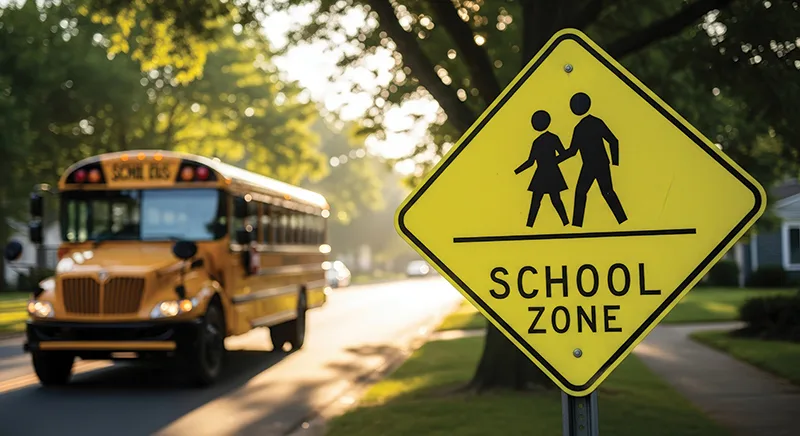
The survey covered topics like general preparedness, campus security, communication protocol, crisis response, partnership with local law enforcement and continuous improvement, said Dr. Lorenzo Rizzi, associate superintendent.
The survey also incorporated preventative aspects like anti-bullying efforts and school climate.
“There are certain aspects regarding safety and security that are universal,” said Cascone.
But one of the unique aspects of Catholic schools, he said, is that each one is different. No building, demographics, location or population is exactly the same as another.
As a result, OCS strives for uniformity across the archdiocese when possible, and tailors support for schools with outlying needs.
The information gathered from its survey will improve those efforts, said Cascone, and the office will reach out to schools individually and continue to address safety at its monthly principal deanery meetings.
High standards
Faith and mental health go hand-in-hand when it comes to crisis prevention efforts in the archdiocese.
School counselors and teachers utilize Openlight Media’s Education in Virtue program to foster social emotional learning by intertwining faith with mental health, said Rizzi.
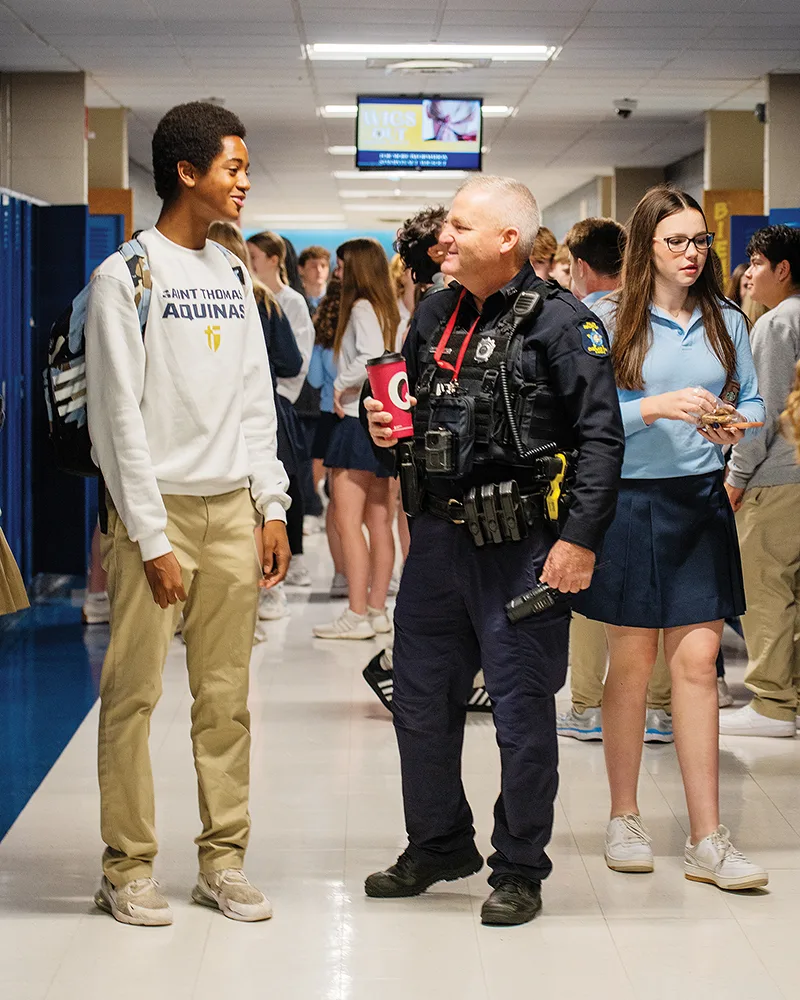
Brian Schenck, president of St. Thomas Aquinas High School in Overland Park, said Aquinas creates a sense of community that empowers students and staff to speak out.
“In schools, you must adopt a ‘See something, say something’ mentality,” said Schenck. “We have fostered a supportive environment where students can share such information.”
The majority of archdiocesan schools have a threat assessment team, which typically includes the principal, pastor or parish manager, a law enforcement officer and a faculty member, said Cascone.
“This gives an opportunity to have people with different skills and different perspectives to come together and look at the safety of the school,” he said.
The team evaluates security needs and responds to potential threats.
Its purpose is both preventative and reactionary, said Rizzi, which is crucial in today’s society, where people tend to be more alert than they were in the past.
“If something gets reported, then it’s not blown off,” said Rizzi. “It’s looked at very seriously, and then we get that person or people [involved] help.
“It makes our overall society safer, too, because we’re not just passing things along. We’re making sure we’re taking care of people.”
Local partnership
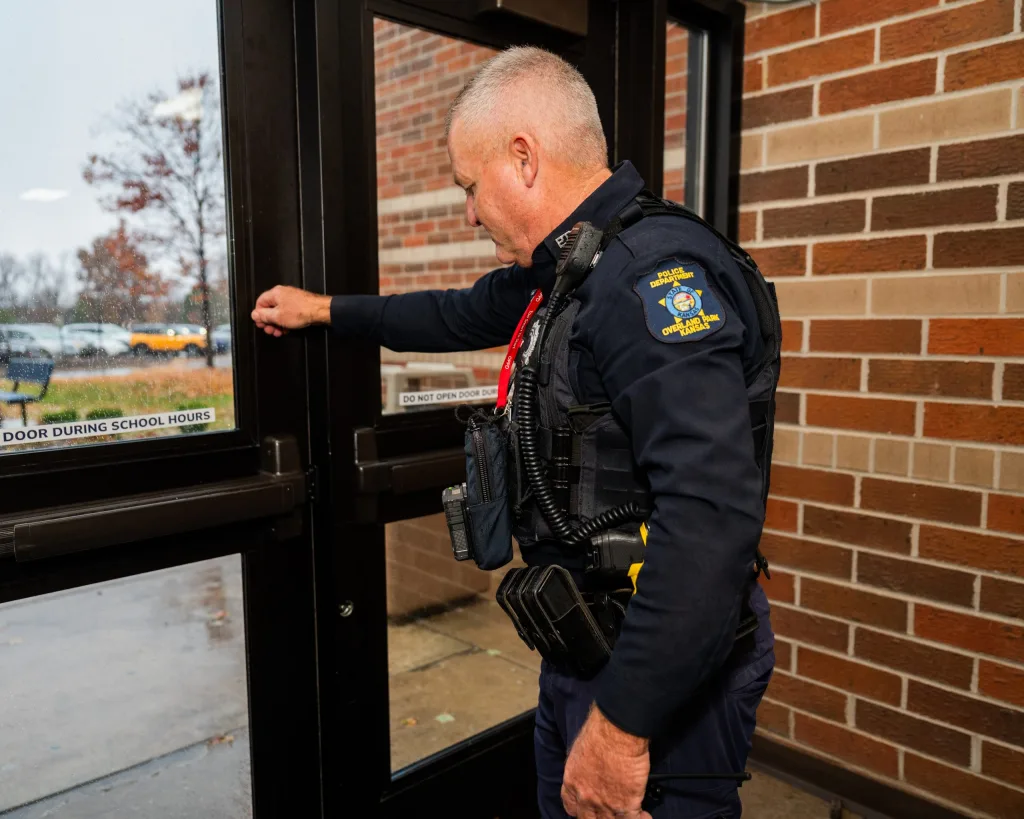
Archdiocesan schools are encouraged to seek support from local law enforcement when it comes to safety drills for emergencies like fires and intruders, as well as crisis prevention efforts.
At St. Joseph School in Shawnee, the Shawnee Police Department has been an invaluable resource, said Kelcey McCauley, principal.
“They did a full walk-through of our building and highlighted areas that we would need to strengthen and strategies and protocols for if the worst thing were to happen, such as an intruder,” said McCauley.
The small tweaks the department suggested have made everyone feel safer, she added.
Schenck said effective communication with students throughout preparedness efforts is key.
“Students need to know there is a plan for various situations, which actually reduces fear and gives the students a chance to put words into action,” he said.
Dads take action
Some tragedies prompt schools to think outside the box when it comes to safety.
After McCauley heard about Annunciation, she talked with St. Joseph pastor Father Scott Wallisch about getting the Dad’s Den involved in all-school Masses.
The Dad’s Den is a group of fathers of St. Joseph students who sign up to volunteer at the school.
Not every opportunity appeals to the dads, but when McCauley called on them to serve in a protective role for their children, they jumped at the chance.
The idea was cleared by the local police department, and now six dads are “on duty” before, during and after each Mass.
They walk the students from the school to the church and guard the perimeters around the building, communicating via walkie talkies.
“If we see someone that maybe is bringing attention to themselves in a negative way,” they’re the first line of defense, said McCauley.
An example happened when an upset parishioner showed up at Mass wanting to talk to a priest, and they diffused the situation before it escalated.
The dads also walk the children back to school after Mass and make sure everything is safe upon their return.
Their support at the church has been instrumental, said McCauley.
“They’re smiling and saying ‘hi’ to kids,” she said. “But their task is making sure that they’re seeing what’s going on outside the building and that everything is how it’s supposed to be.”
Heart for the mission
A capable, reliable and safe figure is critical in schools today. Thus, each archdiocesan high school has a school resource officer (SRO).
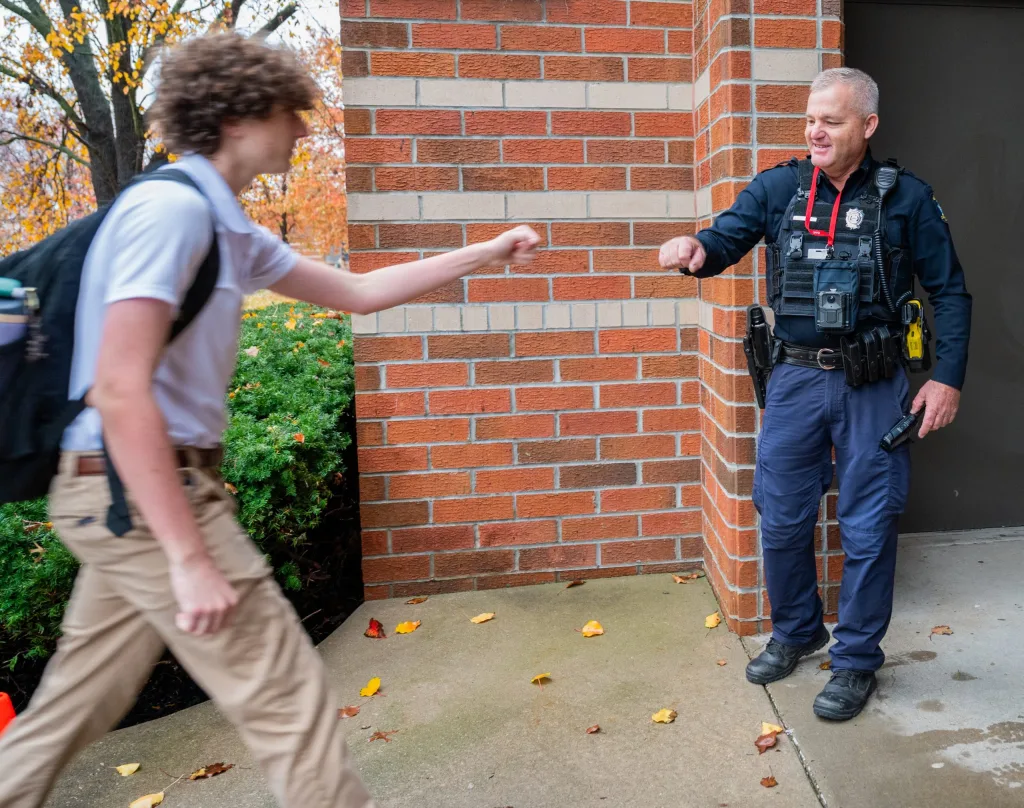
Officer Jeff Beatty at Aquinas said his role is threefold: a law enforcement officer, public safety educator and informal counselor/mentor.
His favorite part of the day is welcoming students as they arrive.
“Greeting the students with a ‘Good morning’ allows me to try and get the day started with a smile and build a little excitement for the day,” said Beatty.
“It also allows me the chance to try and read faces and identify students that might be struggling with something or having a bad day,” he added.
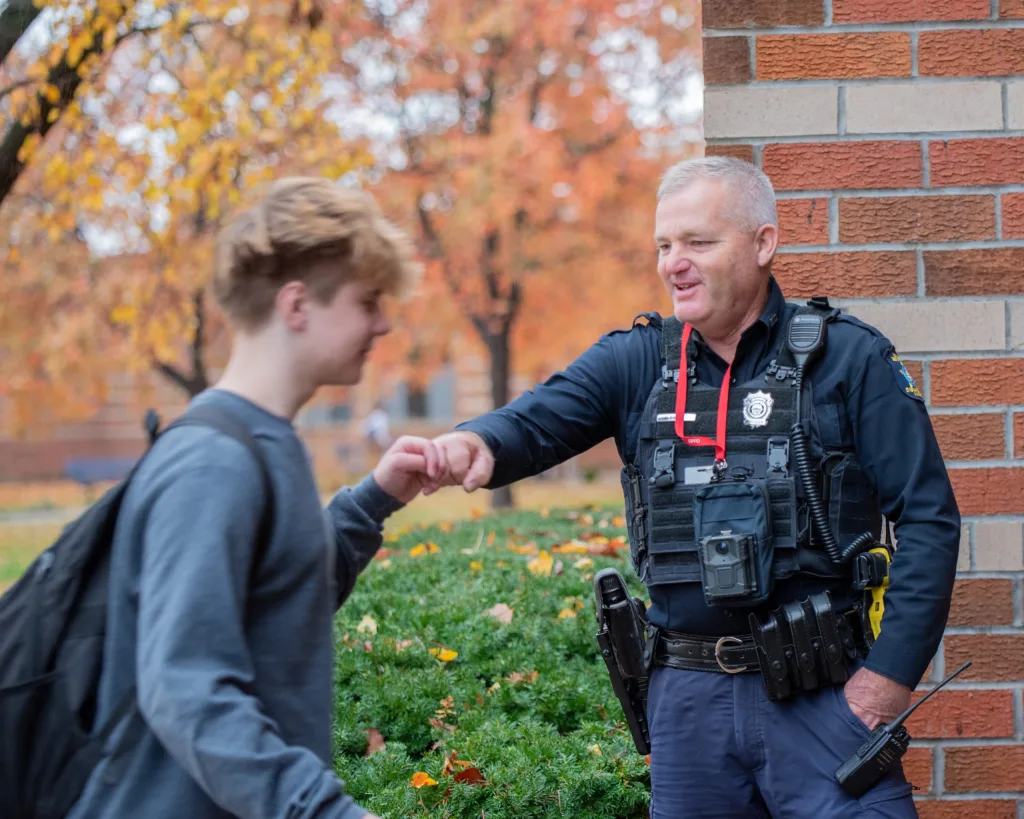
Once school has started, Beatty checks the perimeter of the building to ensure all doors are secure.
Throughout the day, he works on administrative tasks, monitors the lunchroom and continuously checks exterior doors. Sometimes, he’s invited to speak inside classrooms.
“I basically try to be visible around the school and assist however I can,” said Beatty, who believes the SRO position is highly important today.
“Having a uniformed officer on campus creates a visual deterrent, provides a sense of safety and allows for an immediate police response when necessary,” said Beatty.
“It offers an opportunity to connect with students and staff that would be impossible any other way to show a ‘human side’ to police officers and the law enforcement profession,” he added.
Schenck said creating a physically and mentally safe environment coincides with the mission of Catholic schools, which recognizes the God-given dignity of every human being.
“This strong connection within a community fosters a sense of safety and gives everyone a sense of ownership in protecting one another,” said Schenck.
“Our society needs more connection, not isolation,” he added. “The good news is that this is the strength of Catholic education.”