by Kimberley Heatherington
OSV News
EMMITSBURG, Md. (OSV News) — In a revolutionary year, the spirited celebration of America’s 250th anniversary throughout 2026, the national shrine dedicated to the first U.S.-born saint is aiming to help patriotic revelers discover the place of “Mother Seton” among the pantheon of iconic nation-builders.
On her Jan. 4 feast day — which this year coincided with the U.S. observance of the Feast of the Epiphany — The National Shrine of St. Elizabeth Ann Seton in Emmitsburg, Maryland, both closed a 50th anniversary commemoration of her canonization and launched a yearlong America250 initiative exploring her life in post-Revolutionary War America and the ongoing impact of the religious communities she founded.
“She’s born in 1774, which puts her inside the founding of the country,” Rob Judge, the Seton Shrine’s executive director, told OSV News.
Born into a prominent New York Episcopalian family, Elizabeth Ann Bayley married William Magee Seton in 1794. She lived the contented life of a wealthy socialite and mother for a few brief years, until the 1799 bankruptcy of her husband’s business and his 1803 death. She came into full communion with the Catholic Church in 1805 — and a courageous and pioneering life followed as Mother Seton founded the first U.S. community for religious women, the Sisters of Charity of St. Joseph’s, and planted the seeds of Catholic education in America.
“We’ve been doing research,” Judge said, “and we’ve discovered there’s over 20,000 religious sisters that stemmed from her congregations — over the next two centuries, they staffed hundreds of parish schools.”
“Her sisters founded some of the first hospitals; some of the first orphanages,” he added. “And literally — as the faith spread in this country — her sisters were there, teaching and taking care of the most vulnerable. So when we celebrate looking back 250 years of our country, it gives us here at the Seton Shrine the chance to really highlight her legacy.”
In addition to the shrine’s regular programming, special programming in the coming year includes a new exhibit, “Do the Good: The Sisters Who Shaped America” (opening March 19); America250 events and pilgrimages; the Saints on Their Way initiative, highlighting Americans on their way to canonization; and a Seton Shrine endowment opportunity.
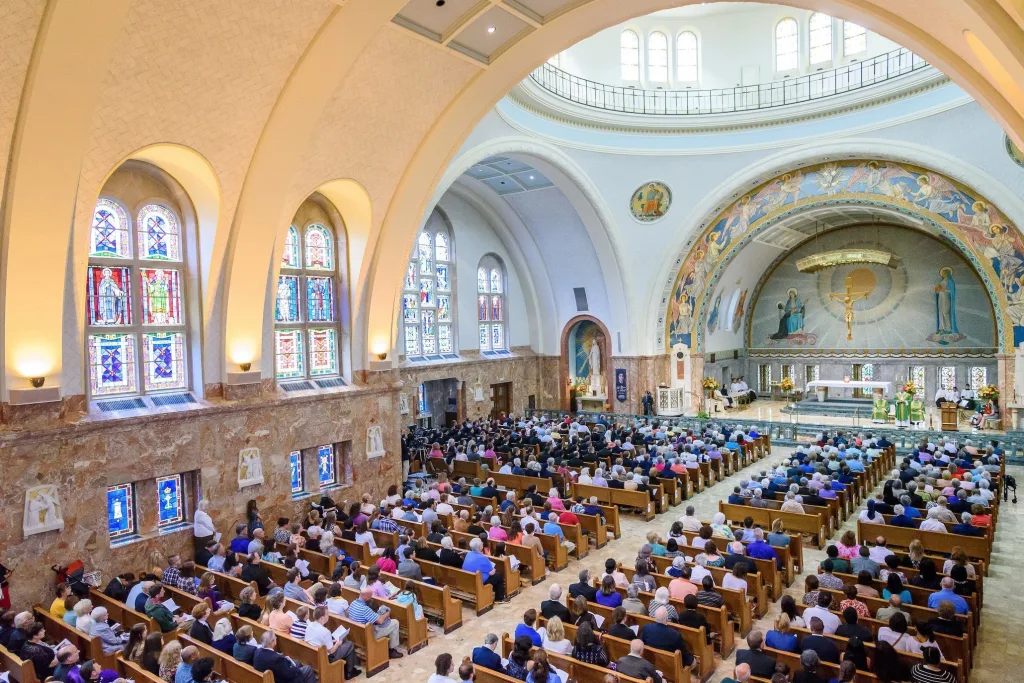
Massgoers at one of two Masses offered on Epiphany at the Seton Shrine were young, old, singles, families with children — a cross-section of American Catholic life.
In his homily, Father Harry Arnone, a Vincentian priest and chaplain to the shrine, linked the Epiphany narrative of the travelling Magi who followed the star to Bethlehem with St. Elizabeth Ann Seton’s own religious journey.
“The idea that God could appear in the simple elements of bread and wine really piqued her imagination — and that consecrated bread, the body and blood of our Lord Jesus, could be taken from the church and brought to the homes of those who were sick, had a powerful impact on her. And she discerned becoming Catholic,” Father Arnone said. “But it was a hard decision — and she often talked about following that star; that was the image that she clung to.”
“But guess what she discovered?” he asked. “She discovered — and this was her ‘aha!’ moment — the God that she expected to be experienced in churches and cathedrals could also be experienced in bread and wine, the elements” that become Jesus Christ in his body, blood, soul and divinity while retaining their outward appearances at the consecration of the Eucharist. “That the God that’s transcendent and all-powerful could also be experienced in the kindness of friends; people who show love and open their homes in a moment of grief and utter desolation.”
“She found it,” Father Arnone continued, “also in looking back at her family life. She found it in the lives of her children. She found it as she kept her home. And as she converted to Catholicism, she found it in the pews of the Catholic Church in New York City.”
Sister Teresa Daly, a member of the Daughters of Charity of St. Vincent de Paul, who offered a bright smile and ready answers to passersby from behind her visitor’s desk, said Father Arnone’s homily resonated with her.
“She was always seeking. Our museum talks about her as a seeker, a servant, and a saint,” reflected Sister Teresa.
About 70 sisters live at the Seton Shrine, many still working in active ministry while others devote themselves to intercessory prayer.
A small cluster of Missionaries of Charity nuns — St. Teresa of Kolkata’s order — in their striking blue and white sari habits, could be seen touring the state-of-the-art museum tracing Mother Seton’s life and legacy through artifacts and exhibits. Mother Teresa’s sisters stopped at the case holding Mother Seton’s bonnet and a shawl, a shared heritage of service bridging the distance of centuries between them.
Sept. 14, 2025, marked the 50th anniversary of the 1975 canonization of the Shrine’s namesake, when its campus hosted what was dubbed “A Day of Joy” as part of a three-day celebration attracting over 3,000 visitors. Prominent among the festivities was the “Saints on Their Way Village” where guests could discover the canonization causes of more than 20 of the 87 American (hopefully) saints-to-be.
“When we started planning for the 50th, we didn’t want to just have a party for Elizabeth Seton,” Judge explained. “We wanted to really push our mission forward. At the end of the day, a shrine’s mission is to help people encounter Our Lord in this life on their way to the next life, in eternity. And the saints give us examples of that … It’s the mission of her shrine to promote examples of holiness, so that hopefully pilgrims, as they come here, realize it’s not hyperbole — we can actually all become saints.”