by Therese Horvat
Special to The Leaven
PEOSTA, Iowa — While Catholic Cemeteries of Northeast Kansas has been a longtime sales agent for the caskets and urns made by Trappist monks, a recent trip to New Melleray Abbey here offered special insights into the spiritual significance of these handcrafted products.
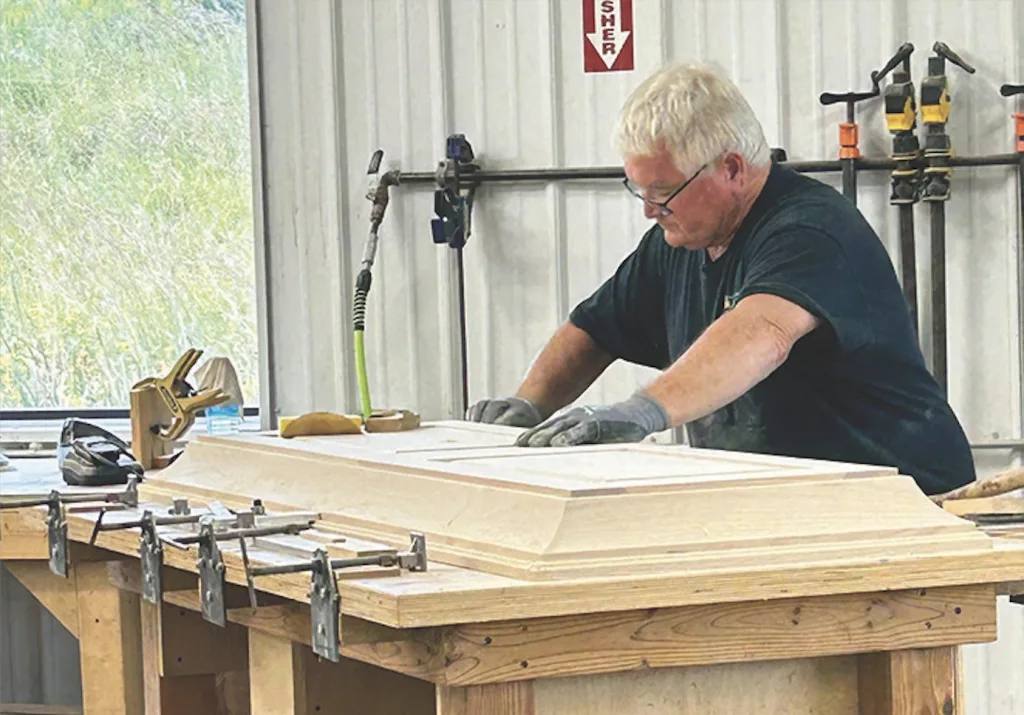
The simplicity and spiritual depth of the process impressed Bryan Alonzo, Catholic Cemeteries director of operations and sales. He explained that monks and lay employees make the caskets in the quiet reverence of a pristinely clean workshop flooded with natural light.
The caskets and urns are built from sustainable Midwestern hardwoods, including walnut and oak — some harvested directly from the monastery’s forest. The caskets come in different shapes, styles, colors and woods. Workers use machines for sawing and sanding with detailing and assembly done by hand.
Each casket bears one or more raised crosses on its cover and is blessed upon completion. For every casket sold, the monastery plants a memorial tree on its grounds, symbolic of new life in Christ. The monks also handwrite the names of those the caskets and urns are for in a book in their chapel and regularly pray for these persons.
Accompanying Alonzo on the Aug. 26 trip to the Iowa monastery were Sharon Vallejo, Catholic Cemeteries president, and four family service advisers: Jerri Adams, Stacy Branham, Jamie Hutchison and Teresa McGuire.
“We made the trip to strengthen our partnership with New Melleray and to witness firsthand the monks’ prayerful labor,” Vallejo said. “In addition to touring the facilities, we expanded our insights into the spirituality behind the caskets and urns, and the monastery’s commitment to ethical sourcing.”
Located in rural eastern Iowa, New Melleray’s history dates to 1849. The monks belong to the Order of Cistercians of the Strict Observance, known as Trappists. New Melleray Abbey launched Trappist Caskets in 1999, and shortly after, began selling caskets and urns. Trappist Caskets provides the monks’ principal work for self-support of the abbey.
“Trappist caskets and urns are more than products,” said Alonzo. “They’re a bridge between our earthly journey and eternal hope. In choosing a casket or urn, you’re supporting vowed religious who pray for the world, embrace simplicity amid consumerism, and affirm the body’s sacredness until the final resurrection. As we face loss, these caskets invite us to trust in Jesus’ promise: ‘I am the resurrection and the life’ (Jn 11:25).”
For more information about Trappist caskets and urns or about services of Catholic Cemeteries, call (913) 371-4040 (Kansas City area) or (785) 272-0820 (Topeka area); send an email to: information@cathcemks.org; or visit the website at: www.cathcemks.org.