by OSV News
WASHINGTON (OSV News) — The U.S. Supreme Court’s Roe ruling was a flawed “free-floating” decision, Justice Amy Coney Barrett said in discussing the legal reasoning behind her vote in the high court’s Dobbs ruling in 2022 overturning the 1973 decision that legalized abortion nationwide.
She called Roe “a free-floating, free-wheeling decision” that read a right to abortion into the Constitution, when nothing in the Constitution speaks to abortion or medical procedures, Barrett said.
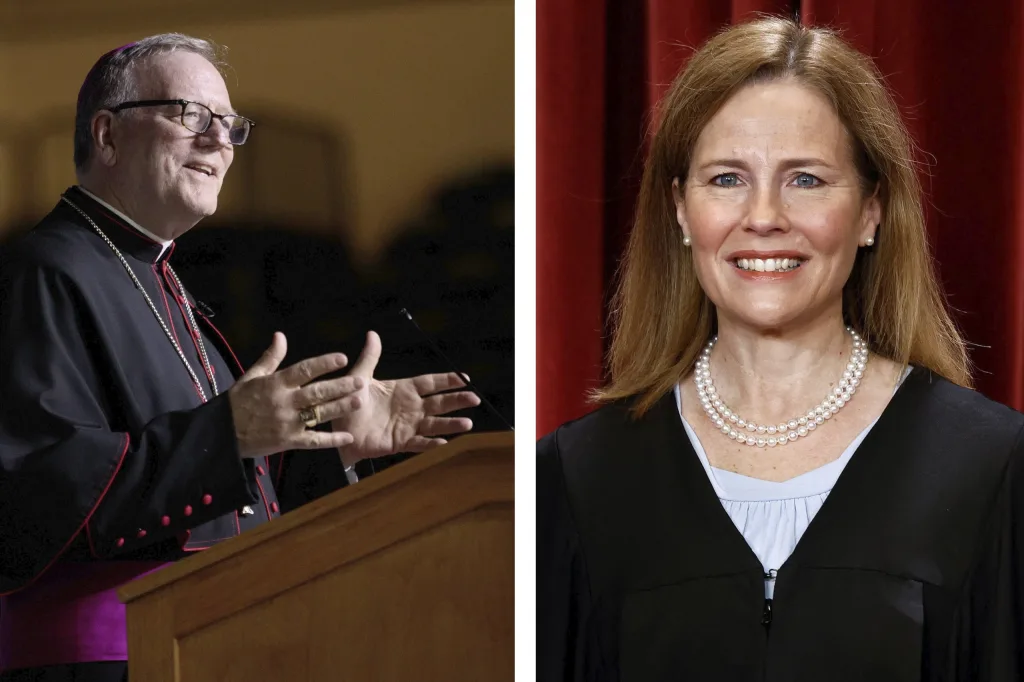
The Catholic justice made the comments in a nearly hourlong wide-ranging interview with Bishop Robert E. Barron of Winona-Rochester, Minnesota, for an episode of “Bishop Barron Presents,” released Dec. 21 on YouTube.
“Roe told Americans what they should agree to, rather than what they have already agreed to in the Constitution” through the democratic process, she told Bishop Barron, a longtime Catholic broadcaster who is founder of Word on Fire, a Catholic media organization that uses digital and traditional media to introduce Catholicism to the broader world.
Bishop Barron talked to Barrett at the court in Washington, with the interview prompted in part, the bishop said, by her book, “Listening to the Law: Reflections on the Court and Constitution,” published by Sentinel in September.
She said many made assumptions that she based her decision in Dobbs on her Catholic belief, but there were plenty of people, she said, who support a so-called right to abortion who, like her, recognized Roe was “ill-reasoned and inconsistent with the Constitution,” including the late Justice Ruth Bader Ginsburg, who “was “fiercely pro-choice.”
In its June 24, 2022, ruling in Dobbs v. Jackson Women’s Health Organization, the court upheld a Mississippi law banning abortion after 15 weeks in a 6-3 vote. It also voted 5-4 to overturn 1973’s Roe v. Wade ruling and 1992’s Casey v. Planned Parenthood ruling, which affirmed Roe.
“The best defense of Roe,” Barrett said — and what she called the “commonly thought” defense of Roe — was “that it was grounded in the word ‘liberty’ in the due process clause,” which states that “we protect life, liberty and property” and they can’t be taken away without due process of law.
But “that word ‘liberty’ can’t be an open vessel or an empty vessel in which judges can just read into it whatever rights they want,” the former law professor at the University of Notre Dame said, “because otherwise, we lose the democracy in our democratic society.”
She noted that parishioners at St. Catherine of Siena Parish in Metairie, near New Orleans, where her father, Bob, is a deacon, asked him to thank his daughter for Dobbs as if the decision had been rooted in her faith.
Barrett said her father, who is also a retired lawyer, would tell them, “You do realize that Amy did this because she thought it was consistent with what she thought the Constitution required?”
“There’s nothing I can do,” Barrett said, “other than to say, no, this was consistent with my view of the Constitution, with my understanding of how the doctrine of ‘stare decisis’ (respect for precedent) works.
“We generally let precedent stand unless we decide they were egregiously wrong and inconsistent with the Constitution,” she explained.
Barrett writes in her book that the “complicated moral debate” about abortion distinguishes it from other rights with broad support, including “the rights to marry, have sex, procreate, use contraception.”
The effect of decisions like Roe and Casey, she told Bishop Barron, is “to say that people can’t make decisions for themselves” about abortion “through the democratic process.”
Bishop Barron noted that the late Cardinal Francis E. George of Chicago, who was a mentor to him, used to complain about “judges having too much authority in our society and judges deciding these high moral matters.” He added that Cardinal George would say, “The nature of marriage is not a matter for courts to decide. It’s a matter of natural law,” a reference to the 2015 Obergefell v. Hodges decision, which legalized same-sex marriage.
“I think what Cardinal George was reacting to is the distinction between the approach to the Constitution that Dobbs took versus the approach that Roe took, which is putting decisions about what liberties are protected in the hands of judges rather than the democratic process,” Barrett said.
Talking about her Catholic upbringing in New Orleans, she said, “The first chapter books that I read were ‘The Chronicles of Narnia,'” the seven-book series by C.S. Lewis. “I just think those allegories give such good ways of thinking about faith and the kingdom of God, and then his more adult books, you know, I loved to read, too.”
Her favorite saint, she said, was St. Thérèse of Lisieux, after whom she named a daughter, usually called Tess, who is one of her seven children with her husband of 21 years, Jesse.
Known as “The Little Flower,” the French Carmelite nun died at just 24, but her “little way” of trust and love has made her one of the most beloved saints in modern Catholicism
“I was captivated when I was young with how young she was (15) when she just completely gave her life over to the Lord,” and joined the convent, Barrett said. “Her ‘little way’ is so accessible to so many,” she added.