
by John Sorce
john.sorce@theleaven.org
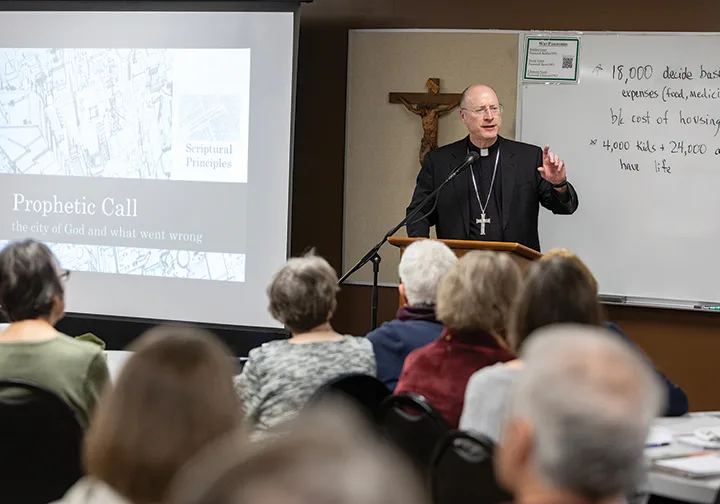
KANSAS CITY, Kan. — “To love God means you must love whomever God loves,” said Archbishop Shawn McKnight at the Rethinking Justice presentation at Savior Pastoral Center here the morning of Feb. 14.
“That is why the second commandment is like the first — to love your neighbor as yourself,” said the archbishop. “Because God loves everyone.”
The commandments are well-known to all Christians, particularly those first two.
Yet for some reason, we live in a world where poverty, doubt and injustice run rampant.
“Do we live in a world that God intended?” asked Ben MacConnell, Great Plains coordinator with the Direct Action & Research Training (DART) Center.

To be able to answer that question, he said we need to first take a step back and see what exactly the world as God intended it looks like.
We can find that answer, he continued, in Scripture.
What God intended
Much of what God intended for a just society can be traced back to the Book of Deuteronomy.
“When God chose the Jewish people and formed them into a nation, he wanted them to understand through Moses and the commandments what God’s vision for a just society would look like,” said Father Frank Coady of St. Thomas More Church in Manhattan and Central Kansas Justice Ministry.
“Israel was kind of God’s experiment in being one nation that could live justly,” he said.
God’s system of justice contains three basic systems: value shaping, economic and political.
All three are intended to work together to create a just society.
The value shaping system is the way that people learn the beliefs and values that society is built on.
Values are still taught today as they have been for centuries — through churches, synagogues and mosques. But there are also other ways now, such as through advertising, the internet and social media.
“Some are good, and some are not so good,” Father Coady said.

The political system was put in place to assure justice and serve people, while the economic system was intended to assure a fair distribution of God’s bounty.
That’s God’s bounty, not man’s.
“One of the temptations in human nature is to think we did this ourselves,” Father Coady said. “But the Bible is constantly reminding us that everything is a gift and belongs to God. Even we ourselves belong to God.
“This is not our wealth, but God’s. We are simply stewards of it.”
In God’s intentions for the world, poverty would never happen. All debts would be remitted every seven years, and immense wealth would never be able to be amassed (Dt 15:1-5).
“The economic system is designed by God to assure a fair distribution of God’s bounty,” Father Coady said. “The value shaping system is to bring us closer to God. The political system assures justice and serves people. And the prophets hold all these systems accountable to God’s intentions.
“This is God’s vision for a just society and what he plans for the human race and the world.”
The presentation featured a triangle pointing upward, which symbolizes a system that is supposed to lead believers closer to God.
Instead, humanity has turned that triangle upside down.
What went wrong
Fast forward 700 years to after the Israelites entered the Promised Land and were being preached to by the prophet Ezekiel.
The Rev. Tony Carter of Churches United for Justice explained how the people during that time turned that triangle upside down.
“The political system became a system of oppression,” he said. “The poor and needy are preyed upon. The rich get richer at the expense of the poor. The value shaping system became a system of control. God judges the politicians if you will, the princes of the city, who are bent on shedding blood. They’re like wolves carrying their prey. They chase down their victims, take the ones who are weak and devour them.
“They destroy lives to get dishonest gain. We see it every day.”
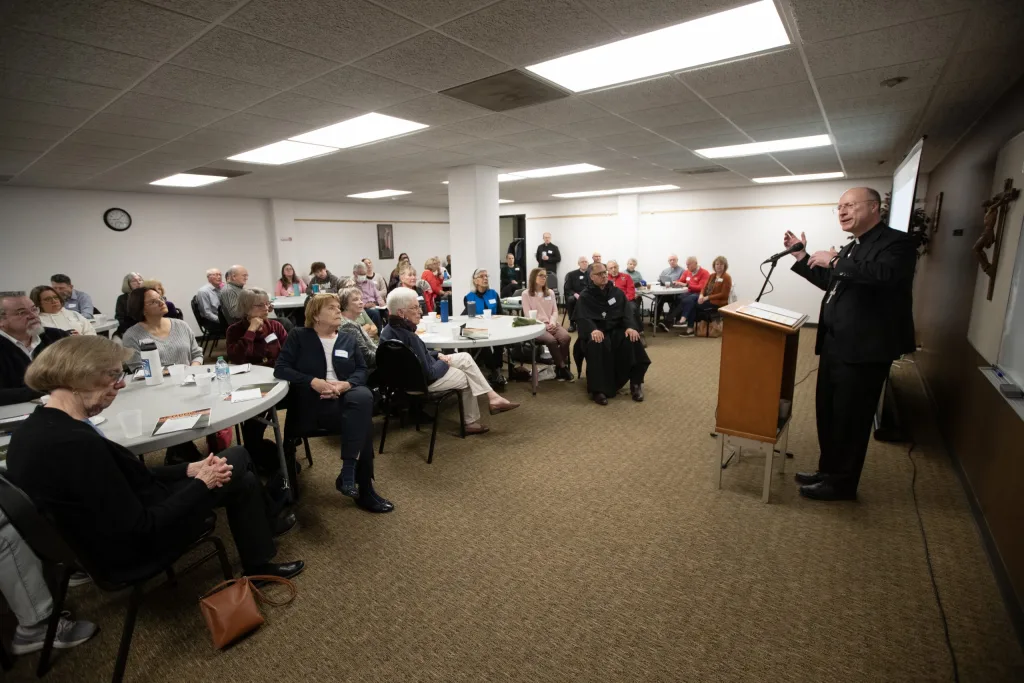
Much of what went wrong during Ezekiel’s time is still wrong today, hence the presentation’s title: People need to rethink how justice is being handled.
“We don’t treat each other humanely the way we should,” Carter said. “The value system has gotten out of whack. The political system has become a system of oppression. We use our authority to inflict harm and shed innocent blood.
“We got to get it fixed.”
According to the presentation, there are 18,000 people in Johnson County that are cost-burdened, needing to choose between basic things.
There are 4,000 kids and 24,000 adults in Douglas County who have experienced such traumatic childhood abuse that it is life-altering.
There are 2,000 homeless people in Wyandotte County.
“Read the book,” MacConnell said. “I’m talking about the Bible.
“This is not what God intended.”
What to do about it
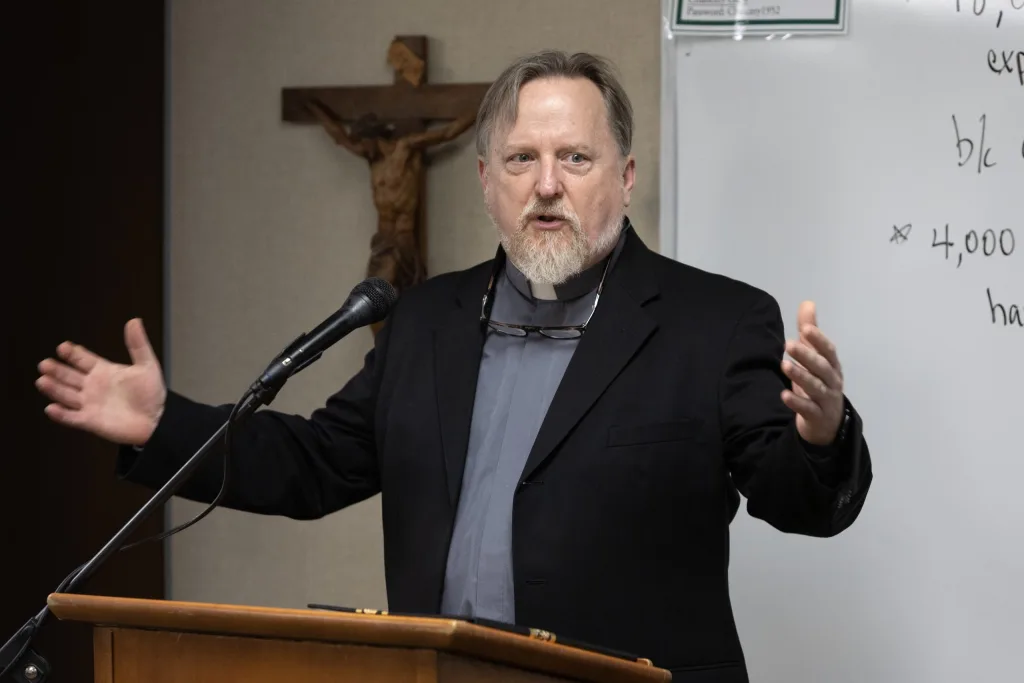
MacConnell drew a diagram on the whiteboard with three circles to showcase the areas within which we all operate on a daily basis: personal, voluntary, necessity.
The inner circle represented our personal lives, consisting of family and close friends.
The middle circle signified our voluntary activities, or things we choose to be a part of. This can be things like our church, neighborhood associations or service organizations.
We tend to have the capacity to handle these two circles, because we have a choice to leave if we don’t want to be there.
The outer circle, however, we don’t have a choice. These are our necessities. Showing up to work every day, obeying the law and paying our bills are things we have to do.
Jesus wants us to show the same love in all three areas.
“I feel like a speck of sand on a beach — powerless,” MacConnell said. “But the fact of the matter is your faith, God, is not so small that the only interest is your salvation and not the salvation of the world. Loving our neighbor as ourselves is supposed to be in all these arenas. That’s how powerful God is.
“The question is: How do you get the capacity to have your values injected out here in this outer arena?”
The answer usually lies in coming together to tackle the larger issues.
“We don’t have the capacity to act as individuals,” MacConnell said. “So, what we’ve got to do is organize. We need to pull congregations together, understand our common ground and marshal large numbers of people of faith in order to challenge any system that’s harming our neighbor or ourselves.”
Archbishop McKnight wants all Christians to keep the focus on the heart and the dignity of every human. That is the church’s top priority.
“In this effort of social justice, there’s a certain church way and political way of doing that,” the archbishop said. “This is not to minimize the political, which is necessary. But there’s an element that has not so much to do with what’s going on at the state Capitol or in Washington, D.C.
“It’s what’s going on in every heart, mind, home and local church. That’s what is really first and foremost for us.”





“We don’t have the capacity to act as individuals”. Goodness! When did Jesus, or His Church ever teach this? Ludicrous. This is the world speaking, not Jesus or His Church.