by Therese Horvat
Special to The Leaven
BASEHOR — When horses interact with heroes who are hurting, healing happens through the equine-assisted psychotherapy (EAP) program based in Leavenworth County.
People come to Horses & Heroes, Inc. (H&H), with different wounds. Most have post-traumatic stress disorder (PTSD), and many have experienced childhood trauma.
The primary audiences served by H&H are the military, first responders and their families. They receive eight hours of private therapy at no cost.
Julie Baker, H&H founder and executive director and member of Holy Angels Parish, Basehor, with her husband Rob, explains it this way.
“Our clients struggle with invisible wounds that negatively impact every aspect of their lives,” she said. “They feel broken, unworthy and a burden to their loved ones. Our aim is to help them understand that PTSD, like any other wound, can be mended.”
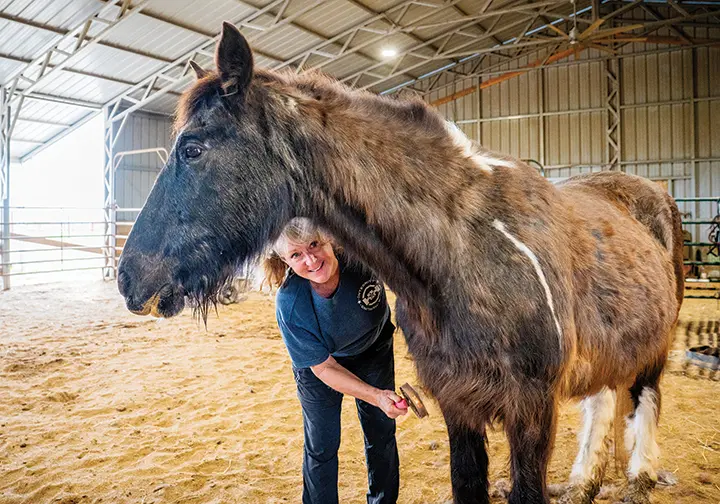
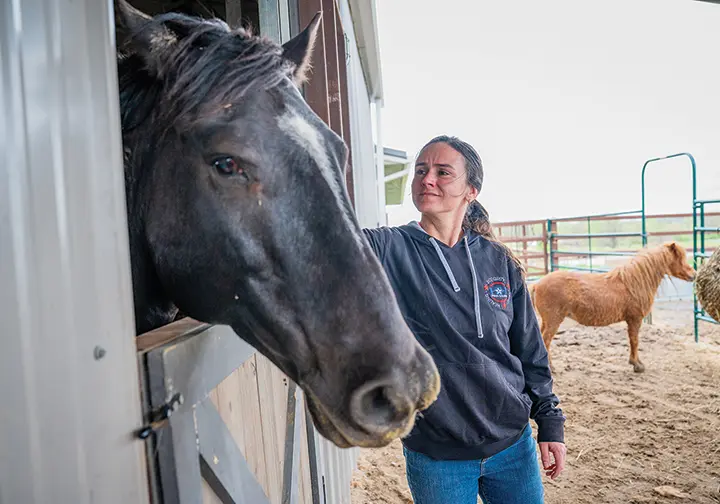
At H&H, clients don’t ride horses. They relate to them in calm, open spaces with certified equine specialists and licensed mental health clinicians observing and interjecting prompts and questions. H&H horses are donated or rescued; some have experienced trauma, abuse or neglect, or been headed for slaughter.
Horses hard-wired
Baker explains that horses’ nervous systems are hard-wired to notice subtle shifts in emotions, facial expressions, stress responses, and unspoken intentions and feelings. Without training, horses universally express behaviors and respond uniquely to each client.
During client sessions, horse behavior patterns emerge. Without providing an interpretation, the clinician asks the client about the observed behaviors.
“The opportunity for clients to interpret horse behaviors is fundamental to the root of their own struggles,” explained Baker. “Because questions are posed as horse-centered (and not about the person), clients unintentionally express insights into their own relationships, experiences or false narratives that may keep them locked in a cycle of destructive behaviors, self-doubt, harmful addictions, or suicidal ideations.”
Toward improved mental health
In this emotionally safe environment, clients can examine relationships, reactions and patterns emerging. Equine specialists and clinicians present ideas clients may not have considered. This process leads toward the development of new connections to neural pathways in the brain and the beginnings of new thoughts, beliefs and healthier attitudes.
“The integrated therapies H&H offers,” said Baker, “touch the parts of clients’ nervous systems that foster safety, trust and true healing.”
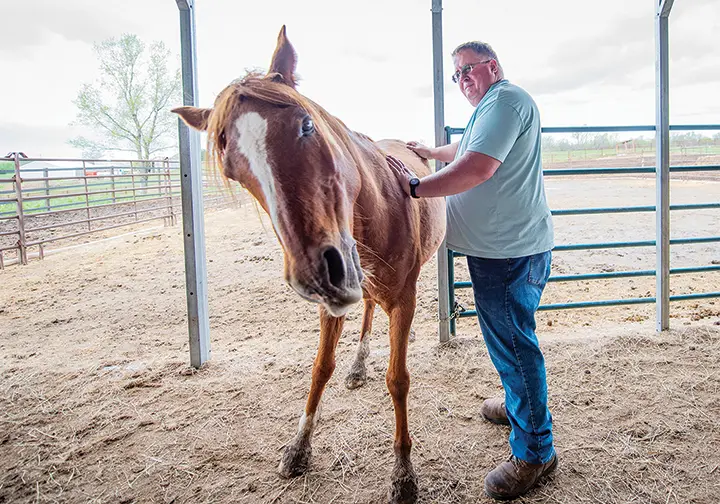
Therapeutic massage and other modalities for pain and stress relief are also available.
H&H also offers fee-based services for the public and skill-building topics for groups.
As a non-profit organization, H&H relies on fees, donations and grants for operations. During May’s Mental Health Awareness Month observance, H&H is a partner in and beneficiary of the national Horses for Mental Health fundraising campaign. Visit: https://horsesformentalhealth.org/campaigns/horses-heroes-inc/# to donate to H&H.
Clients attest to benefits of equine-assisted therapy
by Therese Horvat
Special to The Leaven
Julie Baker, H&H founder and executive director, believes clients have their own answers to issues they are facing. The horse/client interaction draws out both issues and answers as borne out by the law enforcement officer and three veterans whose stories follow.
Billy D.
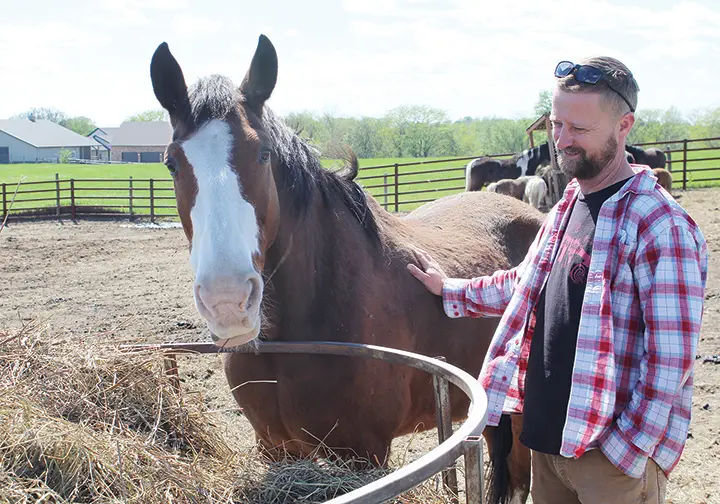
When Billy D., a law enforcement officer, first visited H&H with his agency’s peer support team, he had few expectations. He subsequently became a proponent of equine-assisted therapy.
During his initial visit, a small, ornery horse gravitated toward him. Billy didn’t know the horse’s story but when asked to name her, he called the mare “Survivor.” He sensed that she’d been through a lot — just as he had been. Upon learning the horse had been spared from slaughter, Billy welled up with emotion.
During an obstacle course exercise, the horse resisted participation, and a tug-of-war ensued. At the equine specialist’s suggestion, instead of pulling the lead rope, Billy talked to the horse. “Survivor” proceeded to walk with him, and they completed the course together.
“In the tug-of-wars of life,” said Billy, “I would plow my way through and meet resistance with force. My experience with this horse helped change me.”
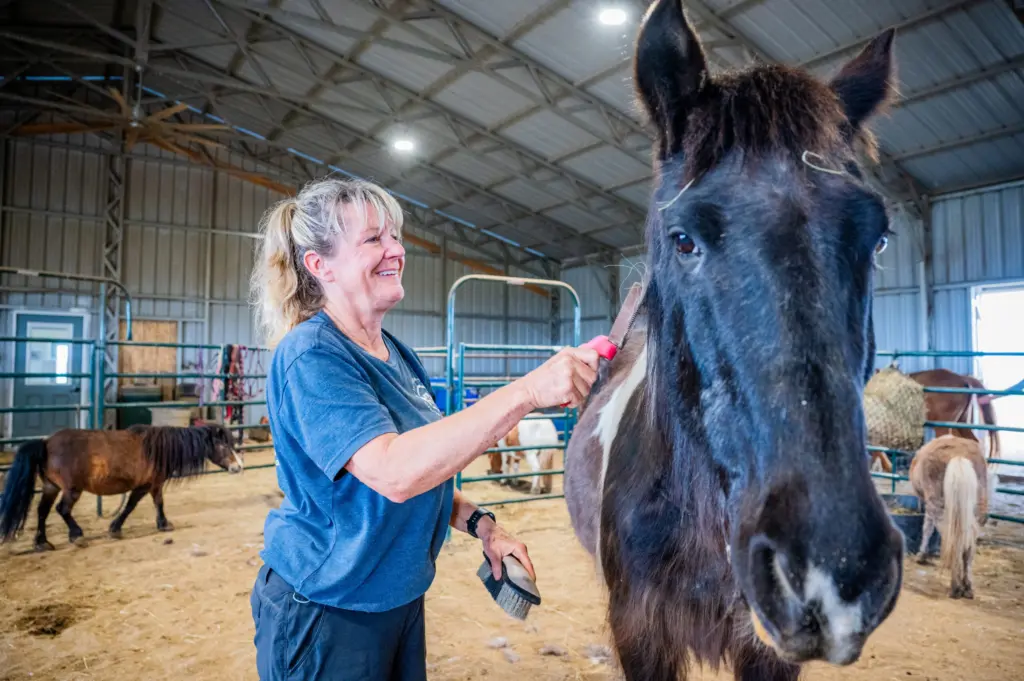
As an H&H client, Billy came to realize that the horrific incidents he’s encountered in law enforcement compounded the childhood trauma he experienced and suppressed. As a kid, Billy felt that he didn’t fit in; he faced negativity and abuse. In law enforcement, he thought he was going to stop all bad things from happening.
At H&H, Billy identified as part of the herd. He learned to accept that not everything’s going to be great and that he can help people to the extent he is able.
After a homicide or a shooting, or a conflict with an officer, Billy now steps back to assess and discuss the situation. He’s become more of an open book and grown comfortable explaining his feelings rather than suppressing them or lashing out. He believes that equine-assisted therapy changed him for the better.
Ted J.
The recent war with Iran brings back painful memories for Ted J., Marine Corps veteran who served in the first Gulf War as an avionics technician.
Ted had the added assignment of morgue detail — retrieval of bodies of fellow troops killed in battle. Thankfully, duty didn’t call. However, during training, Ted saw bodies of dead Iraqis.
“This horrified me,” he recalled. “I thought, ‘This is real.’ Before, it was like playing a game at being a Marine.”
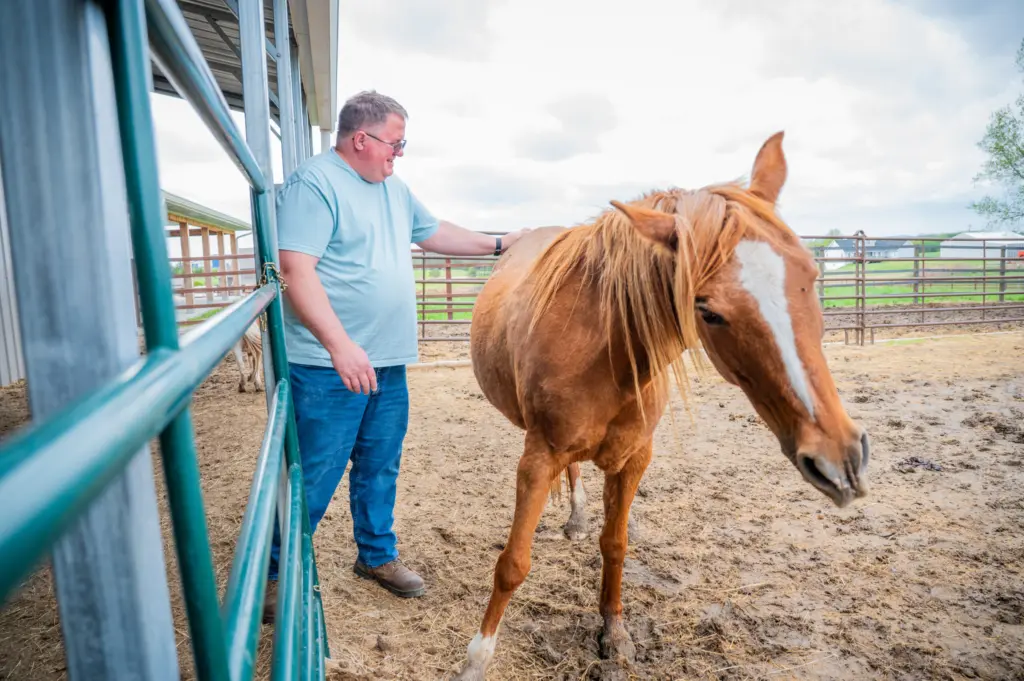
Ted left the military with PTSD. From 1992 to 2011, he had difficulties holding down a regular job. He was wrecked emotionally and became homeless. He participated in a Veterans Administration (VA) rehab program and eventually received a 100% disability rating.
Through H&H’s equine-assisted therapy, Ted came to realize that he needed community — including the herd of horses — to help him understand himself. Ted learned to allow himself to be vulnerable, to be present and to not try to control everything. He’s more resilient.
While he finds the horrors of today’s war with Iran distressing, they are not debilitating for him.
“I’m able to handle stresses better,” he said.
Ted’s also learned from H&H horses that trauma is not the end of the story. There’s still a good life to be lived.
Jason J.
Jason J. lived in denial of PTSD for 15 years. He was deployed by the Army to Iraq in 2003. Detonation of an improvised explosive device resulted in the death of his best friend and two other troops. Jason sustained shrapnel injuries.
In civilian life, his wife and kids tried to convince him that he was experiencing PTSD, but Jason had built a wall around himself. He thought PTSD would cause people to look at him differently. He refrained from showing his emotions.
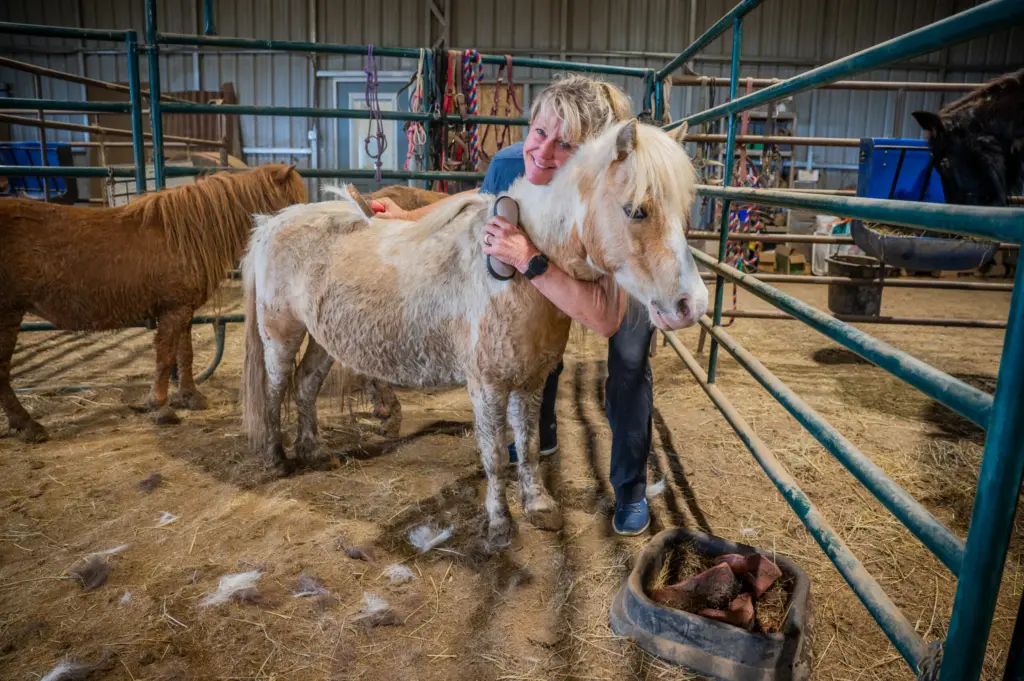
Jason entered talk therapy through the VA system, but that didn’t work for him. After hearing about H&H from friends, his wife told him about the program.
Unfamiliar with horses, Jason’s first visit to H&H was intimidating. The largest horse in the herd approached him. That same horse struck the unusual pose of standing on three legs. Jason associated this with the fact that his war wounds included shrapnel in his left leg.
“Horses can’t talk,” he observed, “but they can communicate, reading what’s going on with a person.”
In another session, Jason assigned significance to a backpack as representative of his past. He placed it on the barn floor with no horses in sight.
When the horses entered the barn, they began stomping on the backpack. Jason interpreted this as encouragement for him to let go of his past. When one horse approached and nuzzled him, Jason petted the animal, and his tears fell freely. Mission accomplished, the horse fell asleep.
“I felt like a different person when I completed the program at H&H,” Jason said. His family relationships and communication skills have improved.
“I would recommend H&H to anyone,” he said.
KC
KC describes his entire life as one trauma after another. He spent 11 years in foster care. Aging out of that system, he was temporarily homeless. He was in two marriages that didn’t work but that gave him two sons.
In the Navy for 20 years, his job was to keep weapon systems in top-notch condition. He also participated in operations that confiscated illegal drugs. During his Navy career, KC was in over 50 countries across five continents.
Yet, he remained haunted by the foster kid who never had a real home or a network of people to support him.
Attempting to save his second marriage, KC and his wife enrolled in a couples’ program hosted by H&H. The marriage failed, but KC gained a valuable mental health resource.
Through H&H, he learned to give himself permission to be what he calls “the horse in my life.” He explains that as herd animals, horses walk toward things that feel good and away from the bad. They’ve taught KC to walk toward the good in life.
“I’ll always be that foster kid, but I’m no longer embarrassed or ashamed,” he said.
One of the things hurting KC was his silence. The horses provided him with a buffer to express himself more openly and helped KC save himself.
For more information or to make a donation, go to: www.horsesandheroes.org or call (913) 210-5678.
H&H backstory
Three occurrences in Julie Baker’s life influenced the development of H&H. At age 12, she earned the trust of her first rescue horse. Later, she spent 14 years as a military spouse in a marriage that ended in divorce. In 2010, her stepmother took her own life.
A convert to Catholicism and remarried, Baker directed her thoughts and prayers toward determining a way to link rescue horses, needs of military families and mental health services. Her “God moment” came in October 2013 when she discovered a website about equine-assisted therapy with a tie-in to the military. Horses & Heroes sprung from that moment.
Incorporated as a non-profit in 2014, H&H saw its first clients in 2015. The organization operated on leased land until the 2023 purchase of acreage in Leavenworth County and the addition of a large barn and office space.