
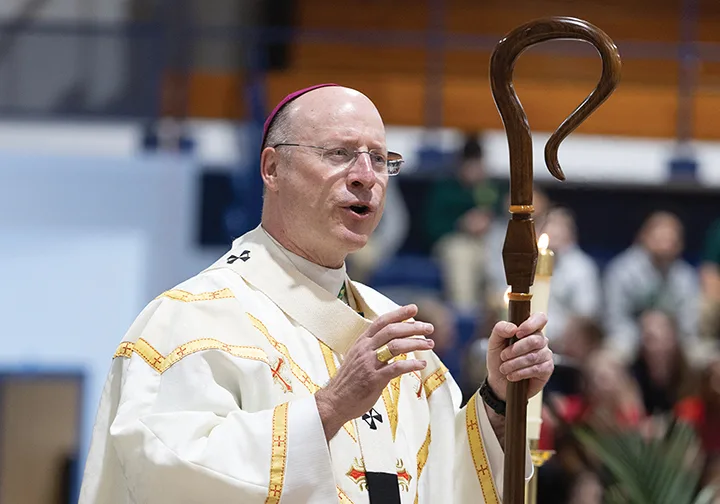
by Archbishop Shawn McKnight
Growing up, my family was very active in the Catholic Church. We went to Mass every Sunday, and I was in Catholic education most of my life, but the idea of being a priest never dawned on me. I was not one of those kids who knew from an early age that he was called to serve as a priest. I was planning on marriage, having a family, and becoming a doctor. That plan carried me to the University of Dallas, where, at the end of my pre-med curriculum, quite suddenly and out of nowhere, I got the call, not through some mystical vision, but in the mail following an extraordinary retreat.
When I received my MCAT scores, I had exceeded what I needed for medical school, and I didn’t feel happy. That was the moment I realized something deeper was at work. If I have one complaint, it’s that the Lord waited until then to call me to a vocation in the priesthood — it would have saved me a lot of grueling studies in physical chemistry if he had called me sooner!
At the time, I was a biochemistry major who was too introverted to even read at Mass, for heaven’s sake. I told myself, “If you are going to be a priest you should at least try lectoring.” During my debut at the ambo in the University’s Chapel of the Incarnation, I was so nervous I felt sick. With some of my professors and fellow students present, I feared making a mistake. I remember thinking, “How am I ever going to do this?” Well, God provides.
One evening before a Saturday Vigil Mass, while all this was swirling in my head, I watched lay volunteers setting up the altar while the musicians and choir practiced, and it struck me: I could devote myself to serving people like this — people committed to the faith and to the church.
Raised at St. Francis of Assisi Parish in Wichita, I saw firsthand the power of Msgr. Tom McGread’s “Stewardship Way of Life.” By applying Vatican II teachings in real time, he invited the laity to use their unique charisms for the mission of the church. It was apparent to me, even in my youth, that the more he entrusted people with genuine responsibility, the more they felt inspired to step up and follow his lead.
The role of bishops and priests is to ensure that the church instituted by Christ remains unified and faithful to apostolic tradition, but this unity requires working in concert with the laity. Because the church is the structured Body of Christ, our unity requires authority — authority that is meant to serve, not dominate. This creates a culture of co-responsibility where clergy and laity respect each other’s distinct but complementary roles. While bishops are called to deeply understand the needs of their people, the laity have the right and duty to speak up with courage, prudence, and respect. When both groups collaborate in this way, the church is alive and flourishing.
This is the purpose of synodality: It is not the capitulation of the clergy to allow everything by vote, but co-responsibility defined as mutual respect for our differing roles in the church. It’s about listening in order to grow in the way we function as the church. This is the dream and the vision — to take delight in one another’s vocation!
I am deeply grateful to everyone who participated in the Beatitudes from the Heartland series and the Listening from the Heart sessions. In June, we will launch an archdiocesan-wide survey. I strongly encourage you to participate. Your feedback, along with the anonymous input from our listening sessions, will be compiled by the Pastoral and Presbyteral Councils to shape our Renewal from the Heartland pastoral planning process. Once the data is compiled, we will share the survey results and general feedback publicly with the community. This initial phase of implementing a more synodal church will help us set the spiritual direction and mission-driven goals of our parishes, discerning what God is calling us to do. We will then embark on a pastoral plan to bring those goals to life. Developing the practice of synodal discernment and strategic planning will ensure we listen to the Holy Spirit as we serve our communities with aligned goals and responsible stewardship.
Based on pastor feedback collected from a Chancery Discernment Survey done earlier this year, as well as input from the Presbyteral Council, it became abundantly clear that a shift was needed in the structure of the chancery to prioritize service over programming. Rather than offering existing initiatives to be implemented by each parish, our new Parish Evangelization Services (PES) will partner and collaborate with parishes and deaneries to shift from a “top-down” model to a supportive framework that exists to increase the capacity and strength of our parishes, schools, and ministries.
PES encompasses the ministries of Charity and Mercy, which include outreach to the deaf and special needs communities, underserved populations, and Prison Ministry; Evangelization and Catholic Formation for Adult and Children’s Catechesis; Human Dignity supporting the Pro-Life, Social Justice, Foster Care, and Project Rachel/Gabriel Project initiatives; Liturgical and Sacramental Life; and Marriage and Family Life. To better serve our archdiocese’s diverse ethnic community, we have transitioned from a standalone Hispanic Ministry to an integrated model, embedding multilingual services across all chancery departments.
Having a service model for our chancery allows us to put more of our resources, personnel and otherwise, into administrative services that our parishes need. We are presently planning ways in which we can increase our capacity to help with accounting, human resources, and parish communications.
While these changes were not driven by financial hardship, they reflect the archdiocese’s responsibility to steward wisely the resources entrusted to the church and ensure they are effectively directed towards the mission of proclaiming the Gospel.
Our ultimate goal is to empower every parish to be more than a place for weekly worship; it must be a sanctuary of mercy and a center of charity. We want all of our parishes to be places where love meets action in meaningful ways for all who seek the Lord. By integrating your voices, we move forward together in this vital renewal!


Very,very well said and encouraging. I look forward to information as to your plans for the Office of Protection and Care and it’s sources for community/parish support. Thank you and God bless