
by Olivia Martin-Davies
olivia.martin@theleaven.org
KANSAS CITY, Kan. — On March 19, Governor Laura Kelly signed a bipartisan bill that restricts student cell phone access during the school day.
Called a “bell-to-bell” ban, the legislation mandates that all public school districts and accredited nonpublic schools set policies that limit student access to personal phones, smart watches, tablets, headphones and computers during school.
Taking a page from ‘The Anxious Generation’
The ban follows in the wake of groundbreaking research on social media’s adverse impact on children outlined in psychologist Jonathan Haidt’s 2024 bestseller “The Anxious Generation.”
According to Haidt, there is a direct causation — not just correlation — between social media use and mental illness in teens.
Haidt argues that several societal shifts that started around 2010 and continue today correspond with a steep, consistent surge in major depression, anxiety, self-harm and suicide in young people.
These include smartphones with front-facing cameras; Facebook introducing the “Like” button; and widespread teen smartphone ownership among teens and children.
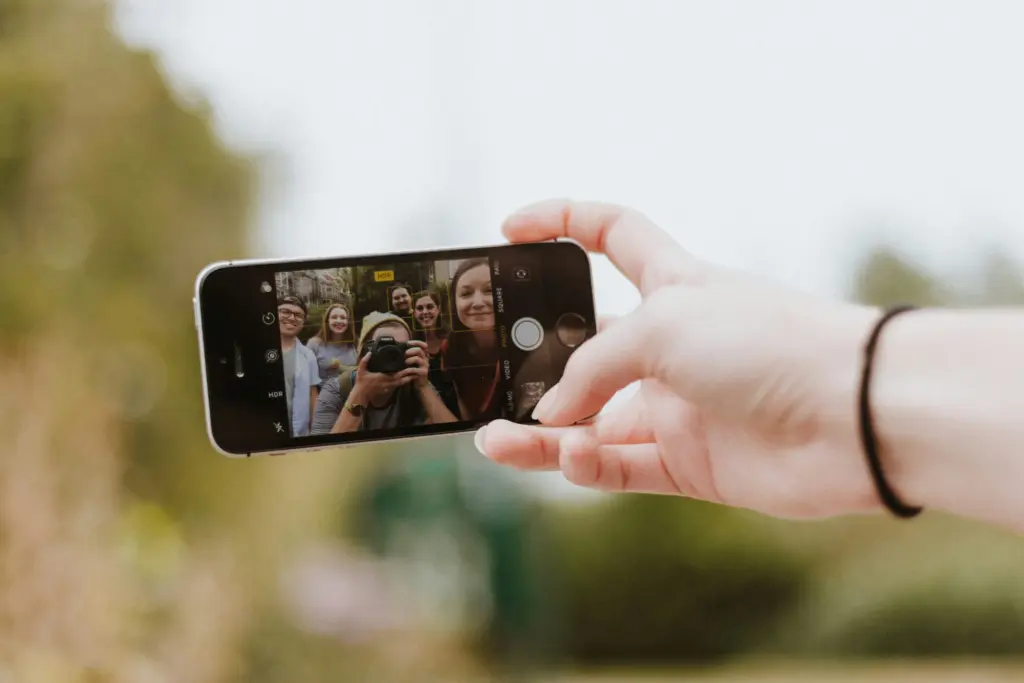
Haidt cites that from 2010 to 2021, the percentage of teens who had experienced a major depressive episode increased 150% and is still increasing.
“All of us are vulnerable to the psychological need to belong and to be invited and to be included and be a part of,” said Shane Rapp, principal of St. James Academy in Lenexa.
“And social media companies are very aware of that and have intentionally exploited that vulnerability, as they would describe it, in order to get people to use their products and then sell access to us to advertisers,” he said.
The amount of access social media companies have to young people is becoming more comprehensive each year.
By 2022, Pew Research reported that 46% of teens reported that they were online almost constantly, whether on social media or other screen-based entertainment. In their study, “online almost constantly” meant around or above 7 hours a day.
The implications have serious effects on young people’s education.
“The average number of notifications on young people’s phones from the top social and communication apps amounts to 192 alerts per day, according to one study,” wrote Haidt.
That’s about one notification every five minutes.
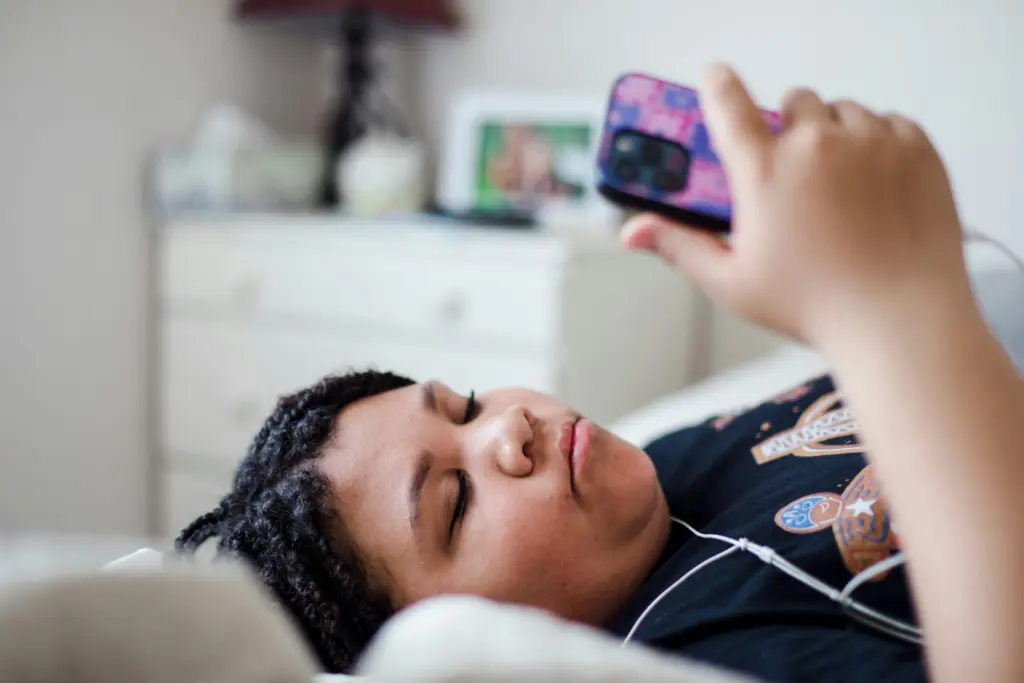
Constant interruptions fragment young people’s attention, seriously disrupting their ability to concentrate, learn and invest in the present moment and relationships.
It also affects their spiritual lives.
Rapp recalls a conversation he had with a student 10 years ago during a cell phone policy listening session at St. James. Phones were to be turned off and in lockers at the time.
“During a listening session, a student said, ‘I have my phone in my computer bag all day, but it’s turned off,’” he said.
When Rapp asked why, the student responded that she liked knowing it was close by.
“Several kids were nodding at that,” said Rapp, “and that was the point where I said, ‘Okay, we’re not just talking about phones.’
“There’s an attachment there that is pretty deep and it is psychological, but I think also as Catholics we can recognize that it’s spiritual, too.”
Leading the charge
Many schools across the archdiocese are ahead of the game, taking steps to make school a healthier, happier place for young people.
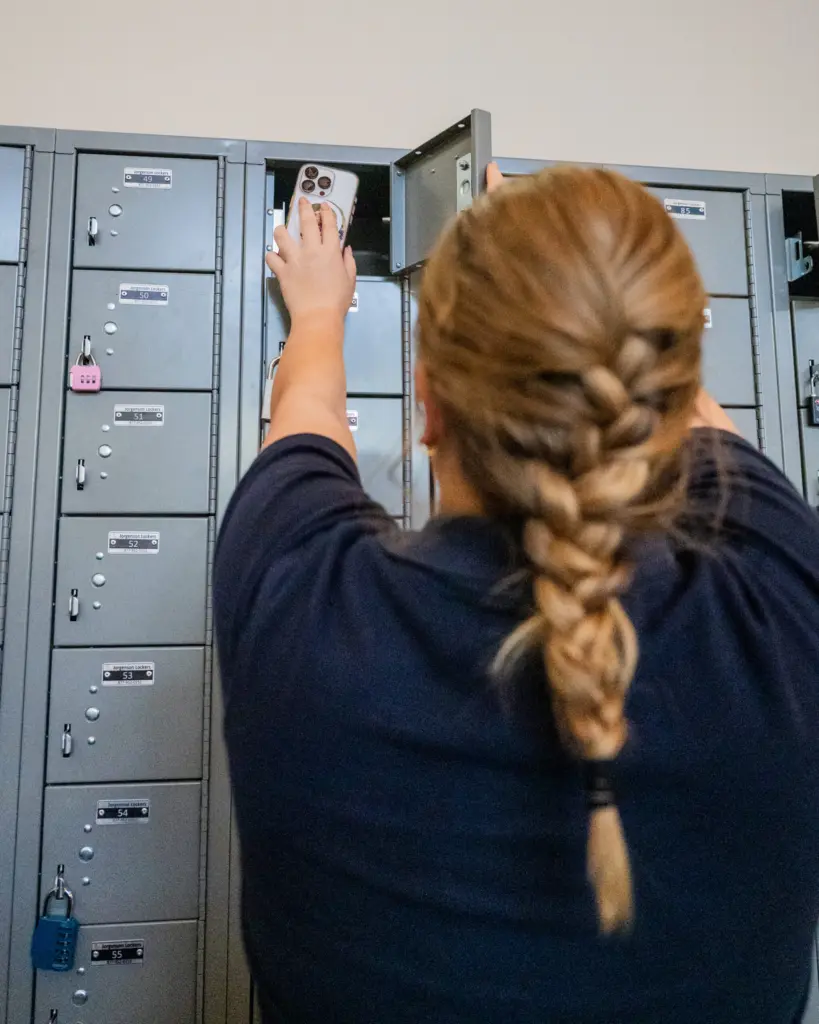
St. Benedict School in Atchison introduced a bell-to-bell phone ban two years ago at the beginning of the 2024-2025 school year. Students are required to leave their phones at home or store them in phone lockers monitored by school administration.
Kevin Lunsford, principal of St. Benedict, testifies to the ban’s positive impact.
“We had a great school before the phone ban, but it just took the edge off kids trying to look at their phone,” he said.
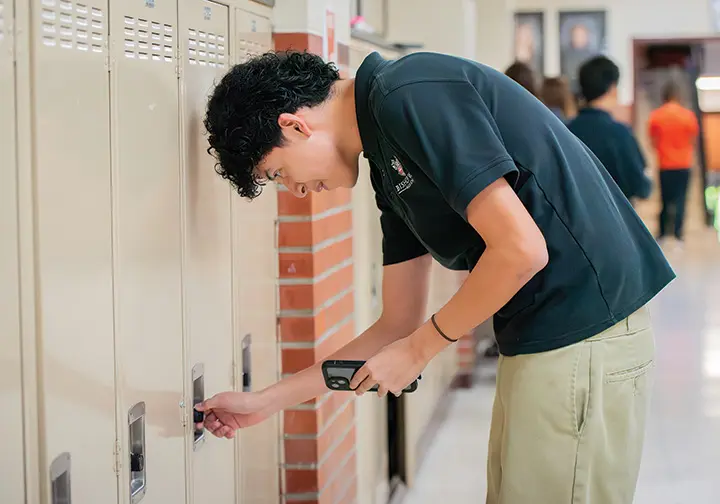
For St. James, a similar phone ban started in August 2025.
“We implemented this [phone-free policy] because we need to acknowledge that [a wrong] was done to [kids] and say, ‘We would like you to know that because the adults did this to you, the adults need to start taking steps to undo it’” said Rapp.
“So we’re [doing] what is within our control,” he added.
Some critics argue that separating students from their phones during school won’t have much impact, as they can access them as much as they want as soon as the bell rings.
But it makes a difference.
The Washington Post recently referenced results from a Harvard social media use study, published in November.
“After just one week of reduced smartphone use, participants reported drops in anxiety (16.1 percent), depression (24.8 percent) and insomnia (14.5 percent),” said The Post.
Other studies have found similar results: Even decreasing social media use, especially Instagram and Facebook, by an hour a day for one week helps people feel more whole.
Clarity is kindness
At St. James, implementing the phone ban has included some trial and error, but clear communication has made it effective — even if it wasn’t easy.
“I was so mad,” said Ben Thill, a junior at St. James. “It felt like it wasn’t needed and that [the administration] was going to penalize the people who were already following the rules.”
Formerly at St. James, students were required to keep their phones in their lockers but could check them during passing periods. Students could also use phones for classroom assignments at the teacher’s discretion.
“There were gray areas,” said Christine Lemmon, a computer science teacher at St. James. “It just felt like a problem you couldn’t solve. And that’s hard on the kids, too, because we weren’t clear.”
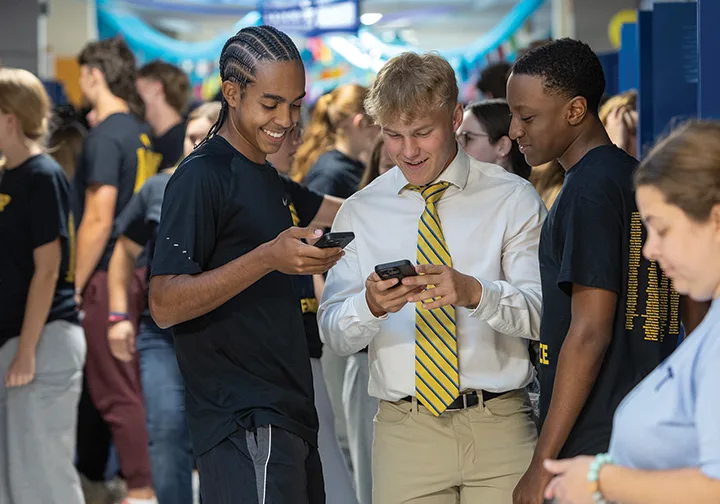
For Lemmon, hearing phone-free success stories gave her confidence that there was a way to truly be phone-free.
“What brought me a lot of peace was we watched another school who had modeled it before us,” said Lemmon. “They said they had [only] two students the first year who had two [phone] violations because of how well they monitored it.”
Additionally, steep consequences have incentivized students to make good choices.
At St. James, the first time a student is caught with a phone, a parent must come to the school to pick it up. This is meant to connect the family with the incident and, hopefully, initiate a conversation about the time and place for personal technology.
On the second offense, the student is sent home for the rest of the day and the next school day, unable to participate in school-related activities.
There have been no third offenses at St. James.
“The second violation, I think, is sufficiently stiff so that they have a great reason to not do it,” said Rapp.
“Raising those penalties has actually been more effective than the [phone] lockers themselves,” he added.
And that clarity is a kindness to students.
Thill said that once he saw the clarity of the school’s phone policy in action, he didn’t feel upset about the phone ban anymore.
“It’s actually kind of weird now to think back, that we used to be able to have our phones in our lockers,” he said. “Clarity is huge. The school sent so many newsletters, updates, everything, leading up to [the ban].”
Lemmon agreed.
“As the faculty and admin,” she said, “you have to have harsh consequences and you have to be willing to enforce them.
“I think the whole system is built on the question, ‘Are the adults in the building going to buy in and believe that that is truly a good for that student and be willing to hold the standard?’”
A step in the right direction
The state isn’t taking phone-free quite as far, but it’s a step in the right direction.
According to the bill, students’ personal devices must be stored out of sight for the duration of the school day. This could mean storage in student lockers, backpacks, cars, school-monitored phone lockers or someplace off-site. It will be up to individual school districts to decide what approach they’ll take.
Each Kansas school district will be responsible for monitoring its schools’ adherence to the phone ban. Schools will be required to produce supporting documentation as part of their accreditation process.
The Office of Catholic Schools commented that it is currently compiling and evaluating a policy that will serve all schools in the archdiocese.
“The problem is some of our schools rely on students to bring personal laptops to school,” said Lorenzo Rizzi, associate superintendent of student services in the archdiocese. “We’re working to figure out if there are any solutions in the bill for situations like that.”
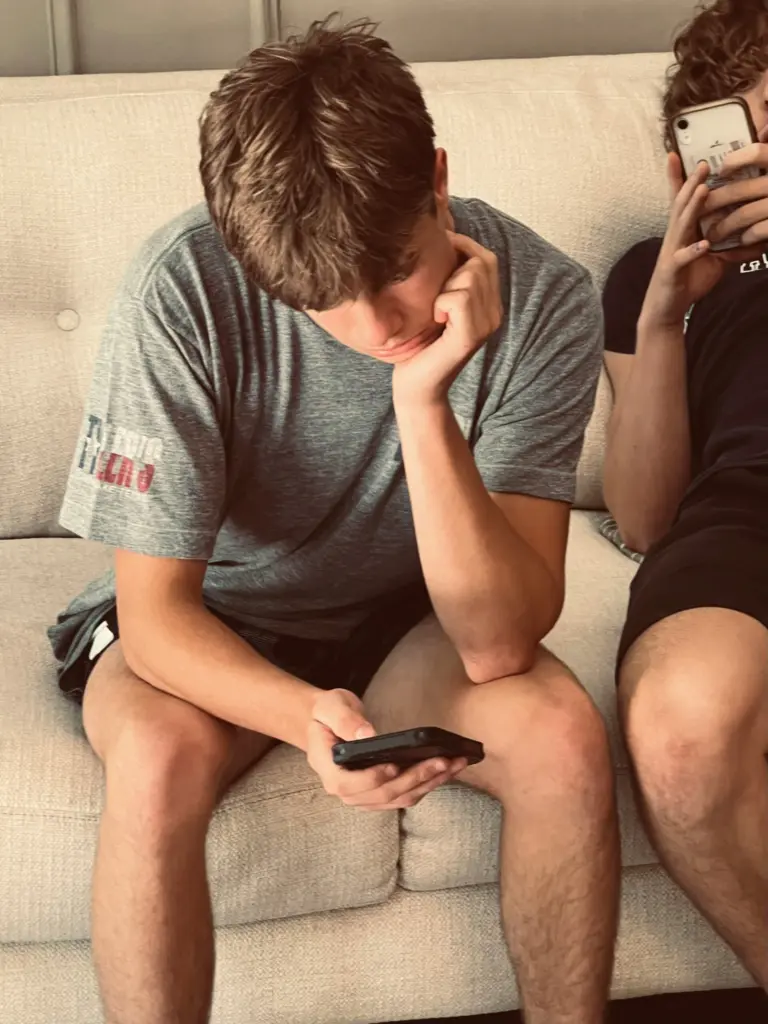
Another hurdle is communicating effectively with parents about the bill’s rationale.
Lemmon has spoken on a panel held by the City of Lenexa about the negative effects social media and unlimited phone use have on teens. She said one of parents’ top concerns with bell-to-bell phone bans is contacting their child in the event of an emergency or intruder.
“Law enforcement officers will be the first to tell you that students using phones can prevent adequate emergency response,” said Lemmon.
According to the National Association of School Resource Officers, phones distract from life-saving instructions, create noise that reveals hiding spots, and cause network congestion.
They can even cause well-meaning parents to block roadways to the school, delaying emergency personnel’s response.
While there is certainly much planning that needs to take place before the start of the next school year, the hope of a positive impact is palpable in area schools.
For the last two years, Bishop Ward High School in Kansas City, Kansas, has operated under a phones-in-lockers policy. The school’s president, Jay Dunlap, has seen the positive changes this step has produced and hopes that Kansas schools experience similar fruits.
“The biggest difference we saw was over the lunch period; kids weren’t looking at their phones and were really interacting with each other,” said Dunlap.
He added that he welcomes any changes that the school may need to make to its approach to remaining phone-free.
“It’s about doing the best possible thing for our students,” he said.
Whole hog or cold turkey
At St. James and St. Benedict, teachers have taken the opportunity the phone ban presents to revisit the role screens in general play in their classrooms and teaching.
That doesn’t mean we reject screens out of hand, said Rapp. There’s a balance to be struck between technology and where, how and how much we use it.
He drew attention to Pope Leo XIV’s October 2025 apostolic letter “Drawing New Maps of Hope.”
The pope speaks to the value of education, that it goes beyond the transmission of content to impart how to live virtuously.
The letter also acknowledged that pastoral creativity is required for technology to become a true human good, and it explicitly warns against fostering technophobia:
“Our attitude towards technology can never be hostile, because ‘technological progress is part of God’s plan for creation.’ . . . The decisive point is not technology, but the use we make of it,” said Pope Leo.
Jonathan Haidt’s recommendations for a healthier childhood in the digital age
1. No smartphones before high school
2. No social media before 16
3. Completely phone-free schools (phones out of students’ possession during school day)