How Catholic immigrants built America
This is the sixth and final article in a series.
by Therese Horvat
Special to The Leaven
In the early days of the archdiocese, as parishes opened to serve people of varying ethnicities and nationalities, two church communities shared the distinction of being established to serve Black Catholics.
Holy Epiphany Parish, Leavenworth
In the 1870s, Bishop Louis Mary Fink, OSB, commissioned the establishment of a parish for Black Catholics in Leavenworth. Holy Epiphany Parish was said to have been the first such ministry west of St. Louis.
The Sisters of Charity of Leavenworth initially taught Black students in a nearby house. Upon completion of the new church, they relocated classrooms to the basement of the building.
In the late 1880s, the pastor opened Guardian Angels Home, an orphanage for boys, and arranged for the Oblate Sisters of Providence from Baltimore to care for the orphans and teach at Holy Epiphany. This congregation was founded by women of African descent to serve Black children. The presence of the Sisters and devoted pastors fostered religious vocations.
Eventually, the parish included a church, elementary and secondary schools, the boys’ orphanage and a home for girls. By 1936, Holy Epiphany had an estimated 300 parishioners.
Membership declined in subsequent years. The national movement toward integration, coupled with Holy Epiphany’s proximity to two other Catholic parishes, were likely reasons behind its closure in the 1950s.
Our Lady of Perpetual Help Parish, Kansas City, Kansas
Our Lady & St. Rose Parish, Kansas City, Kansas
Barbara Bailey and her family have lived the history of the church’s relationship with Black Catholics in Kansas City for many years. Since 2008, Bailey has been pastoral associate of Our Lady & St. Rose Parish. She worships in the same church building where, in the early 1900s, her maternal grandparents were among Black Catholics relegated to the back pews.
This segregation led a group of families to request a parish for Black Catholics. With the assistance of the Franciscan priests then serving St. Anthony Parish, Our Lady of Perpetual Help, known as the Church of Our Lady, began offering services in a vacant storefront in 1924.
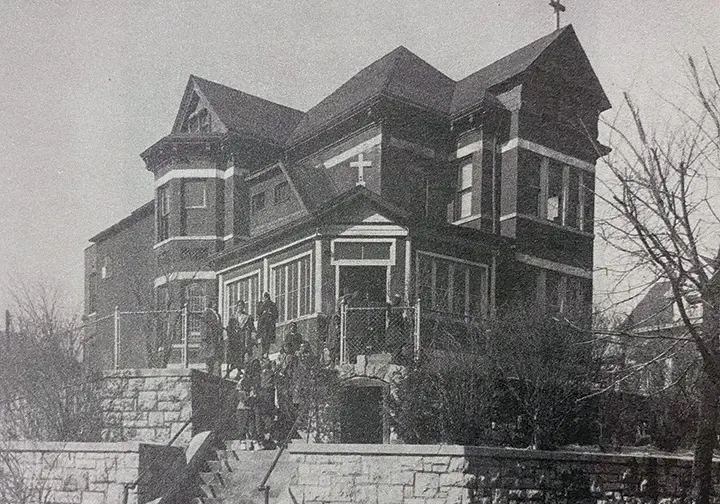
Under the leadership of an energetic young pastor, Father Angelus Schaefer, OFM, the parish purchased and renovated a large brick home at 5th and Parallel in the northeast section of the city. This location housed a chapel, school and offices from late 1924 to 1955. Lay teachers initially taught students.
Bailey was baptized and attended primary grades in this structure. The building was demolished to make way for a new church and school, and in the meantime students attended nearby parish schools. Bailey made her first Communion in a funeral home where the Church of Our Lady held Masses during construction. The new combined church/school was blessed in December 1956.
A succession of Franciscan priests served the parish. Starting in 1926, the Sisters of Charity of Leavenworth staffed the school. The Knights of Peter Claver Council 61, established in 1929, was and remains an influential organization in the parish. The Ladies Auxiliary, Junior Knights and Junior Daughters collaborate with the men in performing corporal and spiritual works of mercy for the parish and community.
In the 1940s, pastoral and lay leaders were instrumental in the integration of Bishop Ward High School in Kansas City, Kansas. As neighboring St. Rose of Lima experienced White Flight and the Franciscans anticipated leaving the Church of Our Lady, discussion focused on uniting the two parishes.
Unification became official on Sept. 24, 1968, with Our Lady & St. Rose placed under the leadership of archdiocesan priests. Bailey said the transition was rocky, but the situation improved as the “congregation grew up together.” The parish school was a powerful unifying force during this time but closed in 1985 due to financial challenges.
In the 1980s, the parish adult choir was formed and became a mark of distinction in helping preserve the Black culture among the congregation. Annual concerts attracted guests from the surrounding area.
Bailey hopes to resume the concerts and the revivals the parish hosted in the past. She believes that except for the Gospel music interspersed in worship, there’s not a big difference between being black or white in the Catholic Church.
Faith is the shared common denominator.