by Gina Christian
OSV News
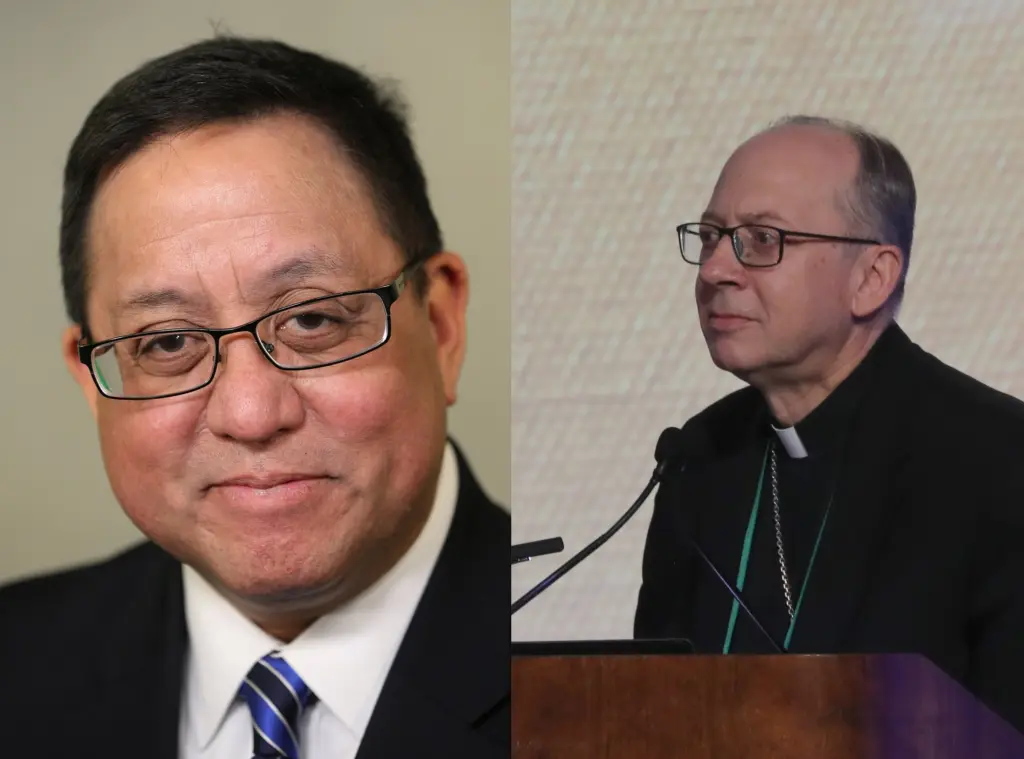
ORLANDO, Fla. (OSV News) — During the U.S. Conference of Catholic Bishops’ annual spring meeting, held June 10-12 this year in Orlando, OSV News discussed forthcoming revisions of the bishops’ “Charter for the Protection of Children and Young People” with Bishop Barry C. Knestout of Richmond, Virginia, chair of the USCCB’s Committee on the Protection of Children and Young People, and Deacon Bernie Nojadera, executive director of the USCCB’s Secretariat of Child and Youth Protection.
Commonly known as the “Dallas Charter” — instituted by the US Catholic bishops at their 2002 meeting in Dallas, Texas, as the scope of the clerical abuse scandals emerged publicly — it lays out a comprehensive set of procedures for addressing allegations of sexual abuse of minors by Catholic clergy. The charter, whose revisions the U.S. bishops approved in a June 11 vote, also includes guidelines for reconciliation, healing, accountability and prevention of abuse.
This interview has been edited for length and clarity.
OSV News: During the plenary discussions, you made clear the charter must remain focused on child protection, and not take on the issue of adult protection. Why did you feel it was so important to make that clarification?
Bishop Knestout: Our mandate was to keep it focused on clergy abuse of children and young people. And the charter has been a very good, strong instrument regarding our response as a Church, as bishops and as priests to that issue. It’s able to help build some trust in our community regarding our accountability and transparency in addressing abuse.
OSV News: Both civil and canon law play roles in addressing clergy sexual abuse. Is there any interplay between the two in the charter?
Bishop Knestout: Canon law is very clearly in focus here, because civil law tends to be different depending on the jurisdiction, whereas canon law applies uniformly across every diocese and every priest and bishop.
We concentrated on making sure the revisions aligned with canonical provisions in the (updated) Book VI of canon law (the section of the Church’s main administrative code that specifies penal sanctions; revisions took place under both Pope Benedict XVI and Pope Francis, culminating in the latter’s 2021 apostolic constitution “Pascite Gregem Dei”).
And we wanted the charter revisions to align with other documents from the Holy See that do have the force of law — “Vos Estis Lux Mundi” (which outlines how the Church should deal with clergy sexual abuse, including procedures for investigating bishops) and the vademecum (issued by the Vatican’s Dicastery for the Doctrine of the Faith in June 2022) on processes for implementing responses to accusations of abuse.
We tried to make sure the charter was aligned with what has happened in the Church since 2018 (when a number of clerical abuse scandals emerged) and all the other adaptations or adjustments that have occurred in canon law since then.
Deacon Nojadera: I would add that the Church is looking at possible legislation coming forward specific to spiritual abuse and other forms of abuse. There are developments coming down from the Holy See, from the Pontifical Commission for the Protection of Minors. The U.S. Catholic Church stands ready once those documents do come forward. We are looking at a review (of the charter) in seven years’ time, so we would again have that opportunity for further discussion and discernment.
Bishop Knestout: I’m going to use an analogy here, since my background is in architecture. We had a situation (in 2002) where the Church was in the midst of a storm: the abuse crisis. The environment was very challenging for us, because of the damage done. The actions taken were heinous, offensive, and both criminal and immoral by clergy, harming many young people, many children.
That all came to light, and the bishops of 25 years ago were in the wilderness in this, without a whole lot of resources. They had to pull together some kind of shelter for the Church to be able to address this issue in a way that would bring in those who need to be protected and cared for, and those who need to be responded to. The bishops had to pull together what sources and tools they had at the time, and they did a good job. It was very creative, very important; it provided shelter for the family of faith.
And that’s what the charter’s done: provide that shelter and warmth for the Church to respond to this issue, so that we can rebuild the trust of our people, so harmed and broken.
Now, there’s always a hope that you would have a better shelter, and over time, we’ve tried to improve that shelter, making it more adequate for the circumstances.
But there’s still a storm out there, and still items that we need to address. That more elaborate construction is an ongoing project that’s unfolding. There are dioceses that are going through bankruptcy; there’s a lot of suffering that’s experienced right now. There are victim survivors who still have the vivid recollections, and they’re going through processes of trying to seek some kind of justice for their situation.
I think there will be a time that comes where there might be more elaborate, fuller constructions that will be able to meet a lot of the other needs.
OSV News: The word “trust” appears a number of times throughout the charter. Where do you think the Catholic Church in the U.S. is at in rebuilding trust following the clerical abuse scandals?
Bishop Knestout: I think trust is being rebuilt, but there’s still a lot of trauma, and I understand that. We certainly have experienced that with those that we’ve heard from in all the consultation for this (charter update). This document affirms the commitment of the bishops to address and to care for victim survivors and for the family (of) faith, the Church, so they have confidence and trust that it’s being handled effectively. Yet, it is an ongoing project.
Deacon Nojadera: I think this trust is also being created and sustained by relationships: accompanying, journeying with survivor-victims by, for example, working with the National Justice Initiative (the National Catholic Restorative Justice Initiative) the National Healing Garden. That’s all that’s survivor-led.
This involves all of God’s people. Our review boards have to trust each other in order to function effectively. Priests have to trust their bishops. Bishops have to have trust amongst themselves. Again, it is an ongoing effort.
OSV News: What is the role of the laity in this process?
Bishop Knestout: The laity are very involved at every level of safeguarding — safe environment coordinators, victim assistance coordinators. Laity are helping to monitor and respond to these issues in schools and parishes, on review boards.
Deacon Nojadera: As the Church is looking at providing and maintaining safe environments, laity are stepping up in terms of how that is practiced at home in the family, the little Church. The protection of minors and the vulnerable should not just be the responsibility of the offices of child and youth protection, religious education, cultural diversity, catechetics, vocations.
For the laity, I think it’s about practicing safe environment training. If anything, the Church empowers parents to be parents, and encourages families to work at being healthy and holy families that will, in the end, create a healthy and holy Church.
OSV News: Part of the debate about the charter revisions during the bishops’ spring meeting centered on whether or not to include the term “trauma-informed” in the document. Do you think there’s a clear understanding of that term?
Bishop Knestout: It’s a term that I’ve heard in recent years, and I think there’s been a desire we’ve heard, through our consultation process, of using that language.
But I’m not clear what that term actually translates into. How does that actually get applied at the ground level? It seems to me it’s a technical term that maybe can change over time in its use. Experts in the field perhaps have disagreements about what it means and entails.
The whole point of the charter is to express both the commitment to addressing and preventing abuse, and to have enough structures in place so that there is credibility regarding our response to it. And to get into therapeutic language didn’t seem to be where the charter initially should be.
It doesn’t mean I refuse to accept or to incorporate the term, but is it something that would be necessary in the charter? It starts to get into specifics, where the general nature of the charter is a commitment of the bishops to address the issue of abuse by clergy of young people, and have the structures in place so that we can address that effectively.
OSV News: The latest charter revisions also emphasize due process for accused clergy. What is your sense of how priests in the U.S. are navigating backlash from the abuse scandals?
Bishop Knestout: The charter does try to express gratitude for priests who have served well and continue to serve well, with dedication and love for their people. So we acknowledge that. We wouldn’t be able to function without good priests. Certainly the vast majority do serve well, with love and with competence.
With regard to the scandal backlash, I think the clergy’s experience is still unfolding. Some are really carrying with them that experience that goes back 20 years, and some the reaction to all that unfolded in 2018. The bishops were not included in the charter up to that point; now they are through “Vos Estis.” But it takes time for that kind of awareness and confidence in that inclusion to unfold.
OSV News: What would you say to the average U.S. Catholic in the pew about the charter and your efforts to prevent and address clergy abuse of children and young people?
Bishop Knestout: I’d say that the bishops are still firmly committed to respond to, with transparency and accountability, any complaints, accusations that come up about the misbehavior of clergy, especially regarding to children and young people. We also affirm and are committed to responding with charity, attentiveness and accompaniment. We express that in the charter.
For victims and survivors of abuse, no matter when it might have occurred — we have great love for them and for the Church, and we were trying to make sure that the Church’s work of both reconciliation, healing and charity is strengthened.
Deacon Nojadera: The charter is an instrument that I feel acknowledges the dignity of the human person, wonderfully made in the image and likeness of God who loves us unconditionally.
This charter is a way in which we are able to communicate that justice and that commitment towards trying to build a church that’s healthier and holier.