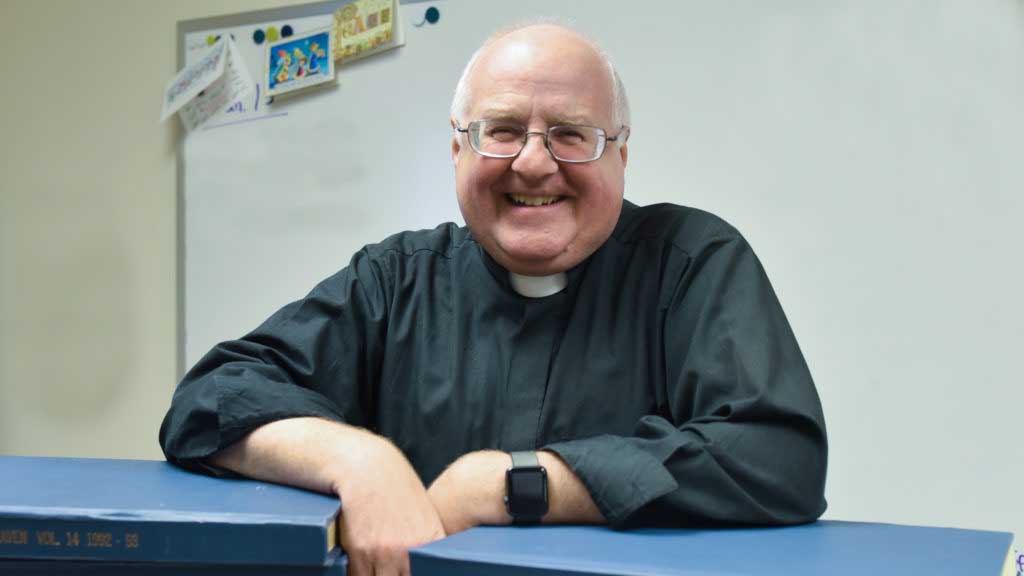
by Father Mark Goldasich
My memory is rusty on this, so please bear with me.
A commercial in the late ’60s or early ’70s depicted two older men, the leaders in their respective countries. They were enemies. Surrounded by some of their fellow countrymen, the two met on top of a hill and started to fight. The gist of the ad was: Wouldn’t it be nice if rather than starting wars where millions of youths and innocents are killed, the leaders of those nations would instead fight it out with each another.
I’m still haunted by the front-page article in last week’s Leaven that spoke about “the battles we don’t see,” those veterans who return home from war “wounded” by post-traumatic stress disorder, depression, thoughts of suicide, alcohol or drug addiction, or homelessness.
While parades are nice on Veterans Day, it’s probably much more appropriate to honor veterans — especially those haunted by the horrors of war — by lifting them up to their patron, St. Martin of Tours, whose feast on Nov. 11 coincides with Veterans Day each year.
It makes my heart hurt that peace seems so elusive for humanity. I recently came across a prayer of astronaut Frank Bormann, part of the crew of Apollo 8, the first manned craft to orbit the moon. I imagine he was overcome with awe to see the “blue marble,” Earth, as he spoke these words on Christmas Eve 1968: “Give us, O God, the vision which can see thy love in the world in spite of human failure. Give us the faith, the trust, the goodness in spite of our ignorance and weakness. Give us the knowledge that we may continue to pray with understanding hearts and show us what each one of us can do to set forth the coming of the day of universal peace.” (Found in Anthony Castle’s “More Quips, Quotes & Anecdotes for Preachers and Teachers.”)
Have we made much progress toward universal peace since that prayer was uttered nearly 60 years ago? Is peace just a nice pipe dream?
Consider this story to find an answer:
Ramsey MacDonald, one-time prime minister of England, was discussing with another government official the possibility of lasting peace. The latter, an expert on foreign affairs, was unimpressed by MacDonald’s idealism. He remarked cynically, “The desire for peace does not necessarily ensure it.”
MacDonald answered, “Quite true. But neither does the desire for food satisfy your hunger, but at least it gets you started toward a restaurant.” (Found in “Illustrations Unlimited,” edited by Fames S. Hewett.)
As Christians, we should have a gnawing hunger for peace. Maybe some of these small actions can get us “started toward a restaurant”:
• Pay attention to how many times “peace” is mentioned in the prayers, readings and songs at Mass. At the sign of peace, truly wish that gift on those you greet.
• Be a peaceful presence online. Stay away from posting comments that are demeaning, disrespectful or divisive.
• If your Thanksgiving gatherings are contentious, seek to be a peacemaker, a calming influence.
• Contribute financially to organizations that assist veterans in need or offer your talents or volunteer efforts.
• Cultivate a peaceful home. Speak respectfully and gently to one another, especially when tensions rise.
• Learn more about saints of peace like St. Francis of Assisi, St. Catherine of Siena, St. Barnabas or St. Dymphna.
• Follow the example of St. John the Silent by speaking less and listening more deeply to God and others.
Peace is Jesus’ special gift to us. May his words give us hope and strength along the way: “Peace I leave with you; my peace I give to you. Not as the world gives do I give it to you. Do not let your hearts be troubled or afraid” (Jn 14:27).