by Olivia Martin-Davies
olivia.martin@theleaven.org
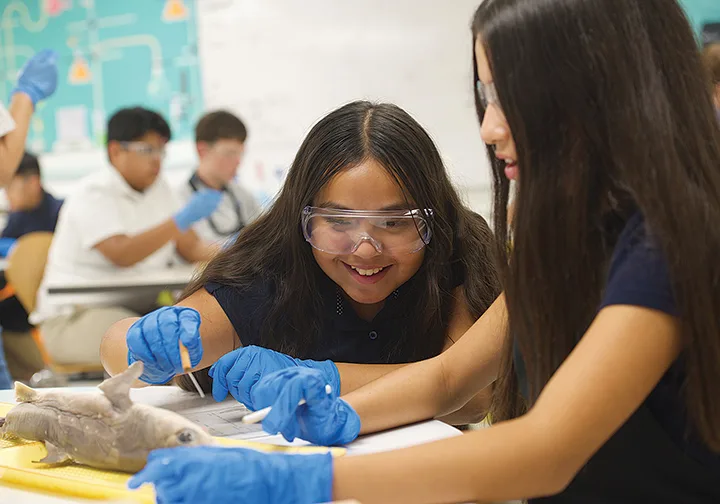
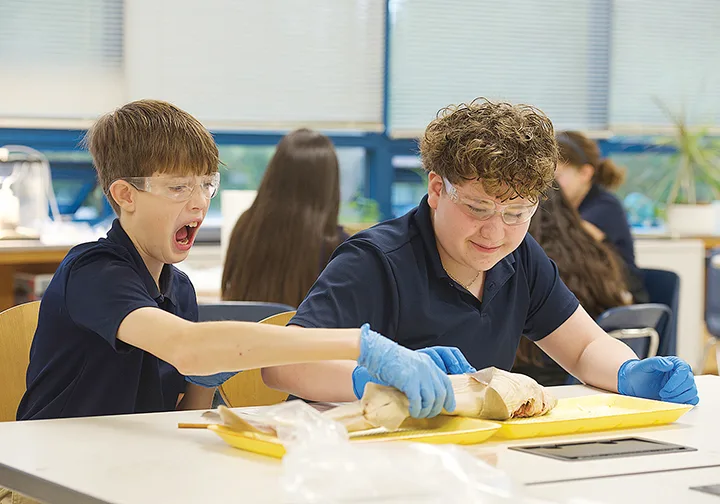
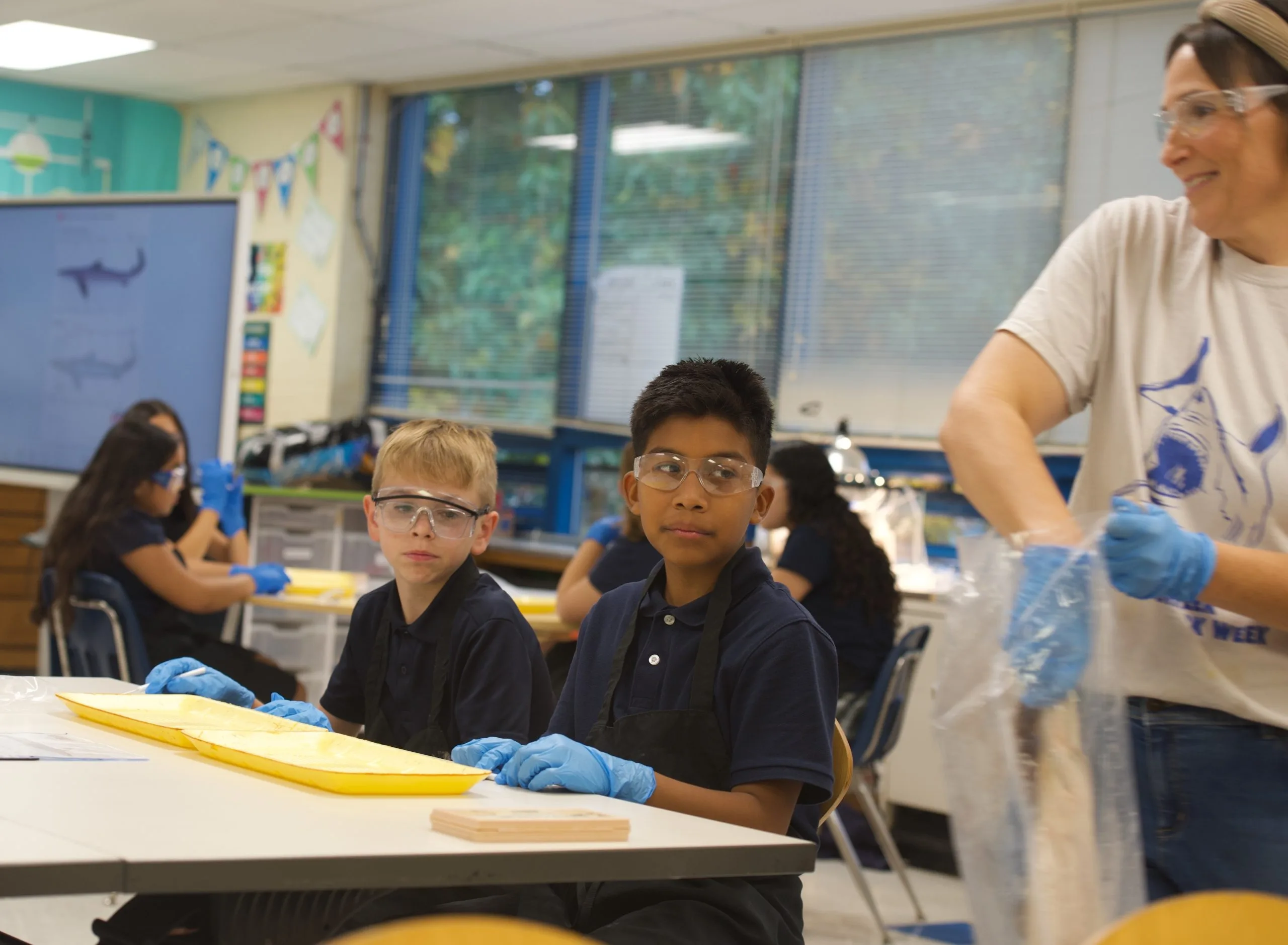
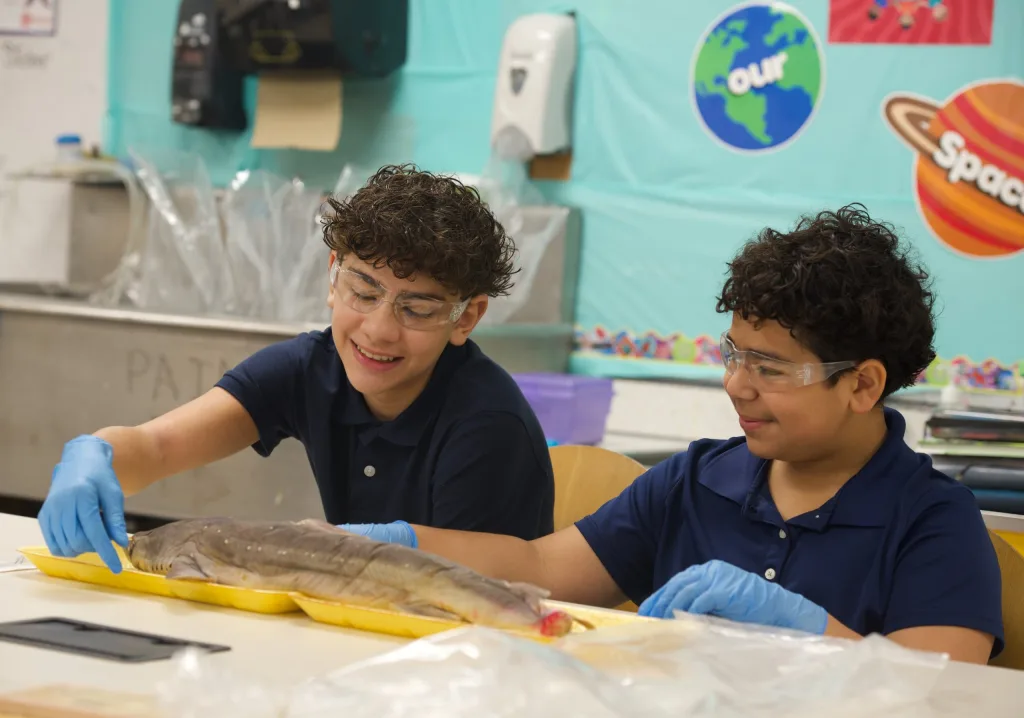
OVERLAND PARK — At 8:15 a.m. on Oct. 14, Shark Week left the confines of the Discovery Channel and came ashore at Holy Cross school here.
“We are dissecting spiny dogfish sharks, and they’re found in the Atlantic Ocean,” Angela Kopp, Holy Cross’ STREAM director, announced to her class. STREAM is an acronym for science, technology, religion, engineering, art and mathematics.
Shark Week is a longstanding tradition in Kopp’s classroom, spanning over a decade. At $7.50 per shark, Kopp has found their cost-effectiveness and unique appeal make them perfect for the classroom.
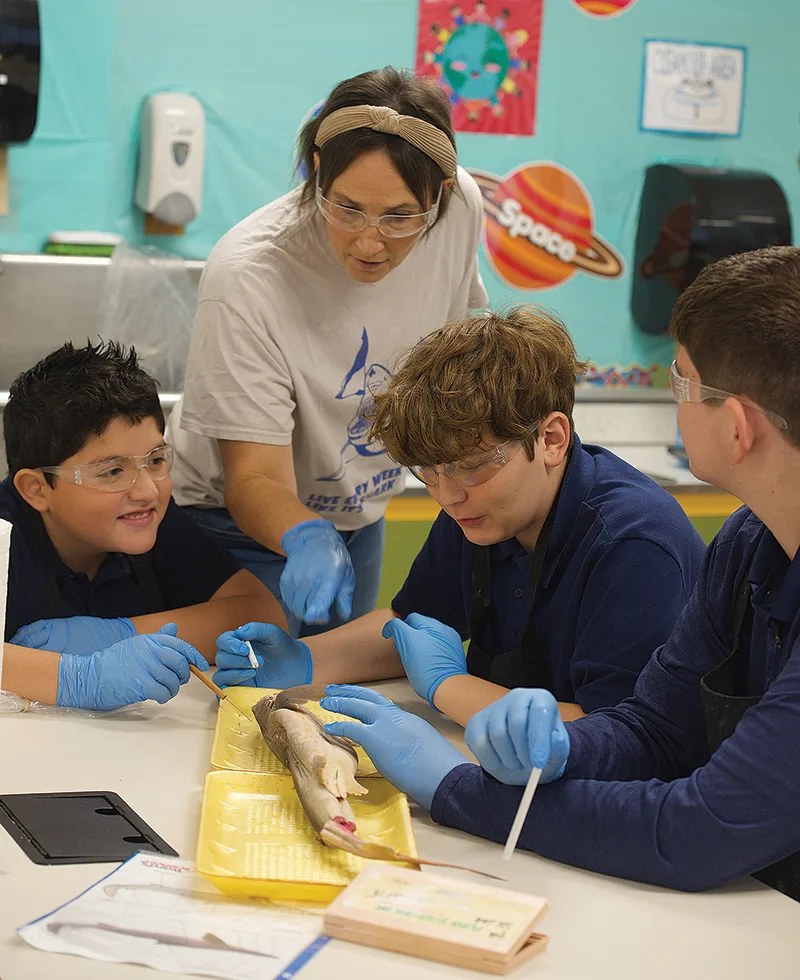
Students put on aprons, safety glasses and gloves as Kopp outlined the sustainable origin of the sharks they will dissect, what they will learn each day during Shark Week and the reason for dissecting.
They might get lucky, added Kopp, and find another organism in the shark’s belly — a prospect that drew sighs of awe from some and squeals from others.
“I’m excited for when we get to open up the sharks and look at the different systems inside,” said seventh grader Grayson Kittle.
“[But] it was cool today looking at how the shark worked and [its] different parts,” he added.
Hands-on learning
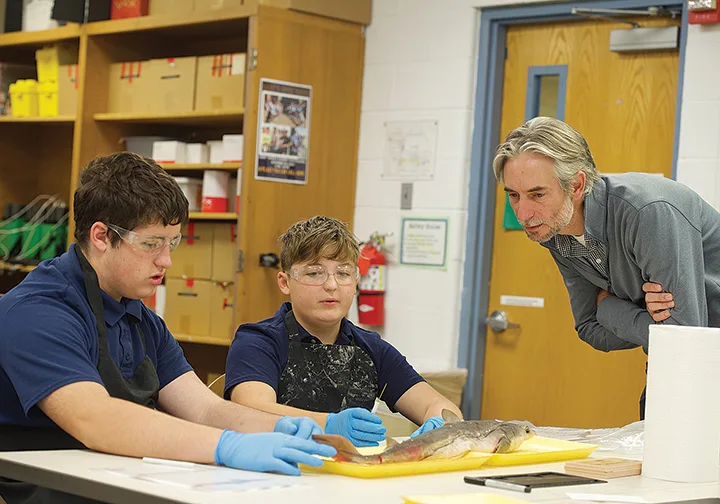
The magic in Kopp’s classroom goes far beyond Shark Week, and it’s her own desire to keep learning that makes it happen.
While in a previous position at Nativity Parish School in Leawood, Kopp enrolled in the STEM Teachers Fellowship program through the University of Notre Dame.
A two-and-a-half-year commitment, Kopp spent a total of five weeks on the Notre Dame campus across three summers and participated in lesson-planning tasks and instructional coaching in between. The program emphasizes hands-on, collaborative learning and real-world application.
“During that time, we were transforming how we taught science and how we incorporated high-quality STREAM projects into our classes,” she said. “It was two years of constant improvement that got you excited about teaching again.”
When she started at Holy Cross two years ago, the school’s STREAM program was just beginning, and one of Kopp’s main goals was to make it as robust as possible.
“The programming should not depend on if I’m here or not,” she said.
However, the excitement Kopp brings to her lessons is unique — and contagious.
“I like the activities we do,” said eighth grader Hunter Dixon. “We build a lot of stuff in our class — cool stuff, like seeing how air interacts with objects. We’re learning about Tufts testing and aerodynamics.”
Kopp’s students particularly value that she takes time to answer their questions.
“If we don’t understand how things work, doing the activities helps you see and understand,” said eighth grader Diana Velazquez. “Ms. Kopp explains things really well and you can always ask if you don’t understand.”
Dixon agreed. “You don’t feel like you’re going to be embarrassed if you ask her something.”
Dominic Calixto Morales, eighth grade, added that Kopp takes all kinds of questions seriously: “She even answers when we ask how dreams work and what they mean!”
A culture of learning
Kopp’s hands-on teaching method has spread outside her classroom, influencing fellow teachers.
“My kids are beyond excited to go into the lab because that means they are truly getting into it,” said Maria Parn, a third grade teacher at Holy Cross. “[Kopp] has inspired me to take chances on topics and has helped me to develop a sense of creativity. . . . She pushes me to think outside of the box!”
Kopp’s impact is no less visible to the parents at Holy Cross.
From evenings spent building catapults and launching marshmallows with parents to inviting professionals like farmers, conservationists and neurologists to speak to her classes, Kopp goes above and beyond to give kids — and their families — a taste of the possibilities.
“My children have a love for learning because of Ms. Kopp,” said Katie Erwin, mother of two Holy Cross students and another at Bishop Miege High School in Roeland Park.
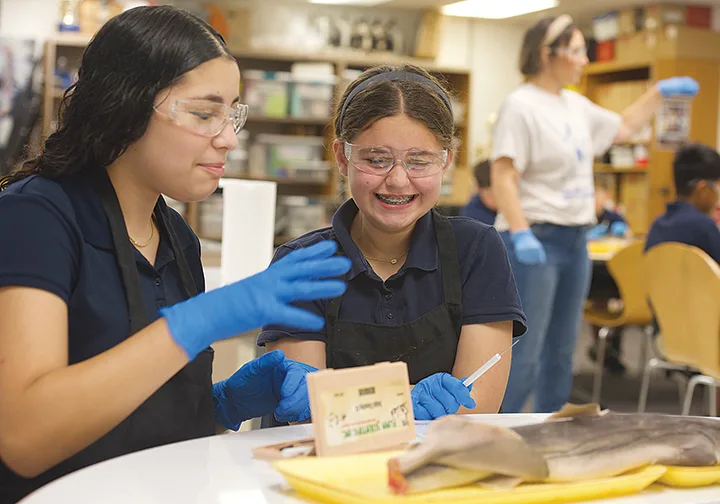
Erwin added that while she only has sons, she appreciates Kopp’s efforts to encourage her female students in the traditionally male-dominated STREAM field.
“As someone who grew up not great at science,” she said, “I can’t help but wonder if my learning experience would have been different with a teacher like Ms. Kopp.”
Care for creation
An ecologist by training, Kopp has a soft spot for biology and the environment — and some of her favorite teaching moments are when she can show students the connection between science and Catholicism.
“I’m such a big proponent of faith and reason,” she said. “We’re constantly looking for what’s the truth and trying to find answers with data, analysis, observation. We call that truth with a small ‘t.’ What it leads [us] to is finding that truth with the big ‘T.’
Pope Francis’s first encyclical “Laudato Si’: On Care for Our Common Home” is one of Kopp’s sources of classroom inspiration.
“It’s important as humans that we are stewards, which means we care for creation,” she said.
For example, Kopp and her students are building a culture of stewardship through a schoolwide, grant-funded lunchroom composting program.
Students are seeing firsthand that they can put the things they are learning into practice, she said, and “it’s teaching the kids to be stewards of the environment.”
The eighth grade class dives deeper by conducting a study on how much methane gas various types of food emit as they decompose in a landfill-simulated environment. Methane gas is one of the leading gases that contributes to climate change.
“We look at things like: How does climate change impact our most vulnerable populations? What is happening to their homes from flooding, drought and other types of weather?” said Kopp. “What we study ties directly to those things.”
While Kopp brings an abundance of faith, knowledge, a desire for learning and continual betterment, her joy is perhaps the most compelling lesson she shares.
“I like how Ms. Kopp is always a happy person,” said Kittle. “And I like how she is a great teacher — one of the best.
“I am glad to have her.”