by Marc and Julie Anderson
mjanderson@theleaven.org
TOPEKA — “We walk by faith, not by sight.”
So writes St. Paul in the First Letter to the Corinthians.
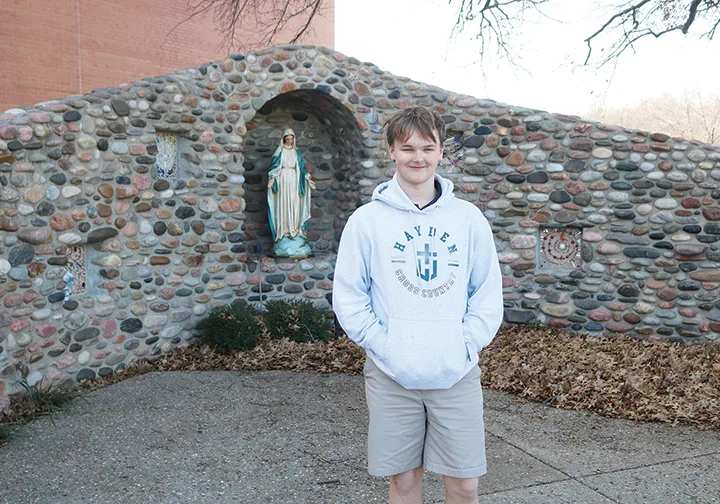
If there’s one student at Hayden High School who lives by that verse, it’s senior Evan White.
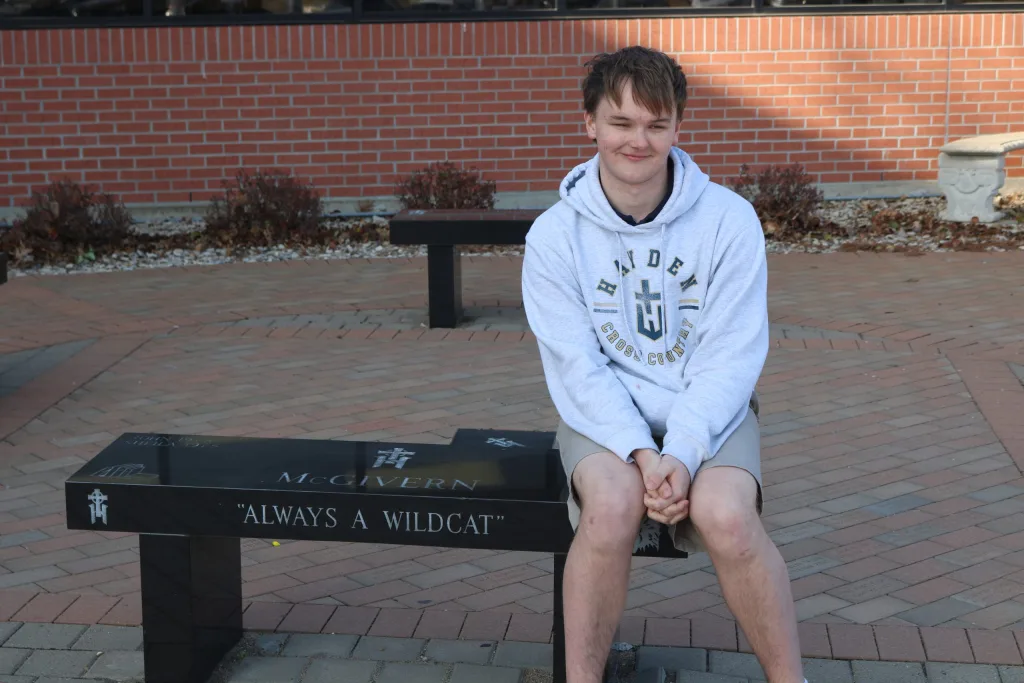
An honors student, tutor, swimmer and cross-country runner, White lives life to the fullest. The only difference between him and other students is that he’s blind.
At two months old, White did not pass the red reflex test used to detect visual impairments in infancy. Thus began a lifetime of doctor’s appointments and at least three dozen surgeries, as well as trips to medical providers in Kansas City, St. Louis and Detroit.
And while the family has never received a complete explanation for his impairment (doctors think it might be due to a collagen disorder), White seems to handle what others might perceive as a “limitation” as merely a guideline.
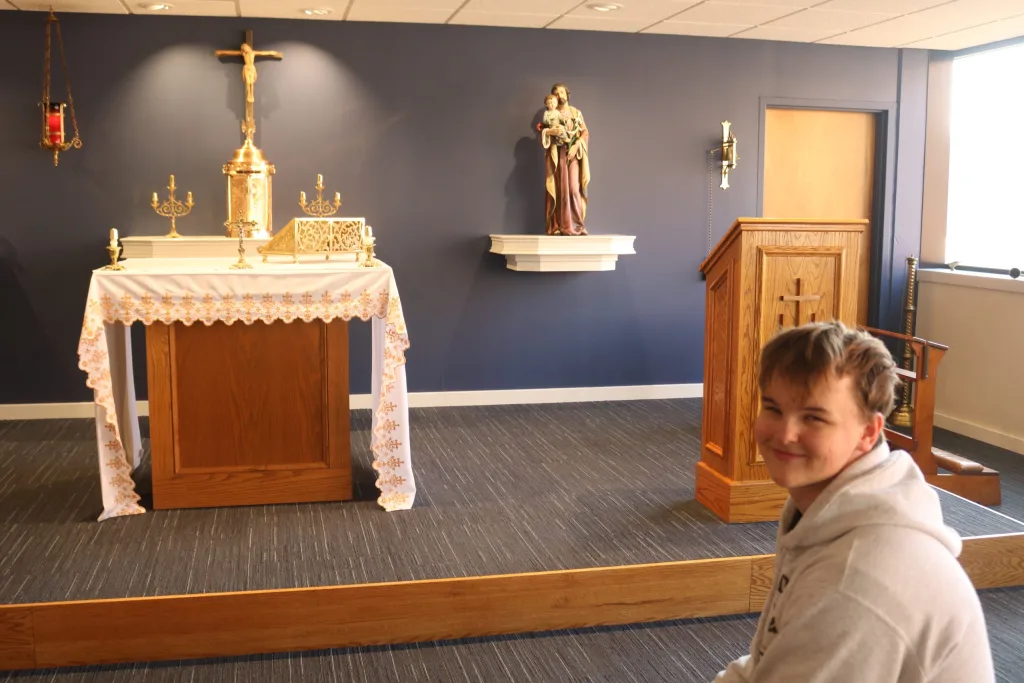
A member of Most Pure Heart of Mary Parish in southwest Topeka, White earned his Eagle Scout award this past November.
The highest award available to youth members of Scouting America, one of the award’s final requirements is for the Scout to plan and carry out a service project benefiting any organization outside Scouting itself.
Because White has received services from the Kansas State School for the Blind (KSSB) in Kansas City, Kansas, since he was a preschooler, he chose to build a sensory box for the school.
“I wanted to do a project for [KSSB] because it’s a community I wanted to give back to,” White said.
When the school provided him a list of nearly two dozen projects for which it had a need, White said, the idea of building a sensory box appealed to him.
“Sensory experiences are so important,” he said. “A lot of kids who are visually impaired have multiple disabilities, so the sensory experiences help with not only the visual impairment, but also the cognitive impairments that some kids might have.”
Throughout the process, White sought the input of Anne Gurss, a teacher of visual impairments who has taught him since he was 4.
“We talked about a lot stuff,” Gurss said of the project, including the addition of a Lego panel.
“Lego has made Braille Legos,” Gurss said. “A student who has the ability can put the Braille Legos on the panel and create words or whatever.”
“I knew it was working,” said White, “because while we were building it, I was playing with it. . . . I knew we were onto something.”
Children who are blind, White explained, often move around, shake or rock back and forth. That’s because 80% of one’s sensory stimulation comes from visual cues.
“The sensory cart helps, you know, give it kind of an outlet for kids to feel carpet or artificial turf or to play with a lock or to build Legos on or something like that,” he said.
The cart even has a miniature xylophone, White added.
“It’s designed for all age groups,” he noted. “There are all kinds of things for everyone to do on it. . . . Most people can find something that they find fun to mess around with on it. And the cabinet also opens to be storage, so they could store sensory tubs and stuff like that in there if they so choose.”
Having lived with blindness his whole life, White said, has taught him to embrace who he is.
“A huge part of the School for the Blind’s mission is getting people involved in careers and not just staying home existing,” he said. “The whole culture up there is that it’s like, we’re not doing it for you. You got to do it yourself.”
“We’re going to do it and just figure things out and keep moving forward,” White said.