by Olivia Martin-Davies
olivia.martin@theleaven.org
KANSAS CITY, Kan. — A changing of the guard is an exciting time.
It’s full of pomp, circumstance, ritual, colors and music.
It brings celebration and, as the name suggests, change.
Since the archdiocese’s “changing of the guard” last year with Archbishop Shawn McKnight’s installation, it has been full steam ahead. One of the most recent changes includes restructuring of the archdiocese’s individual ministry teams into the unified Parish Evangelization Services (PES) department.
Constituted on April 10, PES ministers to the people of the archdiocese through accompaniment, consultation, collaboration and support.
“It’s a renewed approach to how the chancery can serve pastors and parishes in accomplishing the stated goals of Archbishop McKnight,” said Michael Podrebarac, a longtime consultant for liturgy and sacramental life in the archdiocese.
Archbishop McKnight shared that vision with The Leaven in his May 8 column:
“Our ultimate goal is to empower every parish to be more than a place for weekly worship; it must be a sanctuary of mercy and a center of charity.
“By integrating your voices, we move forward together in this vital renewal!”
A renewed approach to parish support
Formerly, there were many distinct ministry offices within the chancery that operated individually, providing direct answers, programs, resources, formation and support to individuals and parishes across the region.
Now, PES will work across disciplines and alongside parish and deanery leaders.
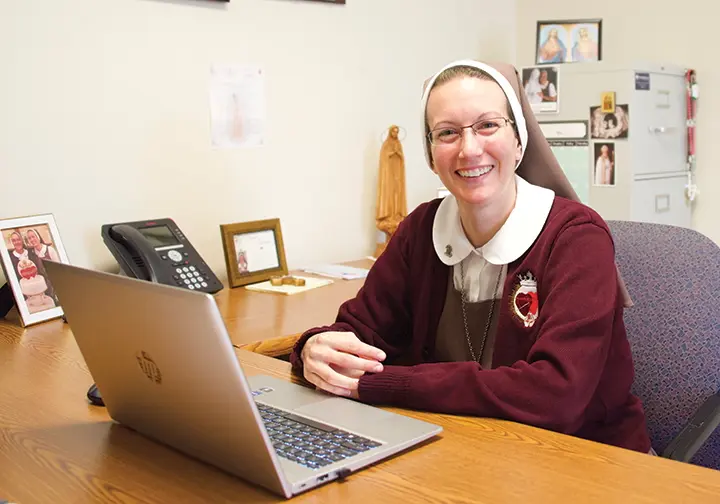
“Parish Evangelization Services is renewing the ministerial structure of the chancery by shifting from a model focused primarily on creating programs to one centered on intentional service, accompaniment and co-responsibility,” said Sister Monica Bernadette Arguello, SCTJM.
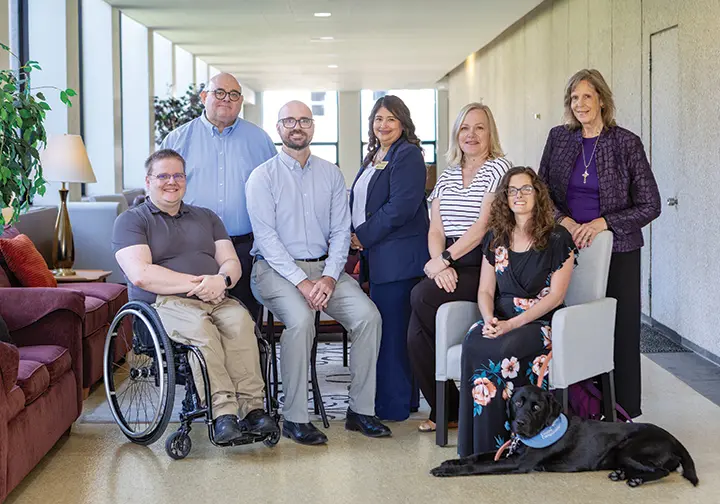
Its members are: Father Michael Hawken, vicar general and moderator of the curia; Debra Niesen, director; Michael Podrebarac, advocate, Karla Melgar, advocate, Sister Monica Bernadette Arguello, SCTJM, advocate and the archbishop’s delegate for religious and consecrated life, and Mark Blaise, advocate; and specialists Josh Ruoff, Katie Locus, Joan Macy and Ann Marie Alvey.
“The idea is to empower parishes and servant leaders, connect them to best practices in other parishes, and build deanery capacity, especially to support rural and smaller parishes,” said Father Hawken.
This renewed approach allows advocates and specialists to work collaboratively as one team while remaining attentive to the diverse needs of communities across the archdiocese.
Niesen, who previously served as director of the pro-life office, will spearhead bringing structure to the new department and will serve alongside the advocates on her team as well.
“I am very impressed with the people that I am surrounded by,” said Niesen. “Getting to know them and listening to them and hearing their vast experience, love for the church and desire to serve makes me proud to be on this team.”
Accompanied
Importantly, this change isn’t occurring because the previous ministry model was ineffective.
Quite the contrary.
The previous model had such significant fruit from sharing the Gospel, fostering relationships and increasing parish engagement that PES will focus intently on doing those specific best practices more.
“The place where most people experience and practice their Catholic faith is in the context of their parish,” said Podrebarac. “We are obliged to be connected to a parish community and to lend to that community, first of all, our worship and our prayers, but then to lend to that community whatever gifts we possess.
“Pope Francis and now Pope Leo in their call for a more synodal approach to living the faith and living out what it means to be the church have reminded us . . . of the co-responsibility that each of us has for the church.”
Cultivating that co-responsibility amongst the parishes in the archdiocese is at the heart of PES.
Melgar agreed.
“While resources, training and events remain important,” said Melgar, “our role is . . . to walk alongside pastors, parish leaders and ministry leaders as partners in mission.”

Niesen said much of the team’s summer work includes refining the department’s vision and mission, receiving training in how to accompany parishes and ministry leaders well and reaching out to parishes and ministers.
“We really want to reach out to our parish ministry leaders so that they know through this change . . . they’re not being abandoned,” said Niesen.
“We are here for them,” she said, “and we want to build stronger relationships with them and stronger communities.”
Like all important work, it will take time and Niesen is ready to embrace the unexpected.
“Change is always hard,” she said, “and we have to be patient and see what the Holy Spirit has in store for us.”
What to expect
For parish and ministry leaders seeking support, start by reaching out to PES.
“We want parish leaders to know that they do not need to have everything figured out before contacting us,” said Melgar. “Our role is to listen, understand their goals and help identify the resources, formation, training and support that may be helpful.”
That support might include consultation, leadership development, recommended resources, coaching, formation opportunities or connections with parish leaders who have experience in similar ministries.
Father Hawken said that the team’s first order of work is to “organize and fulfill ministries that have already been scheduled.” After that, it will begin its broader work with parishes and deaneries.
Specialists will also continue to serve in particular areas. Ruoff, the specialist for special needs ministry, said he will work “alongside the other team members to help strengthen our parishes rather than operating a ministry on my own.”
Macy, one of two specialists for deaf ministry, looks forward to the opportunities the new ministry structure will provide.
“Our deaf Catholic community is on fire for their faith and they want to participate in parish events as well as have events presented in their language (ASL) and targeted to their community,” she said. “To do this, we must educate parishes, ministries and organizations how to best be accessible to bridge the language and cultural gaps.”
The department also plans to start visiting each of the eight deaneries, beginning in the fall.
“We will be listening — listening to their questions, asking them questions,” Podrebarac said. “Sometimes questions can inform us as much as answers can.”
Those questions will go on to inform each deanery’s pastoral plan.
“[Some] people think that a whole bunch of listening doesn’t lead to any action,” said Blaise. “The pastoral plans are literally putting the listening into a place where we can communally discern, ‘What does this mean for our parish?’”
And that listening, not just to ministers and parish leaders but to all baptized Catholics willing to share their voice, is where the spirit of synodality kicks in. “My personal hope is that each Catholic in our [arch]diocese knows that there’s a place and home for them,” said Blaise.