A PASTORAL LETTER ON SYNODALITY IN THE ARCHDIOCESE OF KANSAS CITY IN KANSAS – Part 5 of 7
The following is taken from Archbishop Shawn McKnight’s Pastoral Letter “Renewal from the Heartland,” which explains the ongoing synodal process the Archdiocese of Kansas City in Kansas is currently undertaking to determine the archdiocese’s future path. This series will be presented in seven parts. To read the entire pastoral letter, click here.
FAITH FORMATION FOSTERS RELATIONSHIPS
One of the clearest themes we heard across the archdiocese is the desire to move from a faith that is simply inherited or practiced by routine into a personal, lived relationship with Jesus Christ. Many people expressed deep gratitude for the formation they received as children, but they also named a real gap in ongoing adult formation. Some cradle Catholics said they practiced the faith for years out of habit or a sense of duty before they truly came to understand why the Church teaches what she teaches.
Converts and those who have gone through the Order of Christian Initiation of Adults (OCIA) or the Rite of Christian Initiation of Adults (RCIA) often describe how integrated adult formation changed their lives. And that has led many lifelong Catholics to ask for the same kind of formation for themselves: formation in Sacred Scripture, the Eucharist, Theology of the Body, apologetics, Church history, Catholic social teaching, and prayer.
Just as importantly, people told us that formation is most effective when it is relational and accessible. It cannot be limited only to formal lectures or preaching from the pulpit. It needs to happen in conversation, in small groups, and in settings where people can ask honest questions and grow together.
They also tell us it will mean offering formation at times that working adults, young parents, and busy families can actually attend. This second point goes back to how we understand making people feel welcomed and invited. Are we asking ourselves frequently enough, who is not here, and why not?
Even those who are physically present and trying to focus on their interior life realize that private prayer is not enough. Here’s what one participant in a listening session said about prayer without works: “I can treat my faith like it’s an individual thing. I go to Mass, and I pray, and I read the Scriptures, and I try to grow closer to Christ, and I just kind of have the temptation to keep to myself and keep my head down. Then I wonder why I feel so disconnected and lonely, and I feel like I don’t have anyone to lean on.”
We cannot find our way to heaven alone. Nor can we find it just by sitting in a pew and listening to a good homily. We need the Word of God to take flesh in our own lives.
Our service, outreach, advocacy, and other means of being missionary disciples must remain rooted in prayer and explicitly connected to our life in Christ. Helping our people make that connection is done through strong witness, good homilies, and holistic faith formation that goes beyond memorizing prayers and reciting facts.
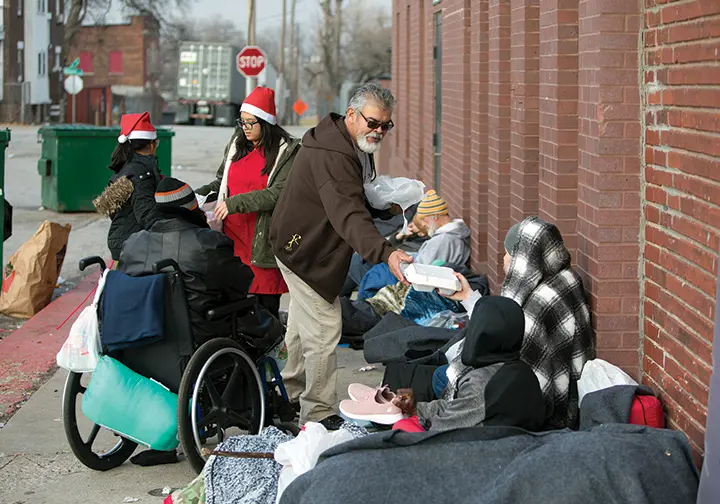
Participants in Listening with the Heart consistently reminded us that faith cannot remain only an interior conviction. We must go out to hear other teachers of the Gospel whose voices may not be found inside a church building. Faith must take flesh in concrete works of mercy, active charity, and compassionate pastoral care. Across the archdiocese, people pointed to food pantries, prison ministry, pregnancy resource centers, support for those experiencing homelessness, care for the elderly and homebound, foster care, immigrant assistance, ministries to the deaf, and parish relief efforts as places where the Gospel becomes visible.
In Pope Leo XIV’s first apostolic exhortation, Dilexi Te (I have loved you), the Holy Father explains that “the poorest are not only objects of our compassion, but teachers of the Gospel. It is not a question of ‘bringing’ God to them, but of encountering him among them” (n. 79). Going further, Pope Leo asserts that “while it is true that the rich care for the poor, the opposite is no less true. This is a remarkable fact confirmed by the entire Christian tradition. Lives can actually be turned around by the realization that the poor have much to teach us about the Gospel and its demands” (n. 109).
The Holy Father highlights that “no Christian can regard the poor simply as a societal problem; they are part of our ‘family.’ They are ‘one of us.’ Nor can our relationship to the poor be reduced to merely another ecclesial activity or function” (n. 104). Furthermore, he recalls the teaching of Pope St. John Paul II to reflect on “the active role that the poor ought to play in the renewal of the Church and society, thus leaving behind a certain ‘paternalism’ that limited itself to satisfying only the immediate needs of the poor” (n. 87).
This requires us to go into some places that may be uncomfortably unfamiliar. In deaneries where we had more Spanish-speaking participants, we heard the call to build bridges across language and cultural communities.
In every deanery, participants asked for a public Catholic witness that holds together protection of the unborn, support for vulnerable families, economic justice, care for creation, and the rejection of racism — not as competing concerns, but as one consistent expression of the dignity of every human person.
Let us be mindful that we use the word “poor” not only to describe someone who has little material resources. Scripture also raises up the “poor in spirit.” Sometimes the poor look very much like us, family and neighbors who have much to teach us about the Gospel and its demands.
Many participants in Listening with the Heart shared painful experiences of judgment, loneliness, racial or language barriers, alienation after divorce or annulment processes, clerical scandals, or being told they weren’t needed anymore as a volunteer.
Their witness calls the Church to take up a posture of mercy — to love first, to honor each person’s dignity, to listen patiently, and to rebuild trust where wounds have been carried for a long time. This is especially the case for those who carry the trauma of abuse by those who held a sacred trust within the Church community.
We must understand that the full breadth of Catholic social teaching connects the Sunday Eucharist to the Monday workplace, to Friday evening socializing, and beyond. My hope for our archdiocese is that every parish becomes known for its integral Catholic community life. Not because we have the most programs or the finest facilities. Those things matter, but they are not what people remember when life becomes difficult. What they remember is whether the Church was there for them. Whether someone noticed. Whether someone listened. Whether, in the hour they most needed mercy, they discovered they had already been known.
This is what I mean when I speak of our parishes becoming centers of charity and sanctuaries of mercy. A center of charity is a community where the love of Christ is made visible through concrete corporal works of mercy. A sanctuary of mercy is a place where no one carries suffering alone, because the Body of Christ has already drawn near by the action of the Holy Spirit.
This kind of parish will never be built by the pastor working harder. It will be built when every ministry, every council, every budget begins with asking the same question: How will this help someone know that Christ knows them and loves them? It requires all of us to listen to the same Spirit, becoming the One Body of Christ for the world.