
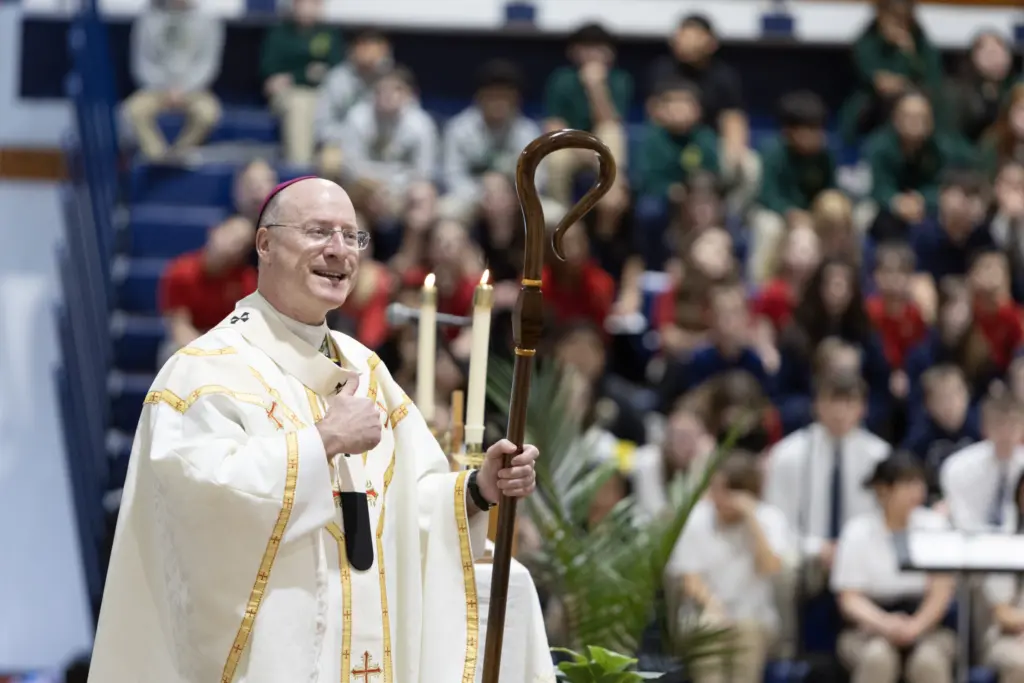
by Archbishop Shawn McKnight
By virtue of our baptism, we are all called to be missionary disciples of Christ sent forth into the world to spread the Good News.
This missionary mandate is fundamental to our understanding of what it means to be Catholic. Made in the image and likeness of God, our very nature is designed to reflect the Holy Trinity — a community of Divine Persons in God. We are therefore naturally oriented to relationships, working together as the Body of Christ to accomplish his divine will in our specific time and place.
Each one of us is an intentional creation, uniquely equipped by the Holy Spirit with talents, experiences and charisms. God places each of us exactly where we are needed to provide our community with every gift necessary to achieve his purposes. When we refuse to participate, the body suffers. We are spiritually impoverished whenever we withdraw from the great adventure he has planned for us — much like the servant who buried his talents in the ground.
Every one of you is essential to the mission of the church — in northeast Kansas and beyond! You are salt of the earth and light for the world, called to walk together as disciples and engage the modern world by listening to one another, fostering co-responsibility in your parish community, and stepping outside the church walls to bring the charity and mercy of Jesus to those on the margins. I invite and implore you to join me on a journey of renewal in his vineyard, for our parishes, our deaneries and our archdiocese.
As a roadmap for this journey, I am excited to share with you a new pastoral vision for our archdiocese: “Renewal from the Heartland: A Pastoral Letter on Synodality in the Archdiocese of Kansas City in Kansas.” (Available online at: https://archkck.org/renewal-heartland/). I am so grateful to all who have participated in the synodal process this past year. Whether you joined a small group listening session or took the survey, facilitated discussions or compiled responses, with great effort and fortitude we have finally reached this milestone of our pastoral planning process — the beginning! Thanks to all of you, we have a path forward using the consistent themes that emerged from your sharing the voice of the Holy Spirit.
This newly issued pastoral letter is a 15-pager, and as much as I’m sure you want to dive in all at once, I will be publishing it a section at a time in subsequent issues of The Leaven so that we may walk this path intentionally together. The goal of this process is to accomplish Pope Leo’s request that we implement the Synod on Synodality in our local church. This new model of pastoral planning, incorporating elements of synodality, will breathe renewed life into our church. The genesis of this renewal is the principle to “return to the source.” We are called to move forward by looking back to our foundational roots through three distinct reflections.
First, our journey must begin as it did for the disciples in the Upper Room and on the road to Emmaus — with a personal encounter with the Risen Lord. Our goal as the Body of Christ is to help others encounter Jesus!
To accomplish this relational objective, the synod asks us to re-evaluate the way we operate in light of the early Christian community described in the Acts of the Apostles. Rather than relying on a top-down approach, St. Peter and the Apostles exercised their authority in a way to invite the whole church in their common mission, to pool their resources, and engage in intense prayer to the Holy Spirit. They walked, listened and discerned together, sharing co-responsibility between clergy and laity.
Finally, the synod encourages us to recover the “freshness of the Gospel.” By rooting our mission in Christ’s mandate to make disciples of all nations, we can focus with fresh eyes, creating solutions to the present challenges we encounter in our parishes and communities, unburdened by outworn pastoral models.
Pastoral planning is no longer a checklist of objectives created by a diocese or a calendar of events created by parish staff. Pope Francis explained that it’s a community using prayer to cultivate a “disposition of listening,” surrendering where God is already leading, and then using that information to move the church from where it is now to where it needs to be in order to better serve God and neighbor.
Pastoral planning is not strategic planning. While pastoral planning involves our core mission and ministry, strategic planning focuses on practical stewardship and the sustainability of our finances, facilities and staffing. Because our strategic choices flow directly from our pastoral vision, we must approach this discernment with great care. Jesus taught that where our treasure lies, there our hearts will be also. We must work so that our budgets mirror our pastoral priorities asking: How will this help someone know that Christ loves them?
The unique aspect about the pastoral planning process to follow is that we will begin not at the archdiocesan level, nor at the parish level, but at the deanery level, that grouping of parishes in a particular region of the archdiocese. This is to structure our discernment in a way that avoids parochialism. By next spring, informed by listening sessions and online surveys, each deanery will present a pastoral plan tailored to its specific goals and challenges. The archdiocese will then develop its own pastoral plan that will leverage archdiocesan resources to help the deaneries achieve their goals. Similarly, each parish will discern how to implement their deanery’s pastoral plan according to the particularities of its mission, people and resources.
The success of our endeavor will be measured by its fruits. Strengthening our communio (our bond with Christ and with one another) serves our missio (our mandate to “go out,” sharing the love of Jesus through the Gospel and service).
Thank you for embarking on this journey of Renewal in the Heartland; may our hearts burn within us as we unpack all that God has in store for the church in northeast Kansas.



We’re doing away with the top-down approach while forcing synodality from the top down. So we can be egalitarian like the apostles…the men who established church hierarchies. Men who collaborated with outside groups to determine a shared model of what their religion should look like. Definitely a theme you find in Acts.