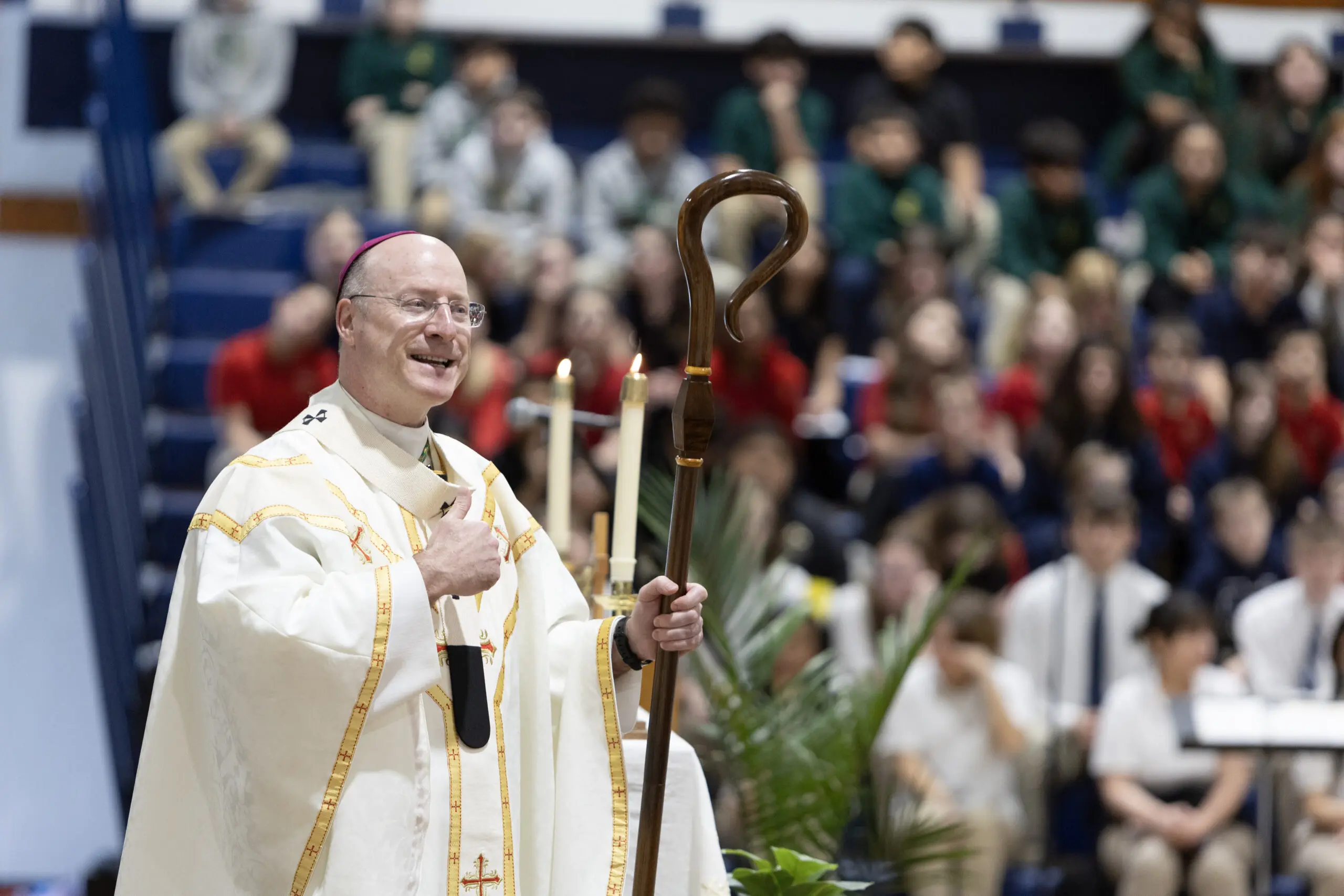
by Archbishop Shawn McKnight
Several events have taken place within the past few weeks that touch upon a common theme and central tenant of our Catholic faith — communion with God and one another:
Pope Leo XIV, our first American pope, released his first encyclical letter, “Magnifica Humanitas,” regarding the emergence of Artificial Intelligence (AI) and the danger it imposes to the dignity of the human person.
The bishops of the United States, gathered in Florida for their Spring Plenary Assembly, consecrated our country on June 11 to the Sacred Heart of Jesus.
We have completed our archdiocesan “Listening with the Heart” survey and listening sessions.
People from all over the world are converging on the United States, and particularly on Kansas City — the heartland of our country — for the FIFA World Cup 2026.
In his 1891 encyclical letter, “Rerum Novarum,” Pope Leo XIII addressed the threat of the Industrial Revolution to human dignity and labor, when dangerous, repetitive factory lines suppressed the worker’s God-given creativity and reduced human worth to a basic production commodity. In response, the pope proposed a middle ground between unrestricted capitalism and socialistic collectivism by defending private property, advocating for fair wages, safe conditions, and trade unions. Ultimately, the encyclical defined the role of government as a protector of its citizens by ensuring the preservation of human rights and human dignity that come from God.
“Rerum Novarum” established the blueprint for modern Catholic social teaching, and Pope Leo XIV is now echoing his predecessor, warning in his recent encyclical letter, “Magnifica Humanitas,” that the emergence of the new technological revolution of Artificial Intelligence (AI) may be an even greater threat to the dignity of the human person.
Unless we look to God to tell us about our true human identity and worth, we are exposed to the cruel fate of a man-made world bereft of ultimate meaning. With AI, mankind has attempted to create a world of our own, but one that can only mimic our creativity, thought processes, and behavior. AI does not offer sacrificial love; it bears no consequences for its decisions; it cannot suffer or empathize; it has no conscience to make moral decisions; it cannot repent or believe. AI can only offer the aggregation of data, even if it appears to be more than that. Yes, it can offer amazing analyses that considers all recorded human knowledge, but at the end of the day, it is just data gathered and synthesized according to defined algorithms. St. Paul eloquently wrote in his first letter to the Corinthians, “And if I have the gift of prophecy and comprehend all mysteries and all knowledge . . . but do not have love, I am nothing.” Bottom line, AI is, ultimately, nothing in comparison to the human being.
The Holy Father warns not only of threats that sacrifice our humanity for efficiency, abdicate life-and-death decisions to automated systems, threaten jobs in favor of profit, usher in new forms of human exploitation and introduce unfair algorithms to determine the distribution of goods, services and opportunities, but, even more dangerously, we run the risk to stop thinking for ourselves, neglect interpersonal relationships, and lose the ability to discern what is true.
Jesus is the Way, the Truth and the Life; in him, we discover who we are. Our response as a believing church to the erosion of human dignity in our culture can be seen in what the bishops of the United States did on June 11, as well as what Pope Leo XIV is asking of the global church in the implementation of synodality.
In commemoration of the 250th anniversary of the signing of the Declaration of Independence, the U.S. bishops offered an historic, first-of-its-kind, national consecration to the Sacred Heart of Jesus at our June 2026 Plenary Assembly in Orlando, Florida. In addition to the observance of America’s anniversary, the consecration serves to entrust our country and its citizens to the love and mercy of Jesus, foster patriotism and unity in times of great polarization, make reparation for acts against human dignity, inspire eucharistic adoration and works of mercy among our citizens, and to revive devotion to the Sacred Heart in a world that often seems “heartless.”
As a pastoral initiative, I invite every household in the archdiocese to enthrone an image of the Sacred Heart of Jesus and observe a novena of family prayer as a means of extending our national consecration throughout our archdiocese and into each domestic church. By bringing this devotion and prayer into our homes, we open our hearts to a profound spiritual renewal centered entirely on the love and mercy of God. Resources such as an image of the Sacred Heart, a worship aid, and an explanatory video are available on the ArchKCK Sacred Heart Consecration page at: https://archkck.org/consecration-to-sacred-heart.
Ultimately, consecration to the Sacred Heart is an act by which we surrender ourselves to the love of God, place our trust in him, and open our own hearts and minds to the transformation necessary to love others. It is a profound mystery that the eternal, all-powerful Creator loves us with a human heart in the incarnate Word made man. The Sacred Heart of Jesus reminds us of who we are; made in the image and likeness of God, we can share in his divine love because he shares in our humanity.
Our second response to a world and culture in need of transformation lies in our renewal as a church in becoming synodal. The Holy Father asks clergy and laity to walk, listen and discern together, under the guidance of the Holy Spirit, to fulfill our mission as church “to bring glad tidings to the poor.” Synodality is humanity walking with God and walking with each other in service, charity and respect, honoring one another’s God-given dignity. It is for this goal that we have been offering listening sessions and the “Listening with the Heart” survey throughout the archdiocese. Your responses will be gathered and implemented as we initiate our pastoral planning process in September.
As the nations converge on Kansas City for the FIFA World Cup, let us unite not only in our passion for the “beautiful game” but rejoice in our shared humanity — a humanity that reflects the image and likeness of the God of life and love. We respond to the gift of life by building a society where technology serves human dignity, power is exercised through charity, and progress is measured not by how much we own or control, but by how much we love God and one another.