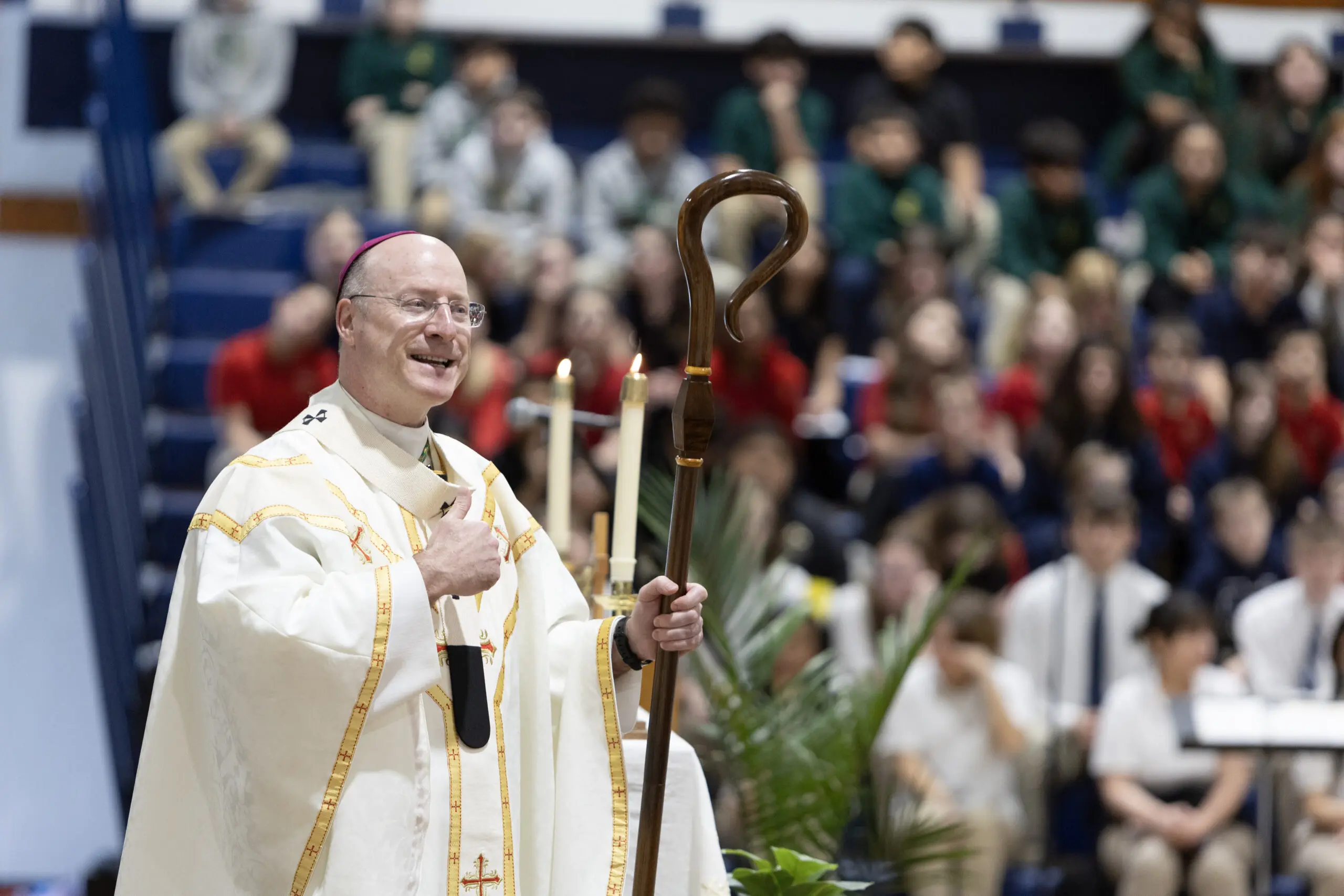
by Archbishop Shawn McKnight
Vengeance and revenge are contrary to Christian moral life. With the ability of modern correctional facilities to ensure public safety, capital punishment is no longer necessary for justice when someone has committed an egregious crime. Instead, its continued use has hardened the hearts of too many, allowing vengeance and revenge to triumph.
Retribution is not a legitimate purpose for taking someone’s life, even when they are guilty. “Vengeance is mine, I will repay, says the Lord” (Rom. 12:19). This reality underpins the collective teachings of Pope Leo XIV, Pope Francis, Pope Benedict XVI and Pope St. John Paul II, who all have insisted that capital punishment violates our Christian moral law.
Nine individuals are currently on Kansas’ death row. Our church teaches that capital punishment is immoral because “it is an attack on the inviolability and dignity of the human person.” Pope Leo XIV has recently reaffirmed the church’s teaching as found in the Catechism of the Catholic Church when he asserted, “the common good can be safeguarded and requirements of justice can be met without recourse to capital punishment.”
I believe that whenever state law permits the taking of human life, whether in abortion, euthanasia or the death penalty, it erodes the moral conscience of an entire community of people. There are other means to justly punish those guilty of heinous and unspeakable crimes. A desire for vengeance should not be recognized by our state as a justification for capital punishment.
First, our dignity is inherent because we are made in the image and likeness of God. It is not earned through our actions.
That dignity is never “lost,” no matter what crimes have been committed. Thus, the death penalty is inadmissible because it is a direct attack on the dignity of the human person without a just cause. Regarding capital punishment, Pope Leo XIV recently stated, “The right to life is the very foundation of every other human right. For this reason, only when a society safeguards the sanctity of human life will it flourish and prosper.”
Second, all things are possible with God, even the conversion of a hardened criminal.
We have only to look at the story of St. Maria Goretti for such an example. At 14, she forgave her murderer as she lay dying after being brutally stabbed. Her act of mercy was the catalyst for his conversion. Years later, he repented and even became a lay Capuchin Franciscan. The death penalty deprives the guilty of the possibility of future repentance, the opportunity to seek redemption and even reconciliation with those devastated by the act of murder.
Third, the Catechism historically taught that the death penalty was admissible only as a last resort to protect the public.
In 1995, Pope St. John Paul II began to challenge the state’s right to impose capital punishment in his encyclical “Evangelium Vitae.” He wrote, “As a result of steady improvements in the organization of the penal system, such cases [requiring capital punishment] are very rare, if not practically non-existent.”
Pope Francis in 2018 revised the Catechism, stating clearly that because it is possible to protect the public without taking a life and because carrying out a state execution is a direct attack on the inviolability and dignity of the person, capital punishment is inadmissible.
At the same time, opposition to the death penalty is not solely a matter of our Catholic faith. There are several practical reasons to consider. The carrying out of executions exacts a profound emotional, financial and social toll on all involved, placing a very heavy burden on others whose rights and dignity deserve to be respected.
Decades of experience have shown that state executions do not heal victims’ families, do not restore what violence has taken away and do not make our communities safer.
This is the cost of vengeance: We are devoting enormous public resources and tremendous emotional energy to a process that cannot undo harm that has occurred already.
Kansas has borne these costs for decades.
Kansans have paid millions of taxpayer dollars for the additional legal proceedings that are required in capital punishment cases. As of 2018, the death penalty was costing Kansans more than $2.l million annually in additional expenditures, with cumulative costs exceeding $23.5 million.
And these costs have only continued to rise. In fiscal year 2024 alone, capital defense expenditures in Kansas exceeded $6.3 million. Death penalty cases consumed approximately 11% of the State Board of Indigent Defense Services, while representing only a tiny fraction (0.014%) of the more than 26,000 cases handled by public defenders that year.
I am particularly troubled by what these figures reveal about our priorities. Every dollar devoted to maintaining the machinery of death is a dollar unavailable to defend the poor and vulnerable who depend upon constitutionally-required legal representation.
The resources consumed by a handful of capital cases place tremendous strain on a system already tasked with protecting the rights of thousands of Kansans who lack the means to defend themselves. A society committed to human dignity should be attentive to how it treats its poorest and weakest members.
Capital prosecutions also require extraordinary commitments from prosecutorial, judicial and law-enforcement personnel. The years of litigation associated with death penalty cases draw time, personnel and funding away from other pressing public needs. Those same resources could improve community-based violence prevention efforts and assist law enforcement agencies in addressing current threats to public safety.
The funds expended to prosecute and carry out capital punishment would be better spent assisting the families of crime victims as they cope with the aftermath of murder. These funds also could be used to integrate research-proven programs, including well-resourced chaplaincies and healthcare, that help inmates make profound decisions to change their behavior and seek reconciliation and mercy.
Expenditures on capital punishment do not purchase greater public safety. Rather, they divert scarce resources from services that can better support victims, strengthen families, improve mental health treatment and enhance public safety in our communities.
There is another cost of vengeance: the risk of irrevocable error. Our criminal justice system, though staffed by dedicated public servants, remains a human institution and is therefore imperfect. Across the country, innocent people have been convicted of serious crimes, including murder. Other innocent people have accepted plea agreements because of fear of a capital murder trial. Once someone is executed, no court can correct a mistake, and no act of clemency can restore a life that has been taken.
Recognizing these realities does not diminish the suffering of victims or the gravity of violent crime. The church accompanies victims and their families, prays for them and expects accountability and justice for those who have caused harm.
But justice does not require execution. Kansas can honor victims and their families and protect society through sentences of life imprisonment, while preserving the possibility of repentance and redemption for those who inflict harm.
I ask for your prayers to end this blight in our state and throughout the world. May God grant us the peace of Christ in our hearts to resist the temptation to exact vengeance, to pray for healing for victims and authentic compunction for perpetrators of violent crime. Through the grace of Christ’s Divine Mercy and prudential human reasoning, may our laws reflect the inviolable dignity of every human being.