A PASTORAL LETTER ON SYNODALITY IN THE ARCHDIOCESE OF KANSAS CITY IN KANSAS – Part 1 of 7
The following is taken from Archbishop Shawn McKnight’s Pastoral Letter “Renewal from the Heartland,” which explains the ongoing synodal process the Archdiocese of Kansas City in Kansas is currently undertaking to determine the archdiocese’s future path. This series will be presented in seven parts. To read the entire pastoral letter, go to: https://archkck.org/renewal-heartland/.
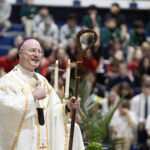
by Archbishop Shawn McKnight, S.TH.D.
INTRODUCTION
“[W]hat we have seen and heard, we proclaim now to you, so that you too may have fellowship with us; for our fellowship is with the Father and with his Son, Jesus Christ” (1 John 1:3).
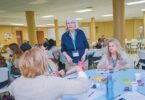
As we gather today at our annual convocation of clergy, religious, and lay leadership of the Archdiocese of Kansas City in Kansas, my heart is full of gratitude for all those who participated in the Renewal from the Heartland synodal listening process this past year. Participation in the “Beatitudes from the Heartland” Lenten small group series prepared us to actively discern the voice of the Holy Spirit in the synodal listening sessions held in April. There were 32 sessions in 17 parishes, two prisons, four high schools, and seven community centers in which approximately 1,000 people participated in English, Spanish, and American Sign Language. About 100 trained facilitators assisted the archdiocesan synodal team in compiling the responses from these listening sessions, and these results informed an online survey in June to help us further discern priorities for the next phase of synodal discernment as we continue to walk together, to listen together, and discern together in pastoral planning. What we have seen, heard, and shared under the inspiration of the Holy Spirit, we now proclaim as we begin the second year of Renewal from the Heartland, our archdiocesan response to the Holy Father’s call for us to become a more synodal church.
The final document of the XVI Ordinary General Assembly of the Synod of Bishops, which concluded on Oct. 26, 2024, states in its very first paragraph, “every new step in the life of the Church is a return to the source.” Now that we are in the implementation phase of the Synod on Synodality, we should have a clear understanding of how our archdiocesan efforts are in alignment with the universal church. The implementation of the Synod on Synodality does not require a new pastoral program or movement in the Church. The essential mission of the Church — the salvation of souls — is not changed. Instead, we are called to renew the ordinary life of the Church from within: A Renewal from the Heartland.
This ecclesial renewal is happening in a synodal way. The “why” of what we are doing is a call to conversion, an encounter with the living Christ. The “how” is the method of being Church, known as “synodality.”
Becoming a more synodal Church does not oblige us to create more documents or to develop a pastoral program that is artificially imposed on our parishes; rather, it fosters a renewal of parish life that springs from our encounter with the Risen One and our sense of discipleship. It requires us to reflect on how we are living as missionary disciples in and among our parishes as we witness our new life in Christ.
A Renewal from the Heartland is about conversion in three significant ways described in the Final Document from the Synod on Synodality: a conversion of relationships; a conversion of ecclesial processes; and a conversion of bonds, which allows for accompaniment across multiple groups and communities.
Conversion of Relationships: Every vocation and every ministry exist in relationship with others. Bishops, priests, deacons, consecrated persons and lay faithful are called to move beyond individualism and to build authentic communion through mutual listening, trust and shared responsibility.
Conversion of Ecclesial Processes: The question is no longer simply, “Who exercises authority?” but rather, “How do we exercise authority together in service of the mission entrusted to the whole People of God?” Synodality calls us to renew decision-making processes through participation, discernment, and co-responsibility.
Conversion of Bonds: Finally, synodality strengthens the bonds that unite us: across parishes, other Christian communities, with other dioceses and episcopal conferences, followers of other religions and society. The Church becomes increasingly capable of walking together with all humanity.
We are called to living synodality faithful to our own time and place. We have so much in common with our sisters and brothers across the planet, and we have so much in common with the first Christians.
THE JOURNEY OF CONVERSION
Like the disciples on the road to Emmaus, we are called to renewal. We pause to listen, not to look nostalgically at the past, but to recognize where the Risen Lord has walked with his people and where their hearts have burned within them because of that encounter.
The story in Luke’s Gospel about the two disciples headed in the wrong direction — away from Jerusalem to the village of Emmaus after the Crucifixion — shows us how the Good News of Jesus’ Resurrection has the power to change where we are headed.
We know the name of only one disciple, Cleopas; the other disciple could be a man or woman, young or old. As such, the other nameless disciple could be a placeholder for any one of us.
The two disciples were debating, grappling with how to wrap their minds around the death of the Lord and what this would mean for them. They were downcast, perhaps their hearts were filled with fear, and they were unable to recognize the Lord when he suddenly joined them on their journey. They relayed their belief in Jesus as a prophet of God, mighty in word and in deed, but also their disappointment that, it seemed to them, he hadn’t turned out to be the savior they were hoping for.
But Jesus changed their minds. He began by teaching them from the Old Testament scriptures, showing how it was necessary for the Messiah to suffer to enter his glory. Then Jesus inspired their hearts.
As they approached the village, they beseeched the Lord to stay with them, for it was already evening. Jesus accepted their invitation. And while they were at table, he repeated his actions from the Last Supper: he took bread, said the blessing, broke it, and gave it to them. With that, their eyes were opened, and they recognized him as he vanished from their sight.
They said to one another, “Were not our hearts burning within us while he spoke to us on the way and opened the scriptures to us?” They turned themselves around and went back to Jerusalem, testifying to all what they experienced, how the Lord was made known to them in the breaking of the bread.
This fascinating story of the disciples, recognizing Jesus in the breaking of bread and reflecting on how the Sacred Scripture stirred their hearts to believe in his Resurrection from the dead, inspires us to consider the many ways we might be disheartened, troubled, and confused without the light of the Gospel, the hope of the Resurrection, and the Real Presence of Jesus until the end of time. It reminds us of how much we need an intimate relationship with the Lord, and that our best place to encounter him is in the “Breaking of the Bread” in the community of disciples known as the Church.
This is the Biblical understanding of synodality, a story about walking together, about accompanying one another to become more deeply in love with our Savior and his people. It’s a story captured in Luke’s Gospel, and it is a story unfolding right now, here among us.