by Marc and Julie Anderson
mjanderson@theleaven.org
OLATHE — Holiness. Wonder. Wisdom. Virtue.
Those are the four pillars of St. John Paul II Academy here, a new Catholic classical liberal arts school set to open Aug. 20. For its inaugural school year, the academy, which will eventually go through eighth grade, will open for preschool through second grade, adding an additional grade each year.
The school is the endeavor of St. John Paul II Parish. Established in 2016, it is the archdiocese’s newest. Its original plans included a school. But, well, things happened.
In 2020, parishioners worshiped on weekends at a public school. Prior to his arrival in 2021, Father Brandon Farrar, the current pastor, said parishioners had petitioned Archbishop Emeritus Joseph F. Naumann to build a parish hall. Capital campaign information was distributed to 550 families, but just as Father Farrar began his assignment, responses came back, showing building a hall was not feasible.
Instead, on his first weekend at the parish, Father Farrar was able to announce a building had been procured in which to celebrate Mass, hold religious education and carry out administrative functions. The building was ready on the feast of St. John Paul II, Oct. 22.
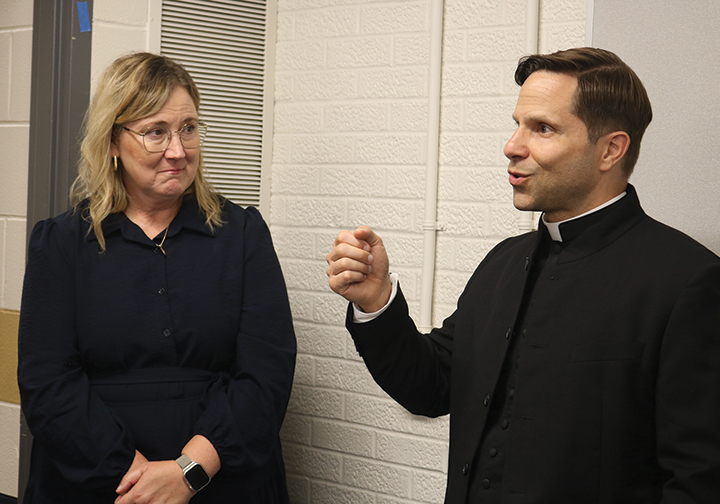
In October 2022, Father Farrar wrote Archbishop Naumann, asking if he’d be open to allowing the parish to determine the most viable building project — a school, a church or a parish hall.
After receiving approval, Father Farrar and the parish formed exploratory committees to research costs, processes, advantages and disadvantages of the projects. Two committees focused on the church. One committee argued in favor; the other against. Likewise, two committees focused on a parish hall; the final two focused on the school option.
After the presentations, parish leadership sifted through the responses and realized the idea for a church and a school had a lot of support. However, costs being what they were, only the first phase of each could be accomplished in the near future. At the same time, if the parish was going to found a school, why not establish it as a classical liberal arts academy?
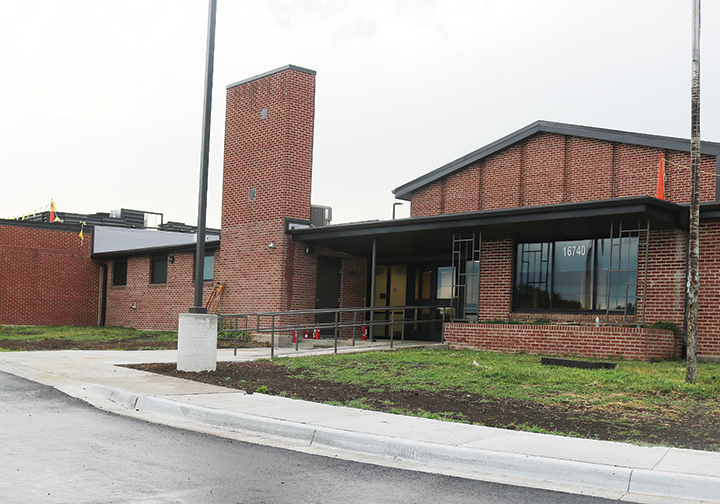
While searching for land, the parish found a building at 16740 W. 175th vacated by the Spring Hill School District, allowing the parish to move forward with plans to open the academy quicker.
What is a Catholic classical liberal arts education?
It is a traditional Christ-centered model of learning that integrates the wisdom of the classical world with the truths of the Catholic faith. It aims to form students intellectually, morally and spiritually for whatever vocation they may pursue in life.
Which helps explain the St. John Paul II Academy’s four pillars which, according to its website, “form the foundation of our mission to cultivate joyful disciples of Christ.”
It’s a mission supported by Father Farrar, and Jenny Kropf, the school’s first head.
“We’re not vessels to be filled. We’re lamps to be lit,” Kropf said. “This child already has, by the nature of baptism, a light. We just really want to set it aflame. So, we give them the best we can through curriculum.”
To learn about classical schools, Father Farrar took a tour of St. Jerome Academy in Hyattsville, Maryland. While there, he observed fifth and sixth graders discussing medieval history.
“As they’re discussing this, they begin to examine the architecture of the time,” he said. “And when they do the architecture, of course, they look at the churches. And then, they look at the construction methods of that time.”
“They looked at the geometry in the stained-glass windows,” he continued, “and they linked that to a discussion about the liturgy. It’s just like, ‘Wow! Look how many touchpoints this has to help solidify all these different things in their minds. It was so convincing for me.”
Father Farrar said he’s excited to open the academy.
In addition to preschool through second grade, the academy will offer a hybrid program for two dozen older students with siblings in the academy. The instruction will include everything except math. Students will complete that coursework at home. Instruction will be offered on Monday, Wednesday and Friday and be led by a Benedictine College student pursuing a master’s degree in liberal education.
Even though the school is not yet open, Kropf and others have been busy readying the building.
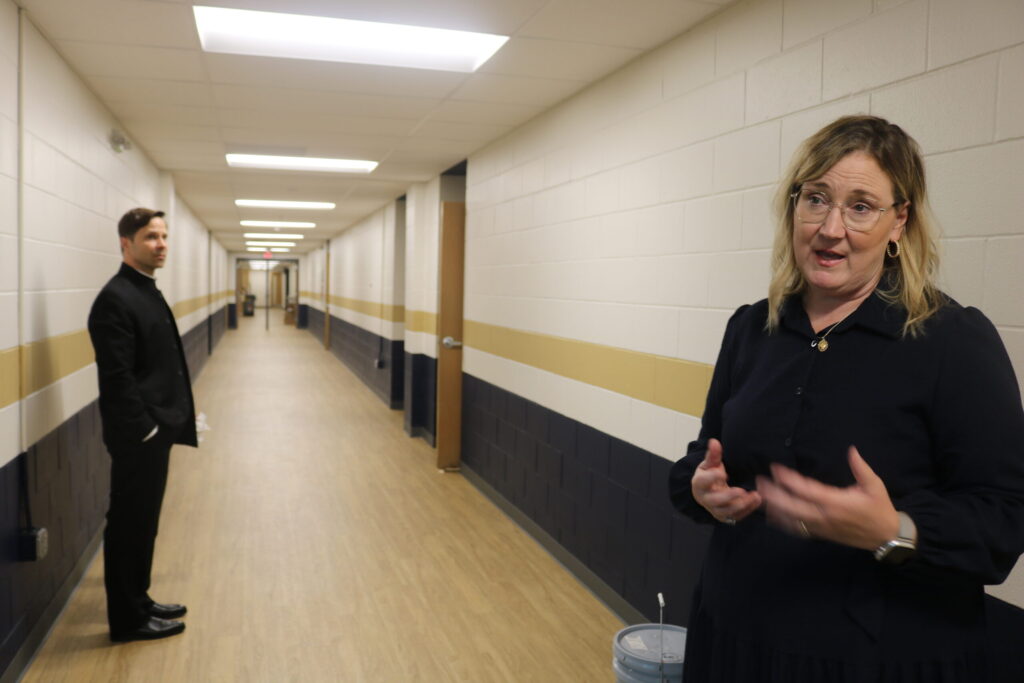
On a recent tour, Father Farrar and Kropf led visitors to where an outside garden and a learning gazebo with space for 24 students will be — a spot, Kropf said, for kids to go outside and get their hands dirty while experiencing the wonder of nature firsthand.
Inside, one of Kropf’s favorite features of the classrooms are the areas set aside for circle time.
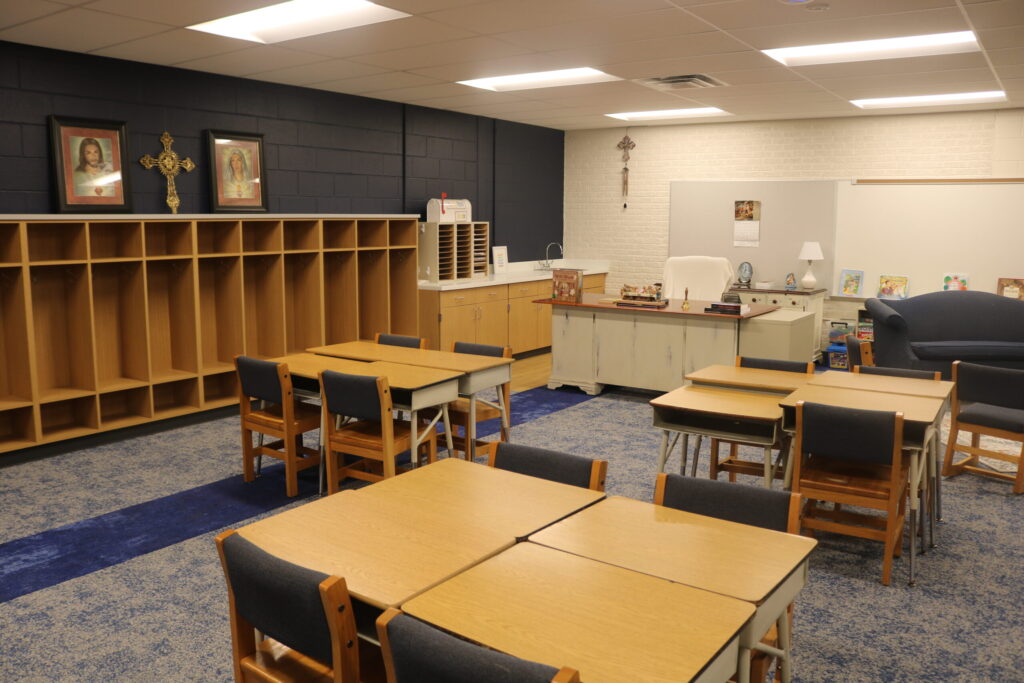
“In a classical setting, there’s a lot of dialogue, a lot of narration,” Kropf said, of the first and second grade classrooms. “So, a lot of our learning will take place in that spot. And look at how inviting it is! [The Blessed Virgin] Mary is right there, inviting the children.”
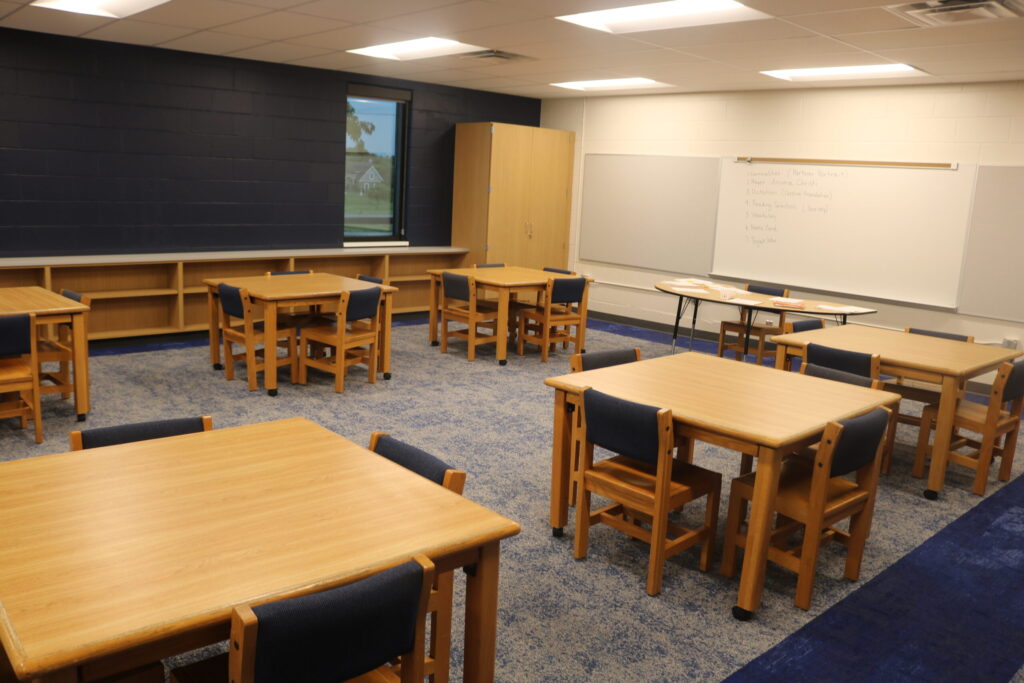
Oak chairs in the classroom, despite their weight, Kropf said, also align more closely with a classical approach to learning, as do great works of art. Currently, she is working with art guilds that aid classical schools in securing nine works of art to hang outside each classroom, works the students will study in depth.
Additionally, Kropf said, the curriculum will draw on the Montessori and Catechesis of the Good Shepherd models. The first method emphasizes hands-on-learning and collaborative play. The second is a religious formation program with a sacred hands-on environment called an atrium where students can engage with religious materials and develop their relationship with God.
Of course, no Catholic school is complete without a chapel. The academy also has a larger, multipurpose space for Mass, which will be celebrated twice a week.
The goal of the academy is simple, Kropf said: to prepare the children for whatever vocation God calls them to later in life.
“We really want to hire teachers that have this ability to just awaken in a child a desire to learn and to know and to wonder and to have joy and peace,” she said. “I truly desire for that lamp — the light of Christ — that is in all children to be set aflame with an authentically Catholic school culture and curriculum that is enlightened by truth and awakens in the child a sense of wonder that ultimately leads them to the source of all that is good — God!”