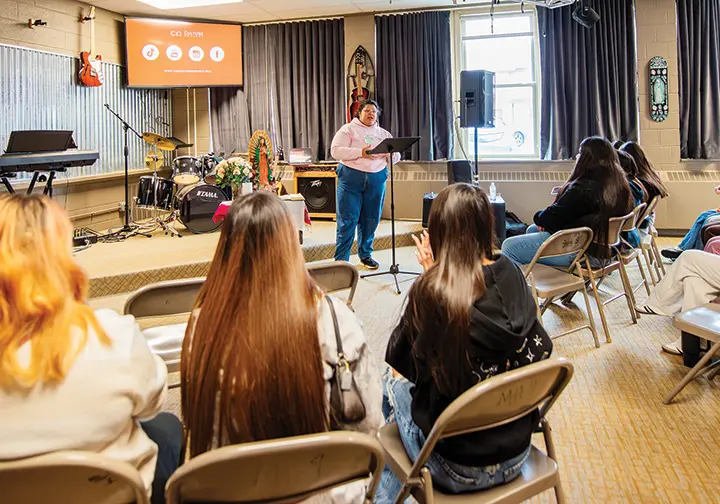
the retreatants from Johnson and Wyandotte Counties at the quinceañera retreat held at ReachKCK at Blessed Sacrament Parish April 1. LEAVEN PHOTO BY KATHRYN WHITE
by Karla Melgar and Kathryn White
Special to The Leaven
KANSAS CITY, Kan. — It’s no surprise that teenagers like to sleep in. While they make it to school on time (mostly), Saturdays are for sleeping in. Sometimes until noon.
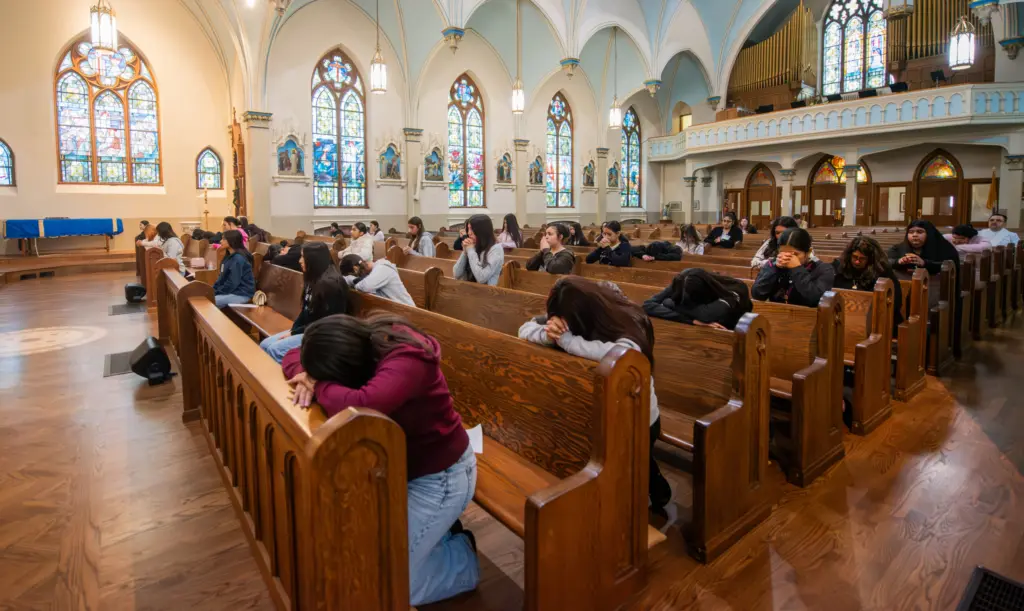
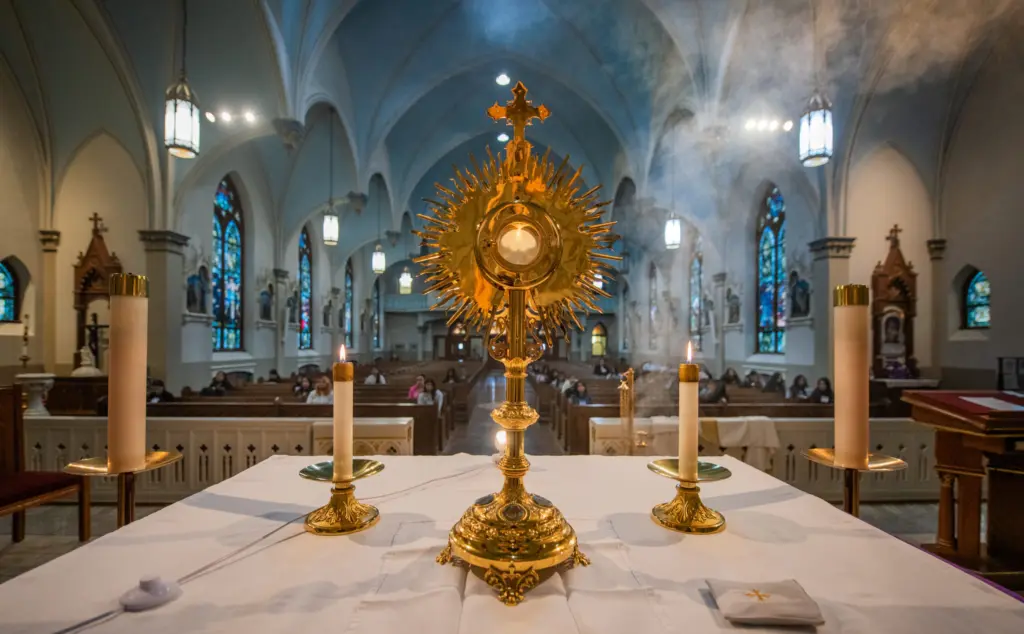
On April 1, however, 49 teenaged girls from Wyandotte and Johnson Counties woke early to participate in a quinceañera retreat, held at ReachKCK in Kansas City, Kansas. Their day consisted of motivational speakers from the Culture Project, eucharistic adoration, small group discussion and team-building activities, all to prepare them for one special day in their lives: their quinceañera.
The quinceañera (sometimes shortened to “quince”) celebration is a coming-of-age rite of passage that is deeply rooted in Catholic Latin culture. It symbolizes “leaving childhood behind” and entering into womanhood for a teen (also referred to as “la quinceañera”), typically around the age of 15 or “quince años.”
Catholic quinces usually follow a traditional pattern, with several key highlights always incorporated.
First, Catholic families celebrate their daughter with a Mass of Thanksgiving, the “Misa de Acción de Gracias,” where family and friends gather to prayerfully celebrate the young woman nearing her 15th birthday. Praying in thanksgiving for her first 15 years, la quinceañera will typically offer a bouquet to Mary as a symbol of thanks while asking for her intercession.
After la Misa, family and friends transition to a reception, not unlike a wedding reception. While this celebration varies, typically la quinceañera, along with her court, “damas and chambelanes,” make a grand entrance, or “la entrada,” signaling the start of the evening’s festivities. The damas and chambelanes are female attendants and male escorts, typically siblings, cousins or good friends, who accompany the young woman on her journey.
After the grand entrance, la quinceañera dances the waltz, or “el vals,” with her father first, followed by her grandfather and/or godfather. There will also be a choreographed dance with damas and chambelanes.
The next key moment of the celebration is the changing of the shoes or “el cambio de zapatillas.” Traditionally, la quinceañera’s father will kneel before his daughter and change her shoes from flats into heels, symbolizing her first steps into womanhood, leaving childhood behind.
While this takes place, or immediately afterwards, la quinceañera’s mother will also place a crown on her daughter’s head, “la coronación,” which symbolizes not only her transition into adulthood, but that she is a daughter of God.
La quinceañera then selects a young girl (typically a younger sister or cousin) to receive a gift, a symbolic “last doll” (“la ultima muñeca”), hinting at the transition (again) into adulthood and saying goodbye to the things of her childhood.
Finally, a dinner, “la cena/la banquete,” follows, big enough to feed a large crowd (the celebration is widely attended), with a cake-cutting by la quinceañera, which is sometimes followed by a candle-lighting. There, she will light 15 candles for the “ceremonia de las velas,” one each for the 15 most significant people in her life, who will in turn come forward and receive the candle from la quinceañera.
The next day, the family will gather for a second customary meal, the “reheating” or “recalentado,” which quite literally means heating up the leftovers. Even this day is an important part of the tradition, especially as it feeds out-of-town guests.
But even before the big day, the girls are preparing for the rite of passage — and not just the festivities.
Quince retreats are an important component of the quince preparation. The 39 girls in attendance at ReachKCK that early April morning participated both seriously and faithfully.
“[I have learned] as a young woman and as a girl who is a part of the church in the community, that no matter what, God is always with me,” explained Sophia Resendez, from St. Paul Parish in Olathe. “He will always be with me within my actions, within my thoughts, with me spiritually. He is always there with me, and that’s something big.”

age rite of passage that is deeply rooted in
Catholic Latin culture. It symbolizes “leaving
childhood behind” and entering into woman-
hood for a teen. LEAVEN PHOTO/ADOBE STOCK
Confirmation is also part of the celebration — typically before or just after the quince celebration. While both are spiritual, one does not replace the other. Because confirmation is a sacrament of initiation, it makes sense to blend preparation for both when able.
While quinceañera celebrations all have key similarities, they are individualized as well.
“Every quince is unique, depending on the family,” said Michelle Hernandez, from St. Pius X Parish in Mission. She celebrated her quinceañera 15 years ago in Belton, Missouri. And out of the very memorable life event, she recalls the retreat she made best.
“I liked being around other girls who were also preparing for their quinceañera,” she said. “It is where I learned that every one of us has dignity. Knowing our worth that we are all created in God’s image, with a unique heart, purpose and beauty that no one else can imitate.”
Preparation for this one quinceañera day, and all it symbolizes, is memorable for all young ladies as they enter adulthood.
“Although my quinceañera was over 20 years ago, I still remember moments from the beautiful Mass, where my parents dedicated my young life to God and I embraced the journey ahead with faith, his love and guidance,” recalled Michelle Kincaid, a member of Holy Spirit Parish in Overland Park.
“I celebrated my quinceañera at Holy Cross,” she said. “I still remember my dress, so beautiful, still treasured today, just like the memories from that day.”
For more information about quinceañera retreats, please contact ReachKCK at: reachkck@archkck.org.