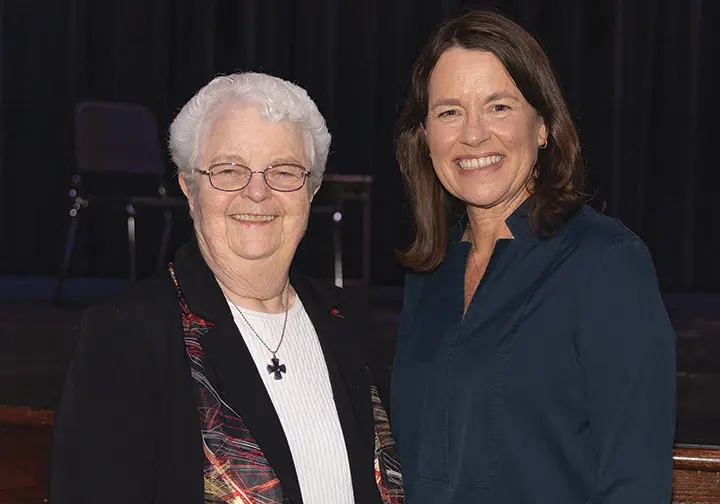
ATCHISON — Kim Daniels, J.D., a member of the Vatican Dicastery for Communication who served in the 2021-24 Synod on Synodality as an expert participant and as the coordinator of one of the 10 major synod study groups, offered a look at the synodal process and Pope Leo XIV’s continuation and deepening of that process.
Her talk, “Pope Leo, Synodality and Women’s Leadership in a Global Church,” was this year’s Fellin Lecture on April 26. The Fellin Endowment Fund sponsors the lecture series, presented each year by the Sisters of Mount St. Scholastica Monastery to support the liberal arts orientation of Benedictine College in Atchison.
“In a divided world, the synod is a model for how to respond to disagreement,” said Daniels, noting that we should step back and consider how remarkable the process was.
“The Catholic Church, this centuries-old, global, multicultural, multilingual institution of 1.4 billion people,” said Daniels, “came together over three years to listen to each other, to face our deepest challenges head on, and to work to renew our church for the next generation.
“A diverse group, women and men, bishops and lay people, with plenty of human frailties on full display, managed to arrive at a broadly agreed upon set of steps toward reform and renewal — things like transparency, accountability, making sure that professional lay people have involvement, meaning people who bring professional skills like finance and human resources to manage the church.
“It’s a model for the world of how to work through differences together.”
A mother of six, she noted that the synod also illustrated the importance of women’s roles in the church and in passing the faith along to future generations.
“The synod made it clear that women’s fuller participation in the life and leadership of the church is not a side issue,” Daniels said. “It is central to the church’s mission, to its credibility and to its capacity to serve the common good.”
She said that when the theologians gathered in 2022 to analyze the results of the local listening processes, it became clear that the question of women’s participation had persistently surfaced across different contexts, cultures and regions.
“This was not about new roles or new ministries, but simply what is already existing in canon law right now,” she said. “Synod Study Group 5, based on the Dicastery for the Doctrine of the Faith, took up the question of women’s participation as its mandate.”
Daniels said their report states that a growing number of women across all age groups and global regions no longer feel at home in the church.
She noted that bringing women back to the church was important for evangelization, “since women are so often, as we know, the life blood of parishes and those who most often transmit the faith to the next generation.”
“This is where the patience of the synodal process meets the urgency of our moment,” Daniels said. “Study Group 5 has now offered a concrete framework addressing the issue, and [Pope] Leo’s early governance signals that he intends to move forward. What remains is implementation in dioceses, ministries and institutions throughout the church of increased use of canonical opportunities already available to women.”
Daniels said that the synod showed how truly global the Catholic Church is, with only 6% of the world’s Catholics living in the United States. So global issues may look different than how Americans see things. For instance, she said many Catholic parishes around the world are facing issues with poverty and a lack of women in the workforce in general.
“The most frequently proposed actions were broader access to leadership and decision-making roles, as well as increased formation — theological formation, leadership formation, pastoral formation,” she said. “Global women’s voices also urgently focused on the conditions of women in society, on poverty, on violence, on trafficking, on war, and on the church’s duty to respond.”
When asked if she was discouraged at all, she said she was not. She said the synod showed that a bright future for the church was not a utopian dream, but very humanly possible.
“I am hopeful,” she said. “I am very, very hopeful.”